We Have Sunk Almost 300 Spacecraft Here and Never Looked at the Bottom
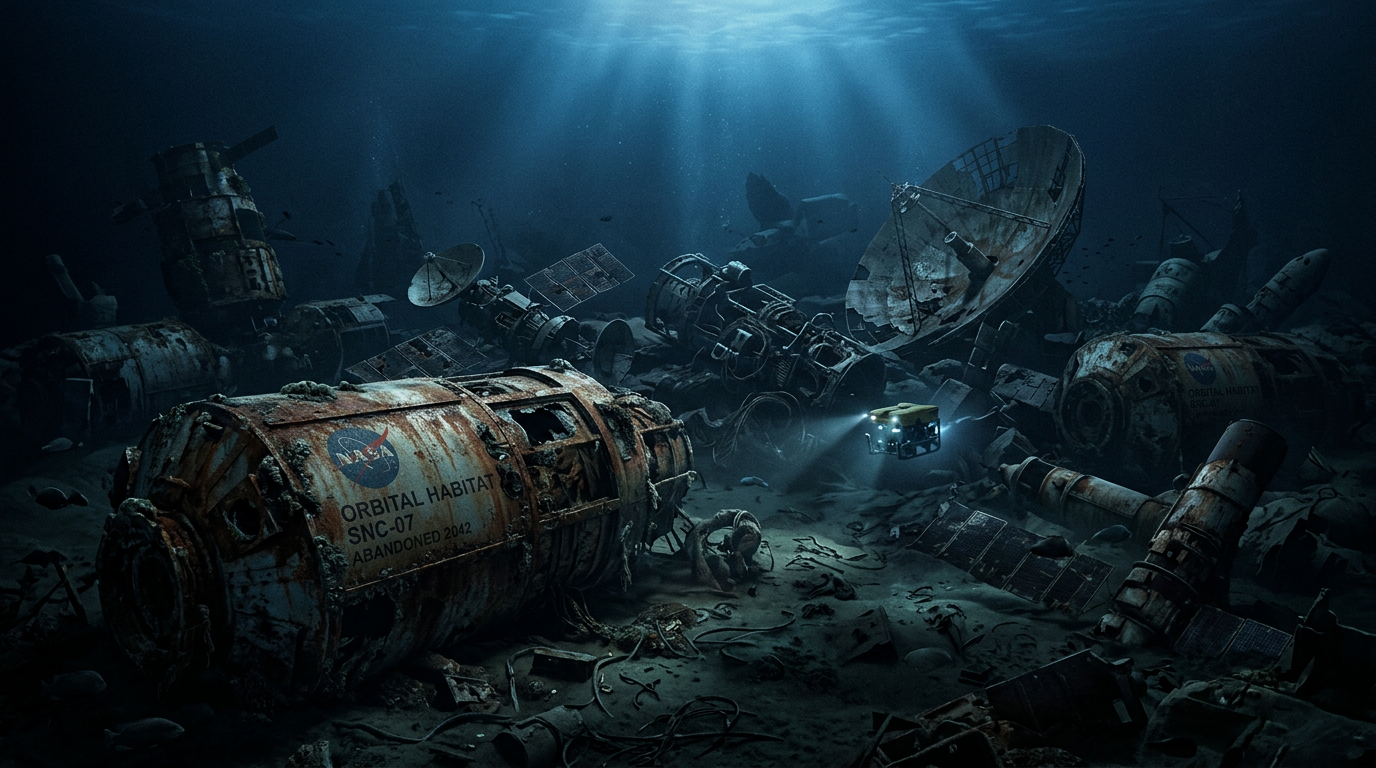
Illustration by Domi Verse X
For over fifty years, space agencies have aimed dead spacecraft at the most remote point on Earth — and nobody has ever gone down to see what's happened to any of it.
This article contains affiliate links. If you buy through them, we may earn a small commission at no extra cost to you.
There is one spot in the Pacific Ocean that space agencies crash things into on purpose. Since 1971 they have aimed somewhere between 263 and 300 spacecraft at it. Space stations, cargo ships, satellites, rocket parts. Nobody keeps an official list of what went in, which is the first hint about how casually this is being handled. The place is called Point Nemo, and in about four years the biggest thing humans have ever built in space is scheduled to be dropped on top of the pile. Nobody has ever gone down to look at what is already there.
What is on the bottom
This is not small debris. It is buildings.
Mir, the Russian space station, weighed about as much as a hundred cars. It was brought down in 2001. Six Salyut stations went the same way. So did roughly 140 Russian supply ships, five European cargo craft, and a run of Japanese freighters, the last of them in 2020. Add satellites and used rocket stages, including at least one from SpaceX. The debris itself is scattered close to four kilometres down, in a stretch of ocean deeper than most of the seafloor, though still less than half as deep as the Mariana Trench, the deepest point on Earth.
Three of those Salyut stations were lying about what they were. Salyut 2, 3 and 5 were secret Soviet military spy stations, given innocent civilian names to hide it. One of them had a real gun bolted to the outside, a cannon taken off a bomber. It was welded in place and could not swivel, so aiming it meant turning the whole station around like pointing a torch by turning your body. In January 1975, with the crew safely gone, ground control fired it at a target. It is still the only time a weapon has been fired in space.
A few days later, they dropped the station in the ocean.
Spacecraft do not land in one piece. They tear apart on the way down, so a single one can scatter wreckage across hundreds of kilometres of water. What is down there is not a tidy scrapyard. It is dozens of overlapping debris fields, and not one of them has been mapped.
Why they picked this exact spot
Point Nemo is the furthest you can get from land anywhere on Earth without leaving the planet.
Stand there and the nearest shore in any direction is 2,688 kilometres away. That is roughly London to Moscow, except with nothing in between. There are three shores at that same distance, and every one of them is an empty rock with nobody on it.
Push that outward and you get a circle of ocean with no human being anywhere inside it. Draw North America on the sea and you have about the right size. It covers a little over four percent of the surface of the planet.
It gets stranger. When the International Space Station passes overhead, the astronauts on board are closer to Point Nemo than any person standing on the ground. They are about 400 kilometres up. Everyone else is more than six times further away, sideways.
That is the whole reason this spot was chosen. If a dead spacecraft has to come down somewhere, you want it coming down where the odds of hitting a person are as near zero as the map allows.
To be fair, the alternatives are worse
It is easy to say that deliberately dumping spacecraft in the sea is obviously wrong. That argument does not hold up once you look at what else could be done instead.
Leave a dead spacecraft in orbit and it becomes a bullet. Space around Earth is already crowded, and one crash up there breaks into thousands of new pieces that can hit everything else.
Let it fall wherever it wants and the heavy parts survive the fire of reentry and land on whatever is underneath. That has happened. Skylab broke apart over Western Australia in 1979. In February 1991 the Salyut 7 station came down out of control: it had been aimed at this same empty patch of Pacific, it overshot, and its wreckage fell on a town in Argentina with nearly 30,000 people living in it. Nobody was killed, and that was luck rather than planning.
So the people pointing hardware at Point Nemo are not being reckless. Out of three bad options they are picking the least bad one, and they are right to.
The problem is not the choice. It is what nobody has to do around it.
Nobody is required to check
Enjoying this story?
Get a short teaser by email whenever we publish something new. No spam.
There is a rule from 1972 that covers this. If space junk falls on another country's land or wrecks someone's property, the country that launched it pays up automatically. Nobody has to prove anyone was careless. You broke it, you bought it.
There is no equivalent rule for the ocean. None.
Mark Spalding of The Ocean Foundation has pointed out what that gap quietly encourages. When you get to choose where your wreckage lands, you aim at the one surface that cannot take you to court. That is not a plot. It is just what happens when the rules point one way and nothing points back.
It possibly matters more than it sounds. It means this site may have been chosen partly because it is legally empty, not only because it is physically empty. A place where nobody can sue you is not automatically a place where nothing gets hurt.
What we are doing without knowing it
The Space Station weighs more than a fully loaded jumbo jet, over 400 tonnes, and most of that is metal that will sit in salt water and slowly rot. There is also leftover rocket fuel on board, which is poisonous. NASA expects a lot of it to burn up on the way down. The denser chunks are expected to make it to the seabed.
Asked what that will do to whatever lives down there, Spalding's answer was that nobody really knows. He called that troubling for an object the size of a football pitch.
The damage may even start before anything hits the water. In 2019 researchers found tiny flakes of aluminium floating in the air above this part of the Pacific. They did not come from the ground and they did not come from meteorites. The best explanation is spacecraft burning up on the way in.
And the water there was already not clean, which is the part that quietly undercuts the whole idea of an untouched dumping ground. During a round the world yacht race in 2017 and 2018, two boats carried scientific sensors and sampled water near Point Nemo that nobody had ever tested. They found tiny plastic fragments in it, between nine and 26 pieces in every cubic metre. That is a low number by world standards. It is not zero. The scientist running the programme, Toste Tanhua, put it simply: nearly every sample they took anywhere had plastic in it, which means the currents carry it even to the emptiest water on Earth.
So human rubbish is arriving at the loneliest place on the planet from two directions at once. From above, on purpose. From the side, by accident.
The one thing that has almost never been there is an actual person. The first people to prove they had stood on the exact spot did it in March 2024, when a British explorer and his son swam there after ten days at sea.
Somebody should probably look first
Here is the number that should bother you. As of April 2026, we have properly mapped 28.7 percent of the world's seabed. Nearly three quarters of the bottom of the ocean has never been surveyed.
Mapping follows money. We map where the cables go, where the fish are, where the oil is, where the ships sail. Point Nemo has none of that, so it sits in the unmapped part.
That is not a fun fact. It means there is no before picture. Without one, there is no way to ever prove the dumping harmed anything, and no way to prove it did not. The question does not get answered. It just gets dropped.
So the point here is a narrow one, on purpose. Bring the Space Station down over Point Nemo, because everything else is worse. But if the biggest object we have ever built is going to be dropped into the least examined part of the ocean, three things seem fair to ask for first, and they are the same three The Ocean Foundation has already asked for: send something down to survey the seabed where the wreckage will land, publish a list of what is expected to survive the fall, and get a straight legal answer on what anyone actually owes the sea.
The tug that will push the station down is being built by SpaceX under a contract worth up to 843 million dollars. Next to that, having a look at the bottom first costs almost nothing. The reason it has not been done is probably not money.
It is that nobody has to.
For thirty years Point Nemo has been proof of how much empty space is still left in the world. It would be a strange ending if the last thing we ever learned about it was that we never bothered to look.
Sources
- Oceanic pole of inaccessibility, Britannica
- NASA wants to dump the ISS in the sea. Experts say the plan raises serious concerns for ocean health, Space.com
- Space cemetery, protecting the Pacific Ocean from space debris, Ocean Vision Legal
- Salyut 3, the Almaz military station and its cannon, Wikipedia
- Volvo Ocean Race provides global microplastic map, The Ocean Race
- Global seabed mapping reaches new milestone, Seabed 2030
- Point Nemo expedition log, Chris Brown, inaccessibility.net