At This Depth, Water Itself Becomes a Weapon Heavy Enough to Crush a Battle Tank in Seconds
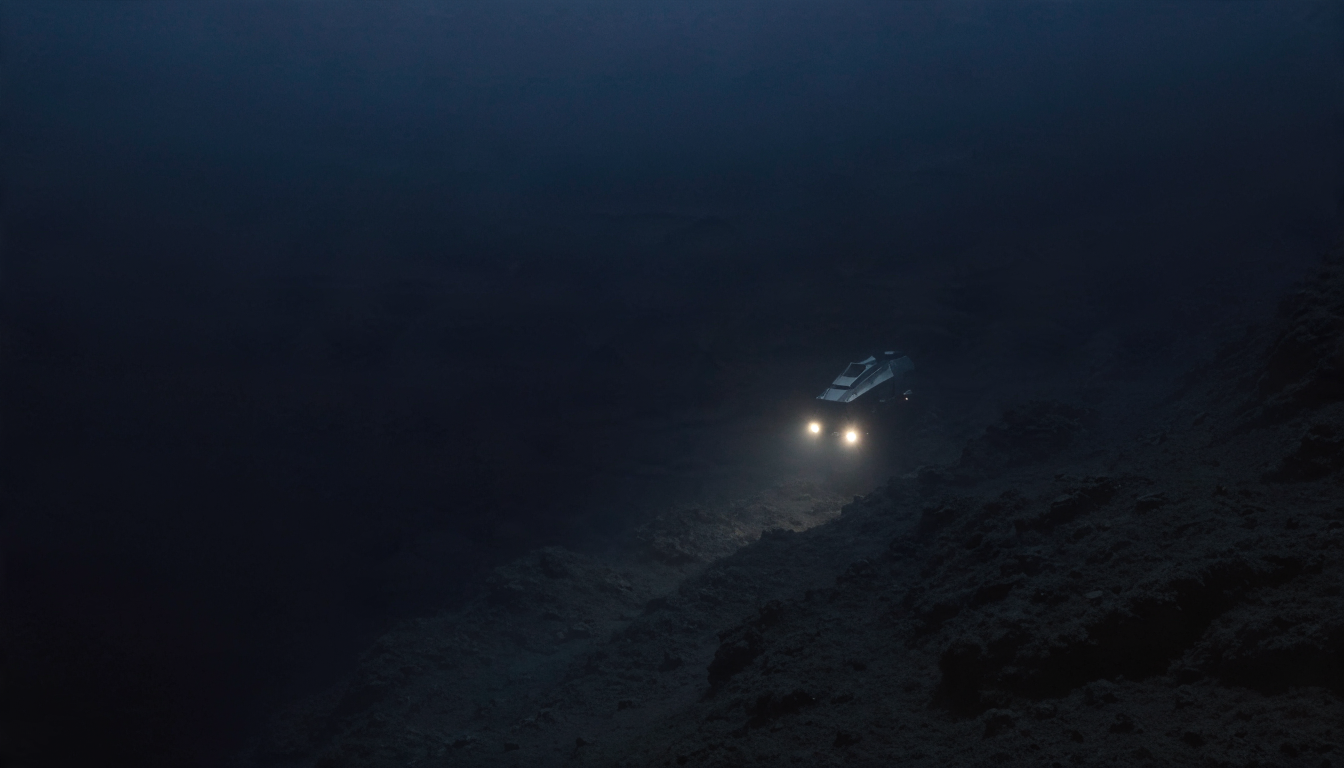
Illustration by Domi Verse X
The deepest place on Earth doesn't destroy things with an explosion. It just squeezes until nothing is left.
This article contains affiliate links. If you buy through them, we may earn a small commission at no extra cost to you.
A battle tank is built to survive explosions, gunfire, and the crushing weight of war. None of that would matter here. About 6.8 miles beneath the surface of the Pacific Ocean, there is a place where the ocean stops behaving like water and starts crushing with more force than most hydraulic presses humans have ever built. It has no sunlight, no warmth, and almost no visitors. Only a handful of people have ever seen it with their own eyes.
This is the Challenger Deep, the lowest point of the Mariana Trench and the deepest known place on Earth. According to the most precise sonar survey to date, conducted in 2021, it sits 10,935 meters below the surface (35,876 feet, about 6.8 miles), give or take 6 meters. That number is not the final word. Earlier surveys placed the bottom slightly differently: 10,924 meters in a 2019 mapping of the eastern basin, 10,925 meters in a 2016 survey of the western basin, and 10,984 meters in a 2014 analysis, also in the western basin. The differences come down to sonar resolution and exactly where in the trench each ship measured, not a moving seafloor, and every serious estimate still lands within about 60 meters of the same depth. To put that in perspective, if you dropped Mount Everest into the trench, its summit, officially measured at 8,849 meters, would still sit more than two kilometers underwater no matter which of these measurements you use.
Older estimates swung far wider than that. A rope-and-weight sounding in 1875 put the trench at just 8,184 meters. A 1957 Soviet ship, the Vityaz, reported 11,034 meters, deeper than any figure accepted today. The most dramatic swing came from the Trieste's own 1960 dive: onboard instruments briefly suggested a depth of 11,521 meters, nearly 600 meters deeper than the modern number, before the reading was corrected down to 10,916 meters once scientists accounted for water density and pressure at extreme depth. Every generation of instruments has narrowed the number further, and there is no serious evidence today that the trench goes any deeper than modern sonar shows. What has changed is not the seafloor. It is our ability to measure it.
A place deeper than anything else on the planet
The Mariana Trench stretches for more than 2,500 kilometers along the floor of the western Pacific, near Guam, formed where the Pacific tectonic plate is slowly forced beneath the smaller Mariana plate. The Challenger Deep is its lowest point, and it has only been visited by a small number of people in the history of ocean exploration.
The first descent happened in 1960, when Jacques Piccard and Don Walsh rode a bathyscaphe called Trieste to the bottom. For more than 50 years after that, only one other person joined them: filmmaker James Cameron, who piloted a solo submersible to the same depth in 2012. It was not until the DSV *Limiting Factor* began repeated dives in 2019 that the number of successful trips to the Challenger Deep started climbing into the double digits.
Why the pressure down there could destroy a submarine
Depth alone does not explain why this place is so hostile. What makes it lethal is pressure. According to NOAA, the water pressure at the bottom of the Challenger Deep exceeds 16,000 pounds per square inch, compared to about 14.7 psi at sea level. That is over a thousand times the pressure pushing on your body right now.
A battle tank would not even get close. Tanks are not sealed against water pressure at all, they would flood and collapse within the first few hundred meters, long before reaching anything like these depths. So it is worth asking what actually could survive part of the way down, and the answer is still humbling. A standard military submarine, one of the most pressure-resistant vehicles humans build, is not built for anything close to these depths either. Public estimates for classes like the Los Angeles and Virginia put their test depths at roughly 250 to 500 meters, with realistic operational limits somewhere in the hundreds of meters below that. Exact crush depths, the point where a hull collapses instantly under pressure, remain classified for most navies, but even generous public estimates rarely place them beyond 700 to 800 meters. The Challenger Deep is more than ten times deeper than that.
Enjoying this story?
Get a short teaser by email whenever we publish something new. No spam.
A cylindrical steel submarine hull is engineered to resist pressure evenly around a long tube shape, which works well down to a few hundred meters but becomes structurally hopeless far beyond it. That is why the vehicles that have actually reached the Challenger Deep, the Trieste in 1960 and the Limiting Factor since 2019, do not look like ordinary submarines at all. Their crews ride inside separate spherical titanium capsules, a shape that distributes crushing pressure evenly in every direction instead of concentrating stress along a hull. It is a completely different category of engineering, built for one purpose only.
Life that should not exist down there
Despite the crushing pressure and total darkness, the Challenger Deep is not empty. When James Cameron reached the bottom in 2012, he reported seeing almost nothing larger than an inch, describing only small amphipods drifting past his viewport. Other expeditions have since found sea cucumbers, bristle worms, and tube worms living in the sediment, along with bacteria and fungi surviving in conditions that would instantly destroy most known organisms.
One of the more striking discoveries is the Mariana snailfish, *Pseudoliparis swirei*, found living on the trench's slope at depths around 7,581 meters, in water so heavy that its own cells have adapted at a molecular level just to avoid collapsing under the pressure. No sunlight has ever reached this creature's world. It has spent its entire existence in a place darker and heavier than almost anywhere else life is known to survive.
Why this matters beyond the record book
The Challenger Deep is not just a curiosity for record books. It is one of the least explored environments on the planet, less mapped in fine detail than the surface of Mars, and it continues to reveal organisms and geological processes scientists did not expect to find. Every successful dive adds to a very short list of direct human observations from a place that, for most of history, was completely unreachable.
It is also a useful reminder of just how much of Earth remains unexplored. We tend to imagine the unknown as something far away, out past the Moon or beyond the solar system. Sometimes it is directly beneath the waves, deeper than the tallest mountain on Earth is tall.
Sources
- NOAA: Seven miles deep, the ocean is still a noisy place
- Challenger Deep – Wikipedia
- List of people who descended to Challenger Deep – Wikipedia
- Mount Everest height agreed by China and Nepal – CNN
- How deep can military submarines go – Marine Insight
- Trieste (bathyscaphe) – Wikipedia)
- Mariana Trench – Wikipedia