A wave as tall as a six story building rose out of nowhere
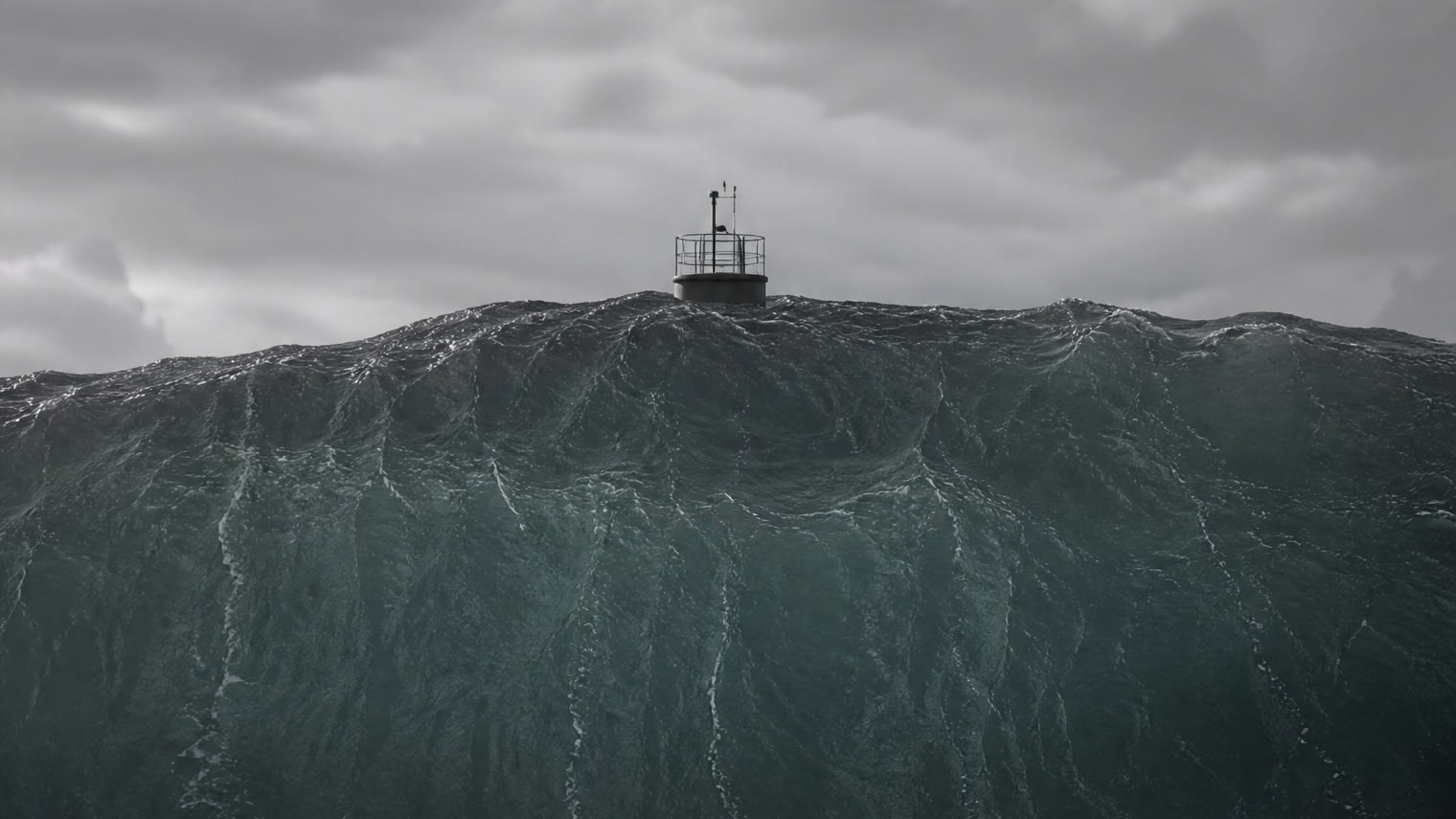
Illustration generated with AI for DomiVerseX
One small buoy off the coast of Canada was lifted far higher than the sea around it. What it measured holds a record, but probably not the record you are thinking of.
This article contains affiliate links. If you buy through them, we may earn a small commission at no extra cost to you.
It is November 2020, and the ocean off the west coast of Canada is rough. Wave after wave rolls past. They are about 6 meters high, as tall as a house with two floors.
About 7 kilometers from the shore of Vancouver Island, near a place called Ucluelet, a research buoy rides those waves. Seven kilometers is a walk of about an hour and a half, if you could walk on water. Find Vancouver Island on a globe and you will see that it sits on the edge of the Pacific Ocean.
The buoy is 0.9 meters wide, about as wide as a door. Its job is simple. It goes up and down with the water and keeps a record of how high it goes.
On 17 November 2020, it went up, and it kept going up.
One buoy, one giant
The buoy was lifted 17.6 meters, measured from the bottom of the wave to the top. That number comes from a study by Johannes Gemmrich and Leah Cicon, published in the journal Scientific Reports in 2022. The buoy itself belonged to a company called MarineLabs.
Remember the other waves that day: about 6 meters. This one was nearly three times as tall as its neighbors.
Why does this matter to you? Because people plan for the waves they expect. A wave that is far bigger than everything around it is the one nobody is ready for.
How tall is six floors, really?
Here is something you should know before you look this wave up. Many reports call it a "four-story" wave, not a six story one. The news site gCaptain wrote that it was "the equivalent of a four-story building". ScienceAlert called it a "four-story wall of water".
So who is right? Both. It depends on how tall you think one floor is.
This article counts about 3 meters for each floor. That is the usual height of a floor in a building where people live. With floors like that, 17.6 meters is almost exactly six of them.
Floors in a business building can be taller, about 3.9 meters each. Count with those and the same wave is about four and a half floors.
Nobody made the wave bigger or smaller. Only the building next to it changes.
Why does this matter to you? A comparison is only fair if you say what you are comparing with. When you read "as tall as a building", ask which building.
Why "out of nowhere" is a fair way to say it
Scientists have a name for a wave like this: a rogue wave. ScienceAlert puts the rule in plain words. A rogue wave is any wave more than twice the height of the waves around it.
Twice is already enough to earn the name. The wave off Ucluelet was nearly three times.
"Proportionally, the Ucluelet wave is likely the most extreme rogue wave ever recorded," Gemmrich said, according to gCaptain. Look at his first word. Proportionally means "compared with the waves around it". He did not say biggest.
The study also gives a number that is easy to read the wrong way. A wave this far above its neighbors, at that spot, should come along about once in 1,300 years. That is about 16 long human lives, one after another.
It does not mean that such a wave appears somewhere on Earth only once in 1,300 years. It is a calculation for one place, not a count of real waves. Nobody has watched that spot for 1,300 years.
Why does this matter to you? "Once in 1,300 years" sounds like a promise that it will not happen again soon. It is not a promise. It is the best estimate from one study, for one small patch of sea.
The twist: this is not the tallest rogue wave
The Ucluelet wave is not the tallest rogue wave ever measured. It is not even close.
On 1 January 1995, a wave hit a gas platform in the North Sea, about 160 kilometers off the coast of Norway. That is about two hours of driving on a fast road, but straight out over open water. A laser on the platform pointed down at the sea and measured the wave as it passed.
Enjoying this story?
Get a short teaser by email whenever we publish something new. No spam.
It was 25.6 meters tall. That is about eight and a half floors, using the same 3 meter floors as before. It was 8 meters taller than the Ucluelet wave, which is almost three more floors on top.
It is known as the Draupner wave, after the platform. It was the first rogue wave ever caught by a measuring instrument.
So why does the smaller wave hold the record? Because the sea around the Draupner platform was already huge that day. The other waves were about 12 meters high, as tall as a building with four floors. The giant was a little more than twice their size.
Off Ucluelet, the other waves were only 6 meters, and the giant was nearly three times their size.
That is the whole secret. The record is not about height. It is about how far one wave stood above the rest.
One more thing, and it is good news. The Draupner platform took only minor damage. And according to ScienceAlert, neither of the two waves caused severe damage or deaths.
Why does this matter to you? "Biggest" and "most extreme" are different words. A tall child in a class of tall children does not stand out. A very tall child in a class of small ones does.
The only witness was a machine
There is no photograph of the Ucluelet wave. There is no film of it either.
Every picture you may see with this story is something else. Some are an animation made by MarineLabs. Some show the line that the buoy drew as it rose and fell. Some are photos of other waves in other places. The picture on this page is our own reconstruction too.
No report mentions a single person who saw the wave. As far as anyone can tell, the only witness was the buoy.
The head of MarineLabs, Scott Beatty, explained why people still care. "The unpredictability of rogue waves, and the sheer power of these 'walls of water' can make them incredibly dangerous," he said.
Why does this matter to you? If one buoy had not been floating in that exact spot, nobody would know this wave ever existed. So how many others have passed with no buoy there at all? Nobody can say.
A fingerprint before the wave
A study from February 2026 suggests there could be more to "out of nowhere" than it seems.
The study appeared in the journal Ocean Science. Its authors are Laura Azevedo, Gabriel Marcon, Steven Meyers and Mark Luther, and ScienceAlert reports that it was led from the University of South Florida.
First, the team compared real buoys with two computer models that are used to describe waves all over the world. The tallest wave in the buoy records was about 30.5 meters, as tall as a building with ten floors. In both models, the tallest wave was only about 19.7 meters, which is less than seven floors. The models missed the rare giants.
Then the team looked at 81 rogue waves measured by four buoys off the coast of California between 2015 and 2021. Before 61 of them, the buoy records showed the same pattern. One measure of how the waves fit together dropped sharply and then jumped back up. Then the rogue wave arrived.
That is three rogue waves out of every four. Look at a map and find the West Coast of the United States. In this study, that is where rogue waves showed up most often, and mostly in winter.
But be careful here, because the authors are careful too. They did not count how often the same pattern appears and no rogue wave follows. Until somebody counts those false alarms, the pattern is a clue. It is not a forecast.
Why does this matter to you? If the clue holds up, ships and people working at sea could maybe get a warning one day. If it does not hold up, the sea keeps its surprise.
So can a wave from nowhere be forecast?
Scott Beatty of MarineLabs answered that question honestly. "The potential of predicting rogue waves remains an open question," he said, according to ScienceAlert.
One wave in four left no fingerprint at all in the new study. And nobody yet knows how many fingerprints are followed by nothing.
A buoy as wide as a door caught the most extreme rogue wave on record, probably, by being in the right place. Will the next one be seen coming, or will it also rise out of nowhere?
Sources
- Generation mechanism and prediction of an observed extreme rogue wave, Scientific Reports (University of Victoria repository copy)
- Record Rogue Wave Measured Off British Columbia, gCaptain
- Massive Wave in The Pacific Was The Most Extreme 'Rogue Wave' on Record, ScienceAlert
- Rogue wave indicators from global models and buoy data, Ocean Science
- Draupner wave, Wikipedia
- 'Once in a millennium': Record-breaking rogue wave measured off Vancouver Island, CTV News
- Storey, Wikipedia