More than 200,000 barrels of nuclear waste were thrown into the Atlantic and left in the dark for decades
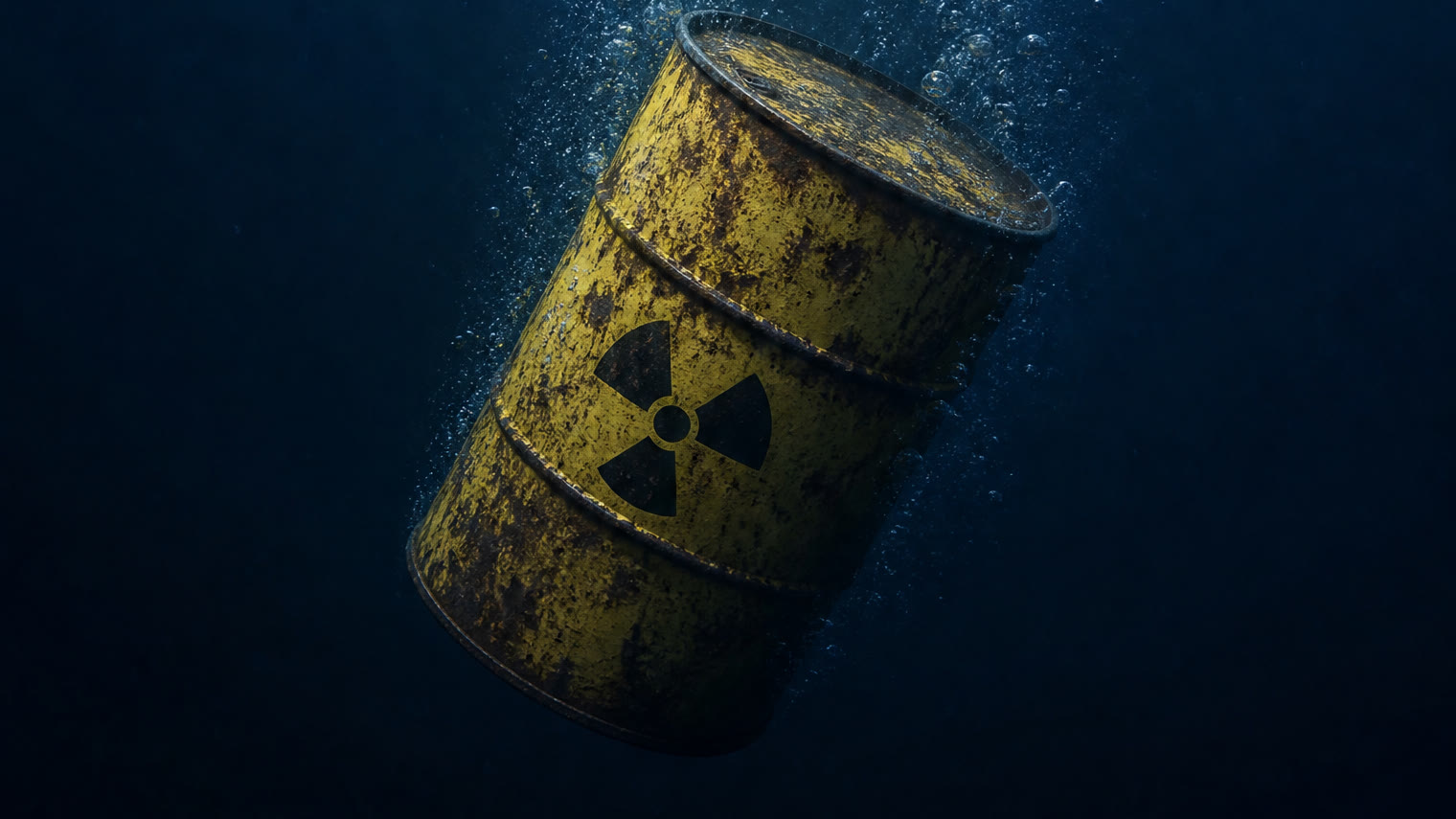
AI-generated illustration
Almost five kilometers under the waves off Europe, rusting drums from the atomic age just got their first real visitors. What the scientists saw raises one big question: if the waste leaks, where does it go?
This article contains affiliate links. If you buy through them, we may earn a small commission at no extra cost to you.
Picture a flat, muddy plain in total darkness, colder than your fridge, roughly 600 kilometers off the coast of France. The water above it is almost five kilometers deep, about twelve Empire State Buildings stacked on top of each other. From 1949 to 1982, European ships dropped metal drums of radioactive waste into this corner of the Atlantic Ocean. Then, for decades, almost nobody went down to check on them.
The best current estimate, from the French research agency CNRS, is about 200,000 barrels, each roughly the size of a standard 200 liter oil drum. Lined up end to end, they would stretch around 180 kilometers, more than four marathons. Together they weigh somewhere around 140,000 to 150,000 tonnes depending on whose count you use, which is roughly 14 Eiffel Towers of concrete, tar and metal.
Who threw it in, and why it seemed like a good idea
Eight countries used the Northeast Atlantic this way: the United Kingdom, Belgium, France, the Netherlands, Sweden, Germany, Italy and Switzerland, a country with no coastline at all. Britain was by far the biggest player. CNRS counts more than 140,000 British barrels, and an inventory compiled by the International Atomic Energy Agency (IAEA) puts the UK at about 78 percent of all the radioactivity dumped in the Atlantic, nearly four out of every five units. France dropped more than 46,000 barrels in two operations, in 1967 and 1969.
This was not spent reactor fuel. Patrick Chardon, a nuclear engineer who co-leads the new research, told CNRS that the barrels mostly held things like gloves, lab equipment and samples. The waste was mixed with concrete or bitumen, the sticky black stuff in road asphalt, and sealed in steel.
So why the sea? Back then, the deep ocean plains were "thought back then to be devoid of life," as CNRS puts it. The logic was simple: the ocean is enormous, so any leak would be diluted to almost nothing. From 1981, a monitoring program run under the OECD's Nuclear Energy Agency, called CRESP, kept watch on the site. According to the IAEA summary, a CRESP review in 1996 found measurable leaks next to some containers, but called the wider environmental impact negligible. By then the practice was over: countries agreed on a worldwide ban on dumping radioactive waste at sea in 1993, and it came into force in early 1994.
Why does that matter to you? Because this is the same ocean that feeds much of Europe's fishing fleet. "Out of sight" was never quite the same thing as "gone".
A robot first, then three people in a steel ball
The new project is called NODSSUM, run by CNRS with the French ocean institute Ifremer and co-led by Chardon and marine geologist Javier Escartín. The problem at the start was almost comic. As CNRS explained before the first trip, the team had "no information on the position of the barrels". Only two small missions in the 1980s had gone looking, and they spotted six.
In summer 2025, from 15 June to 10 July, the research ship L'Atalante sent down an autonomous robot called UlyX. It scanned 163 square kilometers of seafloor, a bit smaller than Washington, DC, and located 3,355 barrels, according to the French Oceanographic Fleet. That is a small slice of the total, but the University of Strasbourg calls it the first comprehensive survey of the site.
Then came the human part. From late May to late June 2026, the ship Pourquoi Pas? carried the Nautile, a three-person submersible built to reach 6,000 meters. It made 20 dives, each one below 4,700 meters, as the Subatech lab involved in the mission reports. At that depth the water pushes on everything with roughly the force of a grand piano balanced on your thumbnail.
What they actually saw
Enjoying this story?
Get a short teaser by email whenever we publish something new. No spam.
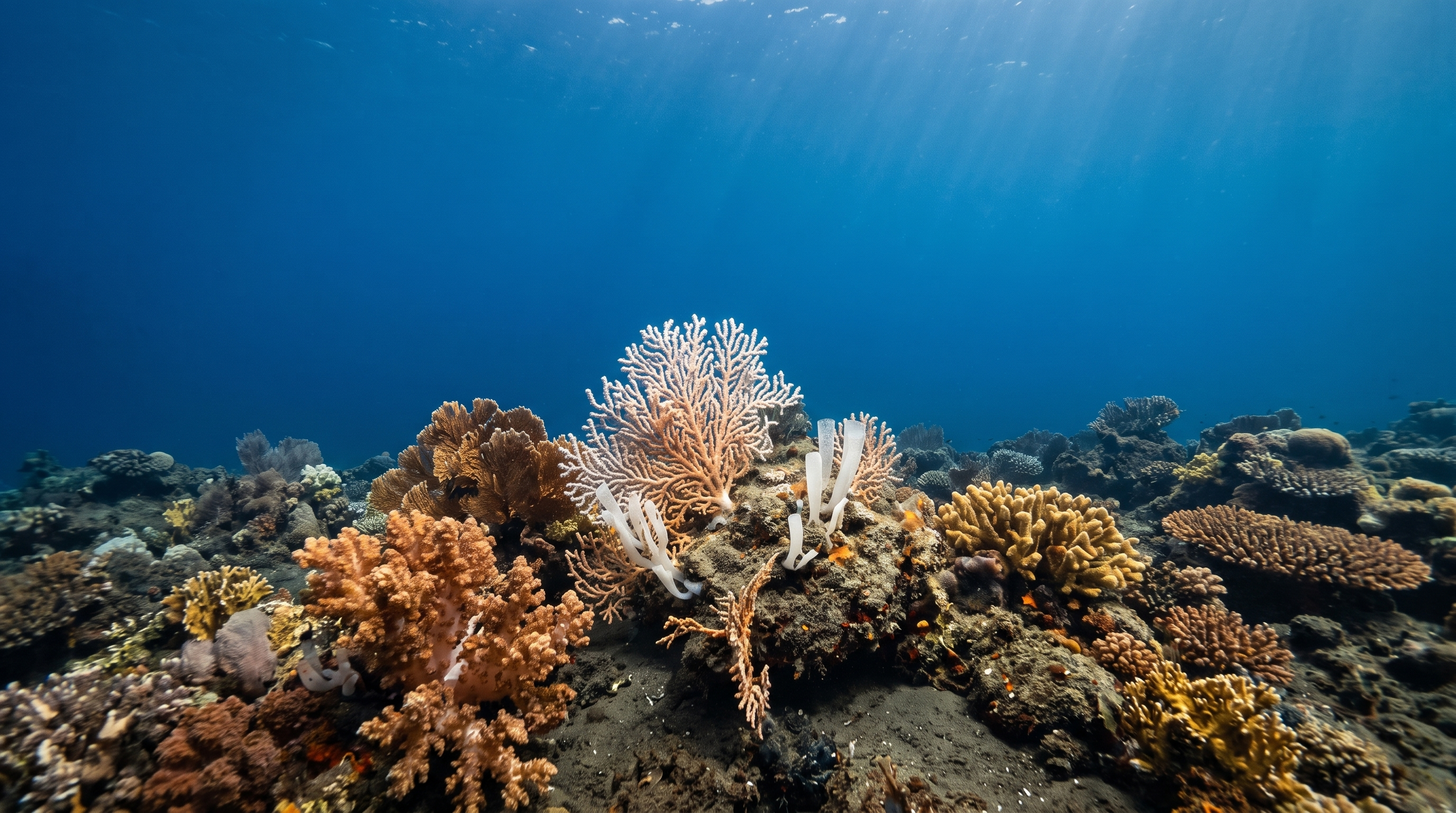
The pictures are strange. Some barrels still look whole. Others are badly corroded, and the team documented material that had escaped from some of them onto the surrounding mud, as reported by Earth.com and ScienceAlert. Life has moved in anyway: anemones, sponges, sea cucumbers, fish and crabs using the drums as shelters in a place where there is almost nothing else to hide behind.
The team detected cobalt-60, niobium-94, cesium-137 and americium-241 near the dump. Americium-241 is the same element found in many household smoke detectors, and it takes roughly 430 years for half of it to decay. So a barrel sealed in 1970 still holds most of its americium when your great-great-grandchildren are born. The levels so far are described as low, but above the natural background you would expect there, according to reports on the mission.
The real question: does it stay, or does it spread?
Here is the twist. The deep ocean might be both the best and the worst place for this waste. It is the best because water is an excellent shield: the IAEA summary notes that water absorbs essentially all radiation within a few meters. A leaking barrel five kilometers down is no danger to a swimmer on a beach.
It might be the worst because leaking waste can take three different roads, and scientists do not yet know which one wins. Some of it probably sticks to mud particles and stays put, like dust settling on a shelf. Some may dissolve and drift away on slow deep currents, getting thinner and thinner, like a drop of ink in a bathtub. And some might enter the food chain: a sponge on the barrel, a crab that eats near it, a fish that eats the crab.
That third road is the one that matters to people. Escartín framed the core question for CNRS: have radionuclides escaped from the barrels, and in what form, and do they move about? My hedged read: the realistic risk here is probably not a glowing ocean. It is a slow, very local leak into a tiny food web at the bottom of the sea, and whether any of it ever reaches animals that swim upward. For perspective, CNRS estimates the total radioactivity dumped at this site was around 300 times smaller than what the Chernobyl disaster released.
This is not the only nuclear dump at sea
The Atlantic site is just the one being revisited in detail. According to the IAEA's 1999 inventory of sea disposals, the Soviet Union dumped radioactive waste in the Arctic from 1959 to 1992, including reactors that still contained spent fuel, mostly near Novaya Zemlya in the Kara Sea. The United States dumped more than 56,000 containers at sites in the Pacific, and Japan used sites south of its main island. Most of those places have never had a robot map them drum by drum. If NODSSUM's methods work, they could become the template for checking the rest.
Waiting for the lab
Now comes the slow part. The team hauled up about 400 kilograms of samples in 2025 alone, roughly the weight of a grizzly bear, including mud, deep water, fish and crustaceans, and collected more in 2026. The Subatech lab says the detailed analyses will take place over the coming months. Early field data from 2025, reported by the University of Strasbourg, showed no measurable environmental contamination, but the lab work is what will say whether anything is building up in living things.
If the numbers come back low, these barrels become an odd kind of reef, built on a 1960s mistake. If they do not, Europe faces a much harder question. Should 200,000 corroding drums be left alone in the dark, or should somebody try to bring them back up?
Sources
- CNRS News: Tracking radioactive barrels in the Atlantic
- French Oceanographic Fleet (Ifremer): Campagne Nodssum
- Subatech (IN2P3/CNRS): NODSSUM 2026 mission
- ScienceAlert: 150,000 Tons of Radioactive Waste Were Dumped in The Atlantic
- Earth.com: Scientists found more than 200,000 barrels of leaking radioactive waste
- University of Strasbourg: Nodssum, des déchets radioactifs sous surveillance
- Wikipedia: Ocean disposal of radioactive waste (IAEA-TECDOC-1105 inventory data)