Scientists Declared This Reef Dead in the 1960s. It Was Alive the Whole Time.
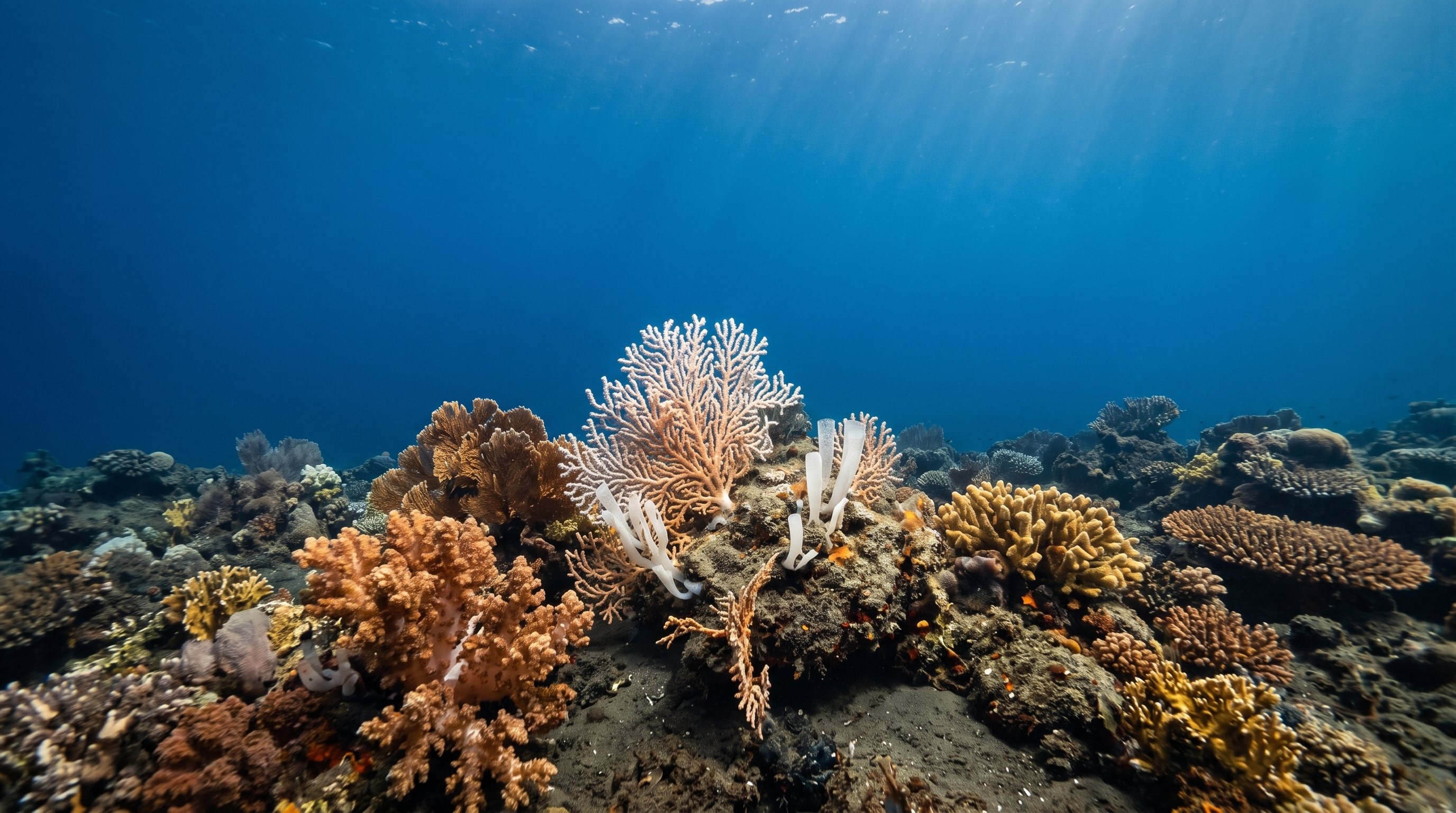
AI-generated illustration
Off the coast of Benin, sonar and camera drones just found a living coral reef in a spot researchers wrote off as dead more than sixty years ago, and nobody had gone back to check until now.
This article contains affiliate links. If you buy through them, we may earn a small commission at no extra cost to you.
Off the coast of Benin, in the Gulf of Guinea in West Africa, there is a patch of seafloor that maps have quietly ignored for more than sixty years. It shows up on old survey charts, but not as a place worth returning to. For six decades, nobody sent another camera down to check.
Now someone has. Researchers scanned the seafloor with sonar, then sent underwater drones and deep-sea cameras down to look, and what they found rewrites a small but stubborn line in the region's scientific record: the reef is alive. If you would like to watch something similar take shape a lot closer to home, a desktop coral-growing kit lets crystal coral formations branch out on your own shelf.
A verdict from the 1960s that nobody rechecked
The story starts with a set of surveys carried out in 1963 and 1964 by ORSTOM (the French Office de la Recherche Scientifique et Technique des Territoires d'Outre-Mer, the predecessor of today's Institut de Recherche pour le Développement), commissioned by the governments of Dahomey (now Benin) and Togo to scout out productive fishing grounds, according to the Frontiers in Marine Science paper. Their instruments picked up something that looked like a coral reef barrier more than 50 meters below the surface. Without equipment to go look at it directly, the surveyors filed it away as probably dead, and the label stuck for roughly sixty years, unchallenged in the scientific literature on West Africa's continental shelf.
That's a long time for a "probably" to go unverified. According to Frontiers's release on the study, a new team led by researcher Gérard Zinzindohoué set out to settle the question with equipment that didn't exist in the 1960s.
What the new survey actually found
The team scanned about 11.5 kilometers of seafloor using side-scan sonar, a technique that works a bit like a bat's echolocation: it bounces sound waves off the seabed and builds a picture from the echoes, letting researchers spot unusual shapes without seeing them directly, per ScienceDaily's coverage. That scan turned up two signals that looked like they could be reef structures. The team then sent down a Qysea Fifish underwater drone and a stationary baited camera rig (a National Geographic Deep Sea Camera System) to look at those two spots directly. Worth flagging: the Frontiers paper's abstract separately describes the surveyed zone as spanning roughly 7 kilometers east-west, likely the width of the mapped area rather than the sonar track length, but the two figures aren't clearly reconciled in the public materials.
Enjoying this story?
Get a short teaser by email whenever we publish something new. No spam.
At both sites, more than 50 meters down (the paper specifies 54 meters, on rocky substrate) the cameras found something alive: patches of coral. Not the reef-building, stony coral you picture from a tropical postcard, but soft corals and black corals, the kind that form branching or fan-shaped colonies instead of solid rock structures. The team counted at least six octocoral types and two black coral types, eight coral groups in total, along with eight fish species living among them, including golden African snappers (Lutjanus fulgens), Guinean angelfish (Holacanthus africanus), Monrovia doctorfish, West African goatfish, blackbar soldierfish, three-banded butterflyfish, and two species of damselfish, according to the paper and corroborated by EurekAlert's summary of the release.
Researchers describe this as the first confirmed record of a living mesophotic (or "twilight zone") coral ecosystem on the entire Gulf of Guinea continental shelf, a stretch of coastline running past several West African countries. Mesophotic reefs sit in a dim middle zone: too deep for the bright light shallow reefs need, too shallow to be the pitch-black deep sea.
Not a wall of coral, but scattered patches in the dark
Here's the part that separates this from a simple "everyone was wrong" story: the reef isn't one continuous structure. It's scattered patches, hidden in near-darkness at depths where sunlight barely reaches, spread across an area historical surveys suggested might extend up to 40 kilometers along the coast, though only a small fraction of that has actually been checked with modern equipment. That distinction matters: the 1960s surveyors weren't simply careless. They picked up a real signal, had no way to confirm what it meant, and an entire stretch of coastline got written off on an educated guess nobody circled back to test.
An open question worth sitting with
Zinzindohoué is careful not to oversell the discovery. "We should not assume they are everywhere," he said, according to Frontiers's release. "Each discovery needs to be confirmed." At the same time, the study's authors note that mesophotic hard-bottom habitats like this one may be more widespread across tropical Atlantic shelves than currently documented, a possibility that remains untested rather than confirmed.
So the honest version of this story doesn't end with an answer. It ends with a question: if one "probably dead" label on a 60-year-old chart turned out to be wrong, how many others, on this coastline or elsewhere, have simply never been checked?
Sources
- A coral reef thought dead for 60 years is teeming with life - ScienceDaily, https://www.sciencedaily.com/releases/2026/09/260913081927.htm
- First evidence of live mesophotic coral reefs on the Benin continental shelf - Frontiers in Marine Science, https://www.frontiersin.org/journals/marine-science/articles/10.3389/fmars.2026.1848226/full
- Underwater drones discover coral reefs off Benin, long presumed dead, teeming with life - Frontiers news release, https://www.frontiersin.org/news/2026/07/20/underwater-drones-coral-reefs-benin-presumed-dead-teeming-life-frontiers-marine-science
- Underwater drones discover coral reefs off Benin, long presumed dead, teeming with life - EurekAlert!, https://www.eurekalert.org/news-releases/1135897