This cloud was not supposed to clean the air.
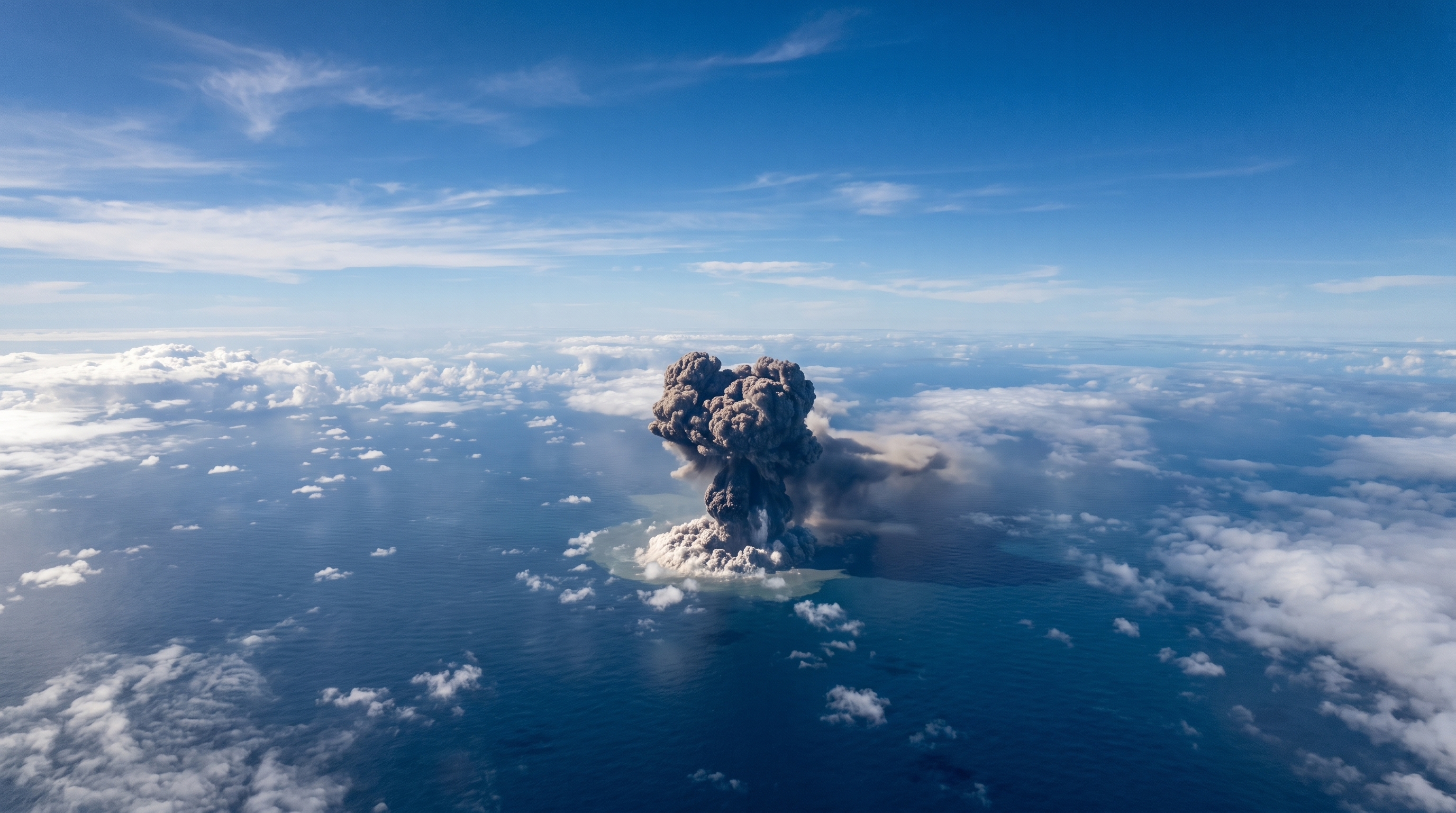
AI-generated illustration
When an underwater volcano tore open the Pacific, it threw ash and sea salt into the stratosphere together, and sunlight turned that mixture into something that started eating a greenhouse gas nobody expected it to touch.
This article contains affiliate links. If you buy through them, we may earn a small commission at no extra cost to you.
On January 15, 2022, the Hunga Tonga-Hunga Ha'apai volcano, sitting underwater in the South Pacific, exploded with a force that shook barometers on the other side of the planet. A plume of ash and seawater shot more than 30 kilometers up, punching straight through the layer of sky where airliners fly and into the stratosphere above it, according to the study published in Nature Communications. For weeks afterward, satellites tracked the plume as it drifted around the globe like a slow-motion smoke ring.
Most of the early attention went to the tsunami, the sonic boom, and the sheer size of the blast. Nobody was looking at that drifting cloud for a chemistry lesson.
A Plume Made of Ash, Salt, and Ocean Spray
Think of the plume like a dust storm mixed with sea spray, except lifted 30 kilometers into the sky and left to bake in unfiltered sunlight for weeks. It carried tiny ash particles and salty seawater that had been vaporized by the eruption's heat. Scientists studying the satellite data noticed something strange trailing behind it: a spike in formaldehyde, a gas that normally exists for only a few hours before breaking down. If you would rather watch an eruption up close without the stratosphere involved, a build-your-own volcano kit lets you trigger a much smaller, much safer one on your own kitchen table.
Formaldehyde that lingers for over a week is like finding campfire smoke still rising long after the fire should have burned out. Researchers led by Maarten van Herpen and Matthew Johnson realized something inside the plume kept producing it, over and over, according to ScienceDaily's coverage of the findings.
The Cloud That Started Eating Methane
Here is the twist: that something was methane, one of the most powerful greenhouse gases in the atmosphere. When sunlight hit the ash and salt particles together, it triggered reactions that released reactive chlorine atoms, tiny fragments that go looking for methane molecules and tear them apart. It is a bit like a spark landing in a room full of balloons: chlorine atoms and methane molecules just cannot coexist for long once sunlight sets things off.
Enjoying this story?
Get a short teaser by email whenever we publish something new. No spam.
The team estimated the plume was destroying roughly 900 megagrams of methane every day, which is roughly equal to the daily methane burped and farted out by about two million cows. Van Herpen described it simply: the volcano had released methane, then its own plume turned around and destroyed some of it.
Why should you care about a gas cloud eight thousand kilometers away? Methane traps far more heat than carbon dioxide, gallon for gallon, over the short term. Finding a natural process that quietly breaks it down, even briefly and even far from any city, adds a small missing piece to how scientists track the planet's greenhouse gas budget.
Not Everyone Is Convinced Yet
Before this gets filed under "great news," a few things are worth knowing. First, this is not breaking news this week: the underlying paper and the first headlines about it appeared back in May 2026, and outside scientists have had months to poke at it. Some are not fully sold. Atmospheric chemist Pete Edwards called the mechanism hard to confirm directly from satellite data, and Emily Dowd, who studies atmospheric chemistry, said the chemistry "still needs to be thoroughly tested in atmospheric models," as reported by CNN. So treat the 900-megagram figure as the researchers' best estimate, not a settled fact.
Second, and just as important: this same eruption also blasted a record amount of water vapor into the stratosphere, roughly 45 million metric tons, which on its own can add a warming effect that may linger for months. That is a separate process from the methane story, working in the opposite direction. The two effects do not cancel each other out or add up to a tidy answer about whether this eruption helped or hurt the climate overall. They are just two different things the same cloud happened to do.
So a volcano accidentally destroyed some methane while also pumping the sky full of warming water vapor, and scientists still are not sure how big either effect really was, or whether anything like it could ever be recreated on purpose. Which effect do you think matters more in the long run?
Sources
- Satellite quantification of enhanced methane oxidation applied to the stratospheric plume following Hunga Tonga-Hunga Ha'apai eruption | Nature Communications, https://www.nature.com/articles/s41467-026-72191-4
- Scientists stunned as volcano cloud destroys methane in the atmosphere | ScienceDaily, https://www.sciencedaily.com/releases/2026/05/260509210640.htm
- A violent volcanic eruption may have revealed a new weapon in the fight against a potent planet-heating gas | CNN, https://www.cnn.com/2026/05/30/climate/hunga-tonga-volcano-eruption-methane
- 50 million tons of water vapor from Tonga's eruption could warm Earth for years | Space.com, https://www.space.com/tonga-eruption-water-vapor-warm-earth