Every winter something bigger than Antarctica itself grows around it
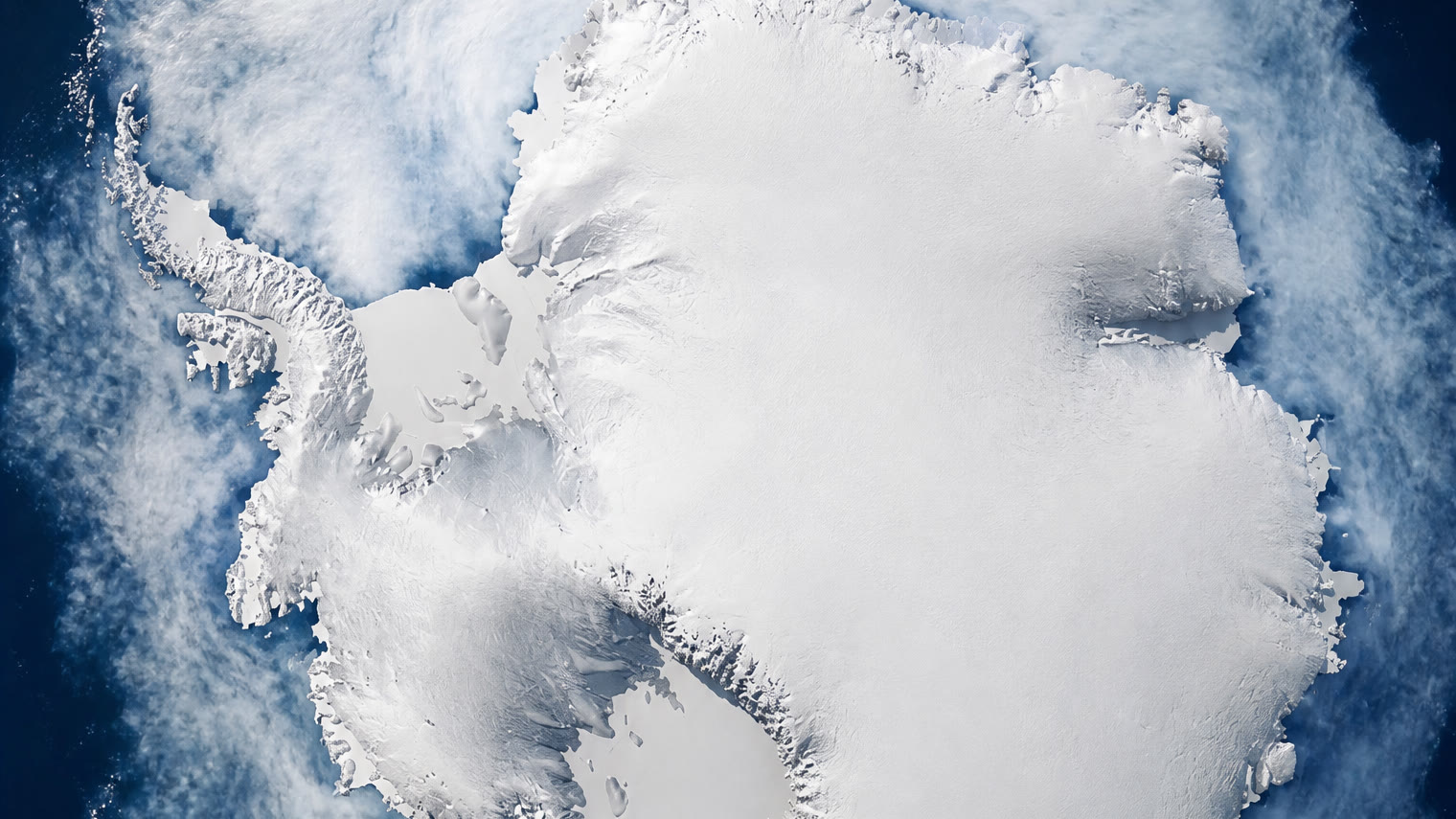
Illustration generated with AI for DomiVerseX
The biggest yearly change at the bottom of the world does not happen on land. It happens on the water, it shows up in pictures from space, and in the last few years it has started to behave in a way nobody expected.
This article contains affiliate links. If you buy through them, we may earn a small commission at no extra cost to you.
Seen from space in late February, Antarctica looks like a white island with a thin white fringe. Come back in the middle of September and the picture is very different. The dark ocean around the continent has frozen over, and a huge white ring now surrounds the land on every side.
The ring is sea ice. It is frozen sea water, floating on the sea, and it is not part of the land at all. It grows through the cold months, which at the bottom of the globe fall in the middle of the year. Then it melts away again. Nobody has to travel there to watch. The pictures come from satellites, and they have been coming since late 1978.
Why does this matter to you? Because it is one of the few changes on our planet that is big enough to see from space, and it happens every single year while most of us are looking the other way.
A ring bigger than the land inside it
Start with the land. Antarctica covers 14.2 million square kilometers. That is about 40 percent larger than Europe. Picture the whole of Europe, then add four tenths of Europe again.
Now the ring. On 14 September 2026 the sea ice reached its largest size for the year: about 17.6 million square kilometers, according to NASA's Earth Observatory. For every four squares of land on the map, there were about five squares of frozen sea around it.
That 17.6 is a first count. NASA says the ice "likely" reached its peak on that date, so the figure could still be adjusted a little.
Put land and ring together and the white area you would see from space was about 31.8 million square kilometers. That is a bit more than double the continent alone. It is as if your bedroom grew overnight until it had swallowed the room next door and part of the hallway. The British Antarctic Survey puts it more carefully: in winter, it says, the continent "appears to almost double" in size.
The ring is not one solid sheet. Scientists count every patch of sea where at least 15 percent of the surface is ice. Think of a drink with ice cubes in it: lots of ice, with gaps of water in between.
Why does this matter to you? Every flat map you have seen shows Antarctica at one size. For part of every year, the real white shape on Earth is more than twice as big.
Then nearly all of it disappears
The ring does not last. On 26 February 2026, at the end of the warm season, only 2.58 million square kilometers of sea ice were left. That is about one seventh of the September peak. Cut a pizza into seven slices and take six away.
So between late February and the middle of September, the ice grew by about 15 million square kilometers. That growth alone is larger than Antarctica, by about 6 percent. Spread evenly over those 200 days, it works out at new ice the size of more than 100 soccer fields every second, day and night.
Does it really happen every winter? The honest answer is: in every year that was checked for this article. The growth beat the size of the continent in 2026, in 2023 and in the average year between 1981 and 2010. Nobody went through all 48 years one by one for us, so we will not promise the other 45.
By the way, the February low of 2026 was nothing unusual. It was the 16th lowest on record and about a tenth below the long term average, which the US National Snow and Ice Data Center (NSIDC) called near average. NSIDC scientist Walt Meier said: "This year's return to less extreme conditions is not unexpected given the large year-to-year variation."
Why does this matter to you? You know how a puddle freezes in winter and melts in spring. This is the same thing, on a puddle bigger than a continent.
The twist: the ring used to be getting bigger
Enjoying this story?
Get a short teaser by email whenever we publish something new. No spam.
Here is the part the short video leaves out.
For a long time the ring was slowly growing. According to NASA, the total sea ice around Antarctica increased by about 1 percent every ten years from 1979 until 2014. That is slow: like a 100 piece puzzle that gains three or four pieces in 35 years. Then, NASA says, the winter ring set a new record high three years in a row, in 2012, 2013 and 2014.
After that it flipped. NASA puts the end of the climb in 2015, with big drops starting in 2016.
Look at the winter peaks since then. In 2023 the peak was 17.07 million square kilometers, the lowest ever measured. In 2024 it was 17.26. In 2025 it was 17.81. In 2026 it was about 17.59, the third lowest. Those are the four smallest winter peaks in the whole record, and they are the four most recent years.
Before 2023, the smallest peaks had been 17.99 in 1986 and 18.05 in 2002, as NSIDC's own table shows. So each of the last four winters came in below anything seen in the 44 years before them. Imagine a class of 48 children lined up by height, and the four shortest are the four newest pupils.
How much is missing? Compared with the average peak between 1981 and 2010, the 2026 ring was about 1.1 million square kilometers smaller. That gap is about one ninth of Europe.
And it did not stop at the peak. NSIDC reported that the ice fell sharply after 14 September 2026. From 2 October 2026, the daily figures dropped to the lowest ever recorded for those dates, lower even than in 2023.
Why does this matter to you? A thing that grew slowly for 35 years changed direction in about two. When something that steady turns around that fast, scientists want to know what pushed it.
Two rulers, one answer
You may see a different number for the same peak. The UK's Met Office uses another set of satellite data, and its report gives 18.12 million square kilometers, reached on 11 September 2026. That is about half a million square kilometers more than the NASA and NSIDC figure, and three days earlier.
Both counts cannot be exactly right. But they agree on the thing that matters most here: each one ranks 2026 as the third lowest winter peak on record. It is like two people measuring the same garden with different tape measures. The totals differ a little, and both still agree it is one of the smallest gardens on the street.
Why does this matter to you? When you see one big number in a headline, remember there may be a second honest number next to it. The ranking is often safer than the exact figure.
What decides the size of the ring?
Nobody has a full answer yet, and one good or bad year does not settle it. Meier's point about the February low cuts both ways: the ice jumps around a lot from year to year.
NSIDC has spotted one clue. In the recent low years, the ice was still above average in some parts of the sea around Antarctica and below average in others. In the record high years, nearly every part of the ring was above average at once. So the ring does not shrink evenly, like a balloon losing air. It changes piece by piece, and the pieces move around the map from one year to the next.
The ring will grow again next winter. If it behaves as it did in every year checked here, it will be bigger than the continent again. But will it climb back toward the sizes of 2014, or are the small rings of the last four winters the new normal? And what flipped the switch in 2015?
Sources
- Antarctic Sea Ice Grows to Its 2026 Maximum, NASA Earth Observatory
- "Stranger Things" in the 2026 Arctic, National Snow and Ice Data Center
- Antarctic sea ice maximum settles in third place, National Snow and Ice Data Center
- Antarctic sea ice extent arrives at a near-average minimum, National Snow and Ice Data Center
- Briefing on Arctic sea ice minimum and Antarctic sea ice maximum report, September 2026, Met Office
- 'Concerning' low sea ice persists as Antarctic hits third-lowest winter peak, Carbon Brief
- Antarctica, British Antarctic Survey
- Antarctica summary, Encyclopaedia Britannica