In August a Queen's Necklace Vanished From a Vienna Museum in Broad Daylight
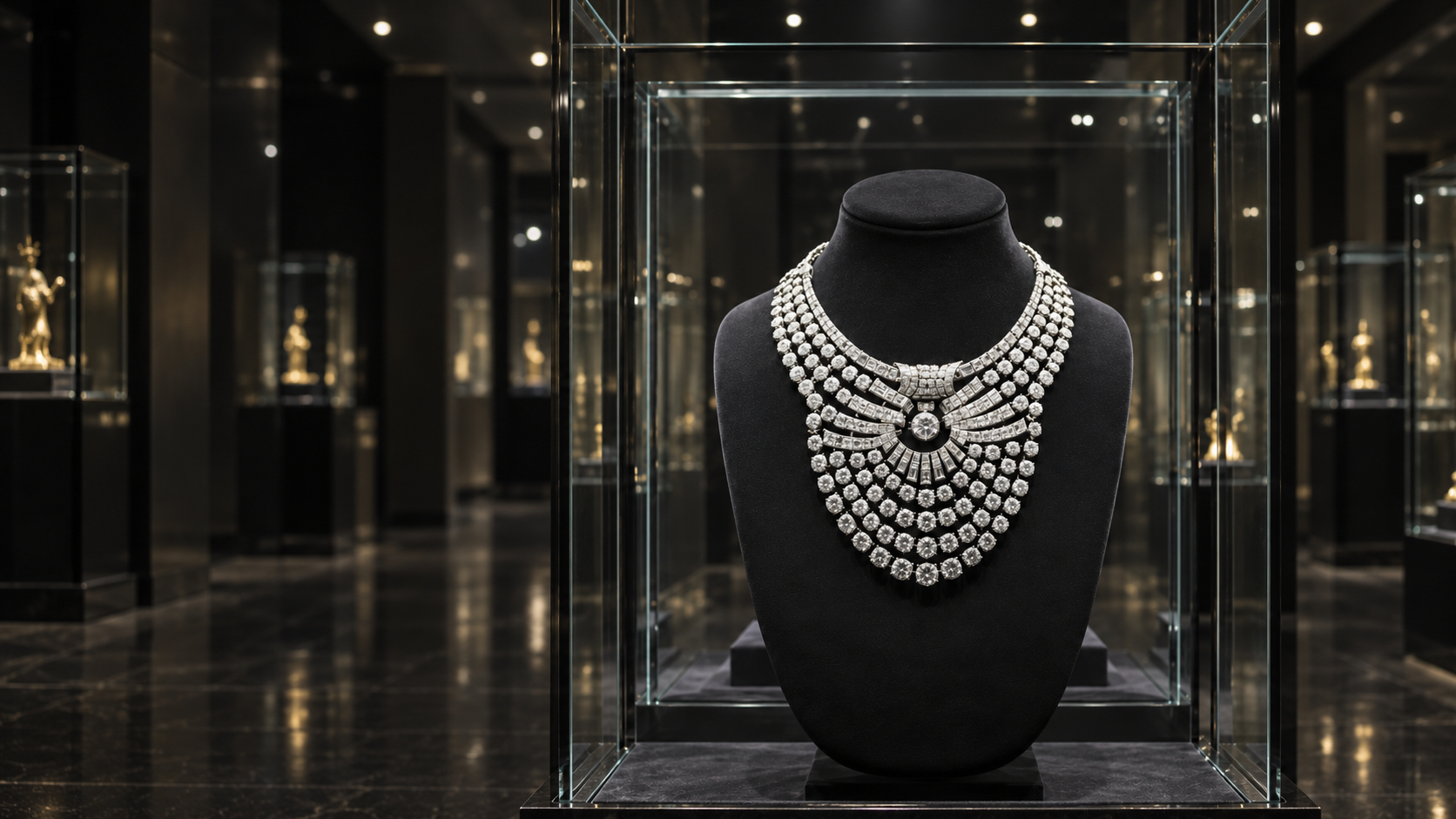
Illustration generated with AI for DomiVerseX
A hammer, a glass case, and a necklace built for an Egyptian queen. The strange part is that this was not the first time it went missing.
This article contains affiliate links. If you buy through them, we may earn a small commission at no extra cost to you.
Nobody had to break in. The Museum of Applied Arts in Vienna sits on the Stubenring, a wide boulevard of nineteenth century facades, and on the afternoon of 27 August 2026 it was open like any other Thursday. Two men walked up to the desk and bought tickets.
They did not wear masks. They walked through the galleries the way visitors do, past cabinets of glass and silver, until they reached the case they had come for. One of them took out a hammer.
What Two Museum Tickets Bought
The case held a necklace of platinum and diamonds. Within seconds it was gone, and both men were out of the building and heading for the city park next door. Several people were standing in the room when it happened. Nobody was hurt, though police believe one of the two was carrying a firearm.
That last detail is the one that sounds wrong. Museum security is built around closing time, alarms, locked doors and motion sensors in empty halls. It is much less prepared for two ordinary looking people who pay the entrance fee, stand in front of a case at two in the afternoon, and swing.
The exhibition was open to visitors again almost immediately, in consultation with the police. Reports differ on whether that was the same evening or the following day, but either way it was fast. That decision tells you something too. There was nothing left to protect in that particular case. By Friday a blue panel had been fitted over the broken cabinet, and the museum has since installed metal detectors at the entrance to the show.
The Necklace Itself
The museum's director general, Lilli Hollein, said the theft had "hit us hard". It is easy to see why.
The piece is a Van Cleef & Arpels design in platinum, set with 673 diamonds. Their combined weight is 204.03 carats, which is roughly 41 grams of cut stone. Put another way, that is about the weight of eight teaspoons of sugar, except every grain of it is a faceted diamond.
There is no colour in it anywhere. No emerald, no sapphire, nothing to break the white. Anyone who has ever looked at a stone through a ten power jeweller's loupe knows how much detail hides at that scale, and a piece like this is built to survive exactly that kind of inspection. The stones are graded in size so the whole thing spreads across the collarbone like a fan and moves as one sheet when the wearer moves. In jewellery terms this is a bib necklace, and it is the kind of object that takes a workshop months rather than days.
All white jewellery is also unforgiving. Diamonds attract skin oil and dust, which is why museum conservators and ordinary owners alike reach for the same basic tools, a soft brush and a mild jewellery cleaning solution, rather than anything abrasive. A single dull stone in a row of 673 is visible from across a room.
It was made in the late 1930s for Nazli, the queen of Egypt, and she wore it in 1939 at the wedding of her daughter, Princess Fawzia, to the man who would become the last Shah of Iran. If you have seen photographs from that wedding, this is the piece catching the light.
One correction if you go reading the news coverage. Several outlets have named the bride as Faiza. Nazli had four daughters, Fawzia, Faiza, Faika and Fathia, and the one who married into the Iranian royal family was Fawzia. It is a small error but it has been copied widely.
Why It Was in Vienna at All
The necklace does not belong to the museum. It was on loan from Van Cleef & Arpels itself, as part of an exhibition called GLANZSTÜCKE that pairs pieces from the jeweller's own archive with objects from the museum's collection. The show opened on 10 June 2026 and is scheduled to run until 27 September, and the museum's own exhibition page still lists the guided tours that were going ahead in the weeks around the theft.
Loaned pieces live differently from owned ones. They are packed, shipped, insured and unpacked on a schedule, and even at the ordinary end of the scale the principle is the same one behind a lockable jewellery case: whatever matters travels in something that closes.
So the thieves did not steal from a permanent collection that had been sitting in the same room for decades. They stole from a temporary show with a published closing date, which means the window was always going to be narrow. Austrian investigators have reportedly considered the possibility that the theft was ordered rather than opportunistic, though nothing has been proven.
A Queen Who Ran Out of Money
Here is the part that most of the coverage mentions in a single line and then moves past.
Enjoying this story?
Get a short teaser by email whenever we publish something new. No spam.
This necklace has been lost before.
Nazli left Egypt after the monarchy fell and spent her later years in the United States. By the mid 1970s she was in serious financial trouble, and in November 1975 she sent both the necklace and its matching tiara to auction at Sotheby's Parke Bernet in New York. The tiara went for $127,500. The necklace went for $140,000, to a private buyer.
Then it disappeared. Not stolen, just gone into a collection somewhere, essentially out of public view, for roughly four decades. For most of a human lifetime, one of the most significant pieces of jewellery ever made for a royal family was simply not visible to anyone.
Thirty Times the Price, Forty Years Later
It came back on 9 December 2015, at a Sotheby's Magnificent Jewels sale in New York. The estimate was $3.6 million to $4.6 million. It sold for $4,282,000, just under the top of that range.
That is a little over thirty times the 1975 price. Some of that is inflation, but not most of it. What changed is that the story attached to the object became worth more than the diamonds in it. By 2015 this was not simply a large necklace, it was the necklace from that wedding, the one connecting the Egyptian and Iranian royal families in the last years before both monarchies ended.
The buyer was Van Cleef & Arpels. The house bought back its own work and has been showing it in exhibitions ever since, which is exactly how it ended up in a glass case on the Stubenring.
Where Something Like This Actually Goes
The uncomfortable answer is that almost nobody could sell it openly.
A necklace with 673 documented stones and a photographed history is unsellable as a necklace. Any serious buyer, dealer or auction house would recognise it immediately, and it went onto Interpol's stolen works of art database within days. There is no discreet collector market for an object this famous.
Which leaves the possibility that everyone in the field dreads. Platinum can be melted. Diamonds can be prised out of their settings and recut smaller, and a recut stone loses its identity completely. If that happens, the necklace stops existing and becomes a pile of anonymous material worth a fraction of $4 million, and the eleven months of workshop time behind it are simply deleted.
That has happened before to other pieces. It may not happen here. But the mathematics of a stolen masterpiece are brutal: the thing is worth far more intact than it is broken up, and yet intact it cannot be sold at all.
What Happens Now
As of early September 2026, no arrests have been reported. The police have released images from the museum's cameras, and the descriptions are thin: two men of slim build, dark hair, dark beards, dark outer clothing.
Vienna is not alone in this. European cultural institutions have had a difficult run lately, and on the same day as the Vienna theft, thieves in Alicante took bronze age gold and silver from the Villena treasure. The pattern is the same in both cases. Daylight, speed, and objects that are internationally famous and therefore internationally unsellable.
The Louvre robbery of October 2025 is the warning here. French police made arrests within a week and have since charged several people. The jewels themselves have never been found. Catching the people who carried a thing out of a building turns out to be a completely different problem from getting the thing back.
The necklace has now been missing for longer than it takes most museums to update an insurance claim, and shorter than it was missing the first time. Between 1975 and 2015 the answer to "where is Queen Nazli's necklace" was simply that nobody knew, and then one day it was on a table in New York with an estimate attached.
If you want the fuller picture of how rarely that happens, Ulrich Boser's account of the Gardner Museum robbery is the standard reference, and its central fact is bleak: those frames are still empty.
That is the thing worth sitting with. This object has already come back from the dark once.
Sources
- CNN, "Thieves steal $4 million diamond necklace in brazen smash-and-grab heist", 31 August 2026
- ARTnews, "$4.3 M. Van Cleef & Arpels Necklace Stolen From Vienna Museum"
- Galerie Magazine, "Van Cleef & Arpels Diamond Necklace Stolen from Museum in Vienna", 31 August 2026
- MAK Vienna, GLANZSTÜCKE exhibition page
- fashion.at, "MAK reopens after Vienna's diamond necklace heist", 28 August 2026
- National Jeweler, "Queen's Necklace Sells For $4.3M", February 2016
- CairoScene, "Styled Archives: The Story Behind Queen Nazli's Necklace"