
People are still hiking into one Arizona mountain range today, searching for gold that has never been found.
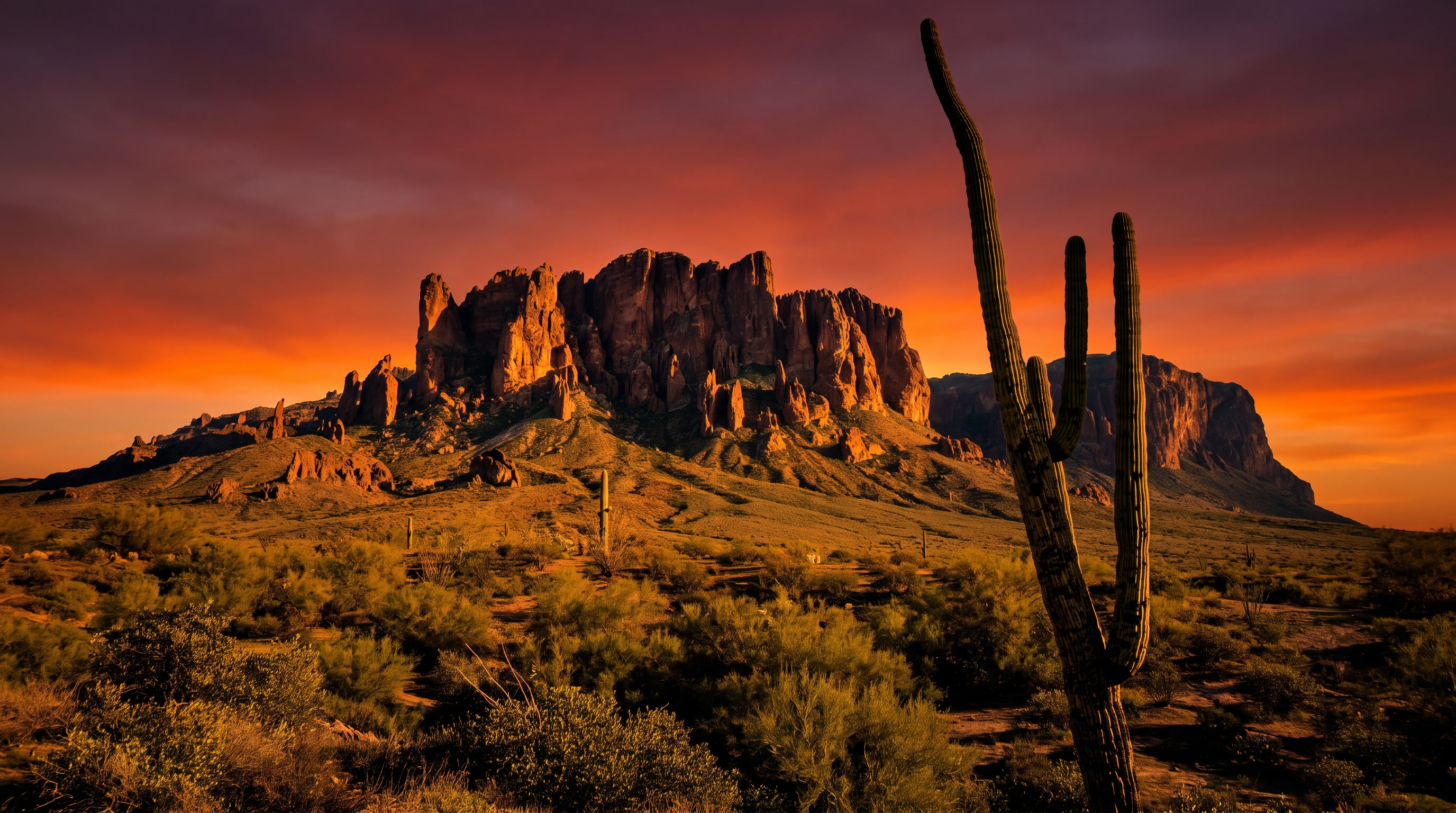
AI-generated illustration
For more than a hundred years, people have walked into one Arizona mountain range chasing a story about hidden gold, and some of them never walked back out.
This article contains affiliate links. If you buy through them, we may earn a small commission at no extra cost to you.
Somewhere in the Superstition Mountains east of Phoenix, Arizona, there might be a gold mine that nobody alive has ever seen. Or there might not be. That is the strange thing about the Lost Dutchman's Gold Mine. It is one of the most famous treasure stories in the United States, but almost everything about it sits somewhere between a documented fact and a tall tale passed around a campfire. This article will try to be honest about which is which. (This modern account of the legend covers both the documented history and the folklore side by side.)
A Mountain With a Scary Name
The Superstition Mountains are a rugged, rocky range that rises above the desert floor northeast of Phoenix. Today the area is protected as part of the Superstition Wilderness inside Tonto National Forest, and a chunk of it is also set aside as Lost Dutchman State Park, which opened to visitors in the late 1970s. A tall, narrow spire of rock called Weaver's Needle stands near the center of the range and shows up in almost every version of the treasure story as a landmark near the supposed mine. If you ever want to explore the range yourself, an official topographic map of the wilderness marks Weaver's Needle and the rest of the terrain in detail. The mountains earned their spooky name long before any gold story started, from old tales that Native American groups considered parts of the range dangerous or forbidden. That reputation only grew once the gold legend attached itself to the mountains.
The Man They Called "The Dutchman"
The one part of this story that historians agree really happened involves a real person named Jacob Waltz, sometimes spelled Walz. Waltz was born in Germany, in the region of Württemberg, around 1810, and he immigrated to the United States sometime before the late 1840s. He eventually made his way to Arizona and settled near Phoenix, where by around 1870 he owned a small farm.
Here is an important fact that often gets mixed up: Waltz was not Dutch, meaning he was not from the Netherlands. He was German. In the 1800s, Americans commonly called German immigrants "Dutchmen," because the word sounded like "Deutsch," which is the German word for German. So "Lost Dutchman" really means "lost German," and the nickname has nothing to do with Holland.
According to several historical accounts, Waltz worked for a time at a real mine near Wickenburg, Arizona, called the Vulture Mine, and some records suggest he was let go over suspicions that he was pocketing rich ore instead of turning it in. From the late 1870s onward, Waltz was seen in Phoenix from time to time carrying unusually rich chunks of gold ore, but he never told anyone where he found it. That part, a real man showing up with real gold and staying silent about the source, is documented in local newspaper accounts from that era. What he actually did in the mountains to get that gold is where the story stops being verified fact and becomes legend. The classic version of the tale, first written down decades after Waltz's death, is where most of these details actually come from.
The Peralta Story
The most famous explanation for where Waltz supposedly found his gold involves a Mexican family named Peralta. According to the legend, the Peralta family ran a rich gold mine deep in the Superstitions in the 1840s, until Apache warriors attacked one of their mining parties and wiped most of them out. The story goes that Waltz later learned the mine's location from a surviving member of the family, or from someone connected to them, and began quietly working it himself.
It is important to say clearly that historians have not been able to confirm this part of the story. There really was a Peralta family involved in mining in the 1800s, and there really was a fraudulent land-grant scheme in Arizona history that used the Peralta name. But researchers who have dug into the specific tale of a Peralta gold mine and massacre inside the Superstition Mountains have found no solid historical proof that it happened the way the legend describes. Some writers who have studied the legend closely believe the Peralta mine story, at least in the form most people know it, was largely invented or heavily embellished by writers in the twentieth century. So while the Peralta story is a huge part of the legend, readers should treat it as folklore layered on top of the Waltz story, not as confirmed history. Some of the on the ground research into the legend, conducted by people who have spent decades hiking the range themselves, comes to the same skeptical conclusion.
Enjoying this story?
Get a short teaser by email whenever we publish something new. No spam.
A Secret Taken to the Grave
Jacob Waltz died on October 25, 1891, in Phoenix, reportedly from pneumonia after being weakened by a flood. He was cared for in his final days by a neighbor named Julia Thomas. According to accounts from that time, Waltz described the location of his gold source to Thomas before he died, and after his death she organized search expeditions into the Superstitions to try to find it. Newspaper reports from 1892 describe search efforts happening around that time, and later stories say Thomas even sold hand drawn maps to the supposed mine for a few dollars each. None of it led anywhere. The mine, if it exists, was never found by her or by anyone who worked with her.
People Who Went Looking and Never Came Back
This is where the legend turns dark, and where readers should be extra careful about separating documented history from rumor. It is true that people have died or disappeared while searching the Superstition Mountains for the Lost Dutchman's mine, and some of those cases are well documented. The most famous is Adolph Ruth, an older treasure hunter who went missing in the mountains in 1931. Months later, part of his skull was found, and it reportedly had two bullet holes in it. Officials at the time said his death was probably caused by heat, thirst, or a fall, not murder, but that conclusion was disputed by Ruth's own family and by many people who have studied the case since. Other searchers and hikers have gone missing or died in the decades since, with documented cases stretching from the 1930s all the way into recent years.
However, you may have heard a claim that hundreds of people, sometimes the number six hundred gets repeated, have died searching for this one mine. That specific number shows up constantly in retellings of the legend, but it does not appear to come from any verified count kept by historians, park officials, or law enforcement. According to the story, the death toll is enormous. According to the documented historical record, a smaller but still real number of deaths and disappearances in the Superstition Wilderness have been tied to treasure hunting over the last century. Readers should treat the huge round numbers as part of the legend's mystique, not as a confirmed fact.
Why Some Experts Doubt the Mine Exists at All
There is another wrinkle in this story that many retellings leave out. Some geologists who have studied the Superstition Mountains have pointed out that the rock in much of the range is volcanic, or igneous, in origin, and that this type of rock does not typically produce the kind of large gold veins the legend describes. That is one expert's view, not a universally settled scientific fact, but it is a real reason some researchers are skeptical that a rich hidden gold mine, as opposed to scattered surface gold, ever existed in that specific spot the way the story claims.
The Search Goes On
More than one hundred and thirty years after Jacob Waltz died with his secret, nobody has ever produced verified proof of a lost gold mine in the Superstition Mountains. No confirmed mine shaft, no confirmed vein, no confirmed treasure has ever been recovered and authenticated. And yet every year, people still hike into the wilderness with old maps, metal detectors, and a lot of hope. A beginner friendly way to try it yourself is a basic gold panning kit, while a modern, practical handbook covers the actual techniques prospectors use today. Some go looking for a family legend. Some go looking for adventure. A few have never come home.
Maybe the mine is still out there, hidden in a canyon nobody has checked closely enough. Maybe it was never as rich as the story says, or never existed in the first place, and Jacob Waltz simply knew a good spot to pick up scattered gold that dried up long ago. Nobody alive today knows for sure. That is exactly why, more than a century later, people are still walking into the Superstitions to look.
Sources
- Lost Dutchman's Gold Mine — Wikipedia
- Legend of the Lost Dutchman — Jacob Waltz, DesertUSA
- Legend of the Lost Dutchman, Lost Dutchman State Park (Arizona State Parks)
- The Lost Dutchman Mine, Arizona — Legends of America
- Peralta massacre — Wikipedia
- Jacob "Lost Dutchman" Waltz (1810–1891) — Find a Grave
- There, in the Valley: the legend of the Lost Dutchman's mine — Axios Phoenix