Who built these giant stone circles 3,000 meters up a mountain?
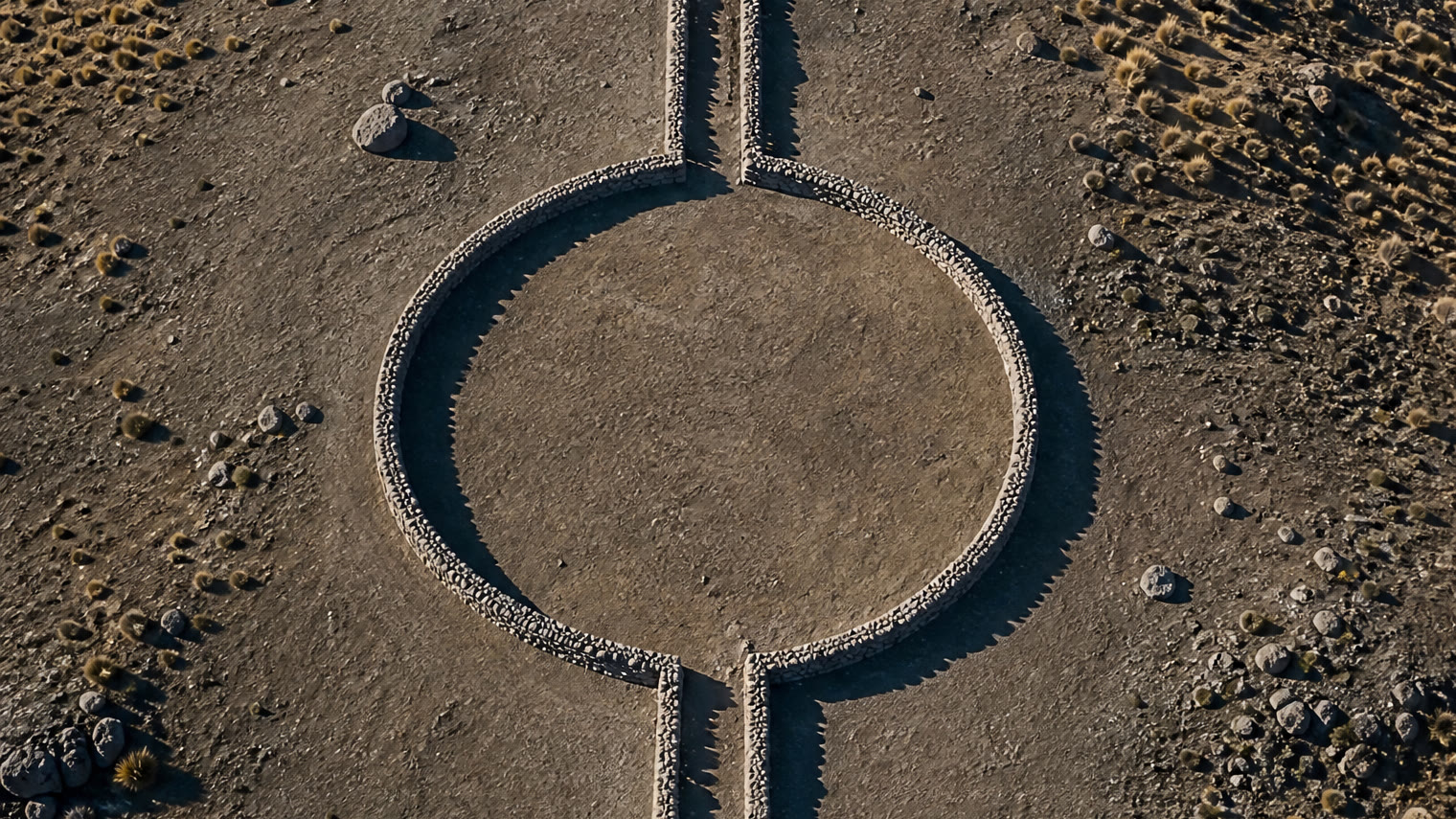
Illustration generated with AI for DomiVerseX
A man looking at satellite pictures saw shapes on a mountainside that nature does not make. It took him three tries to reach them on foot, and standing there turned out to be the most puzzling part.
This article contains affiliate links. If you buy through them, we may earn a small commission at no extra cost to you.
In May 2025 a mountaineer named Carlos Gobbi was looking at mountains without climbing them. He was using Google Earth, which is a globe on a screen, built from pictures taken from space. On one mountainside he saw shapes that did not look natural.
There were circles. There were straight corridors joining them. There were box shapes and ditches too. All of it sat high in a mountain range called the Cordillera del Tigre, in the Andes of Mendoza province, Argentina.
"When I saw that, it was really striking," Gobbi said, as the newspaper El Sol reports.
He had a reason to stare. Gobbi comes from Mendoza, and he had heard talk of old stone walls somewhere in that area. He had wanted to find them for almost thirty years. If you are ten years old, that is three times your whole life.
Why does this matter to you? The tool he used was not locked inside a laboratory. He found this by looking at pictures on a screen, carefully, for a long time.
Wider than a basketball court is long
The circles are big. Each one measures 27 to 35 meters across. A basketball court is 28 meters long, so even a small circle is about as wide as a court is long. The biggest is about one and a half tennis courts across.
Walk once around the biggest circle and you have gone about 110 meters, a little more than a 100 meter running track. The ground inside it would hold almost four tennis courts.
Nobody has published how many circles there are, or how big the whole thing is.
Then there is the height. Depending on the report, the site sits at "about 3,000 meters" or "more than 3,000 meters" above the sea. No exact figure has been published. Three thousand meters is about 9,800 feet. That is about nine Eiffel Towers standing on top of each other.
If the words "stone circle" make you picture Stonehenge, picture something much lower. These are low walls of stacked stones with nothing holding them together. The builders piled the stones up on lighter colored ground. In some places the walls sit down in trenches, like channels.
Why does this matter to you? Somebody carried and stacked every one of those stones, in a place that is hard even to walk to.
Three tries to get there
Seeing a place on a screen is easy. Standing in it was not.
Gobbi set out for the site in September 2025 and did not reach it. He tried again in November 2025 and failed again, according to the newspaper Los Andes. On 14 February 2026 he finally got there with two companions. Los Andes names them as Adrián Radich and Gabriel Orofino.
That was about nine months after he first saw the shapes.
How long was the walk? The reports do not agree. Los Andes says almost four days. El Sol says almost three, and La Nación calls it a three day expedition. So it was three or four days on foot, depending on which report you read. Along the way there was no water nearby and no phone signal.
One more detail makes the wait even longer. If the science site Futura has the caption right, the satellite picture was taken on 7 May 2023. The shapes sat in that picture for two years before he noticed them.
Why does this matter to you? A picture can show you where something is. It cannot take you there. That part still needs legs, and sometimes three attempts.
The twist: from inside, it disappears
Here is what nobody expected. When the three men stood in the middle of it, they could not see what it was.
On the ground they saw walls of stacked stone forming corridors. They saw stone piles raised like small towers. There was a channel lined with rocks that led to a hollow paved with stones, and there were patches where the ground had been cleared to show reddish soil.
Enjoying this story?
Get a short teaser by email whenever we publish something new. No spam.
But there was no figure. The pattern of circles, corridors and boxes only shows up from high above.
That is why the archaeologists who have studied the pictures say it could be a geoglyph. A geoglyph is a giant design made on the ground. If they are right, it is the first one ever reported in Mendoza. The project's director, Cristina Prieto-Olavarría, and its co-director, Horacio Chiavazza, said the team found no earlier mention of the site in notes or publications, and that there is no other like it in the province.
Even the shape is a puzzle. "We cannot be sure it is a particular figure," Chiavazza told the newspaper La Nación.
Some news reports compared the site to the famous Nazca Lines of Peru. Chiavazza said no to that. There is no match in design or in the way it was made. The Nazca Lines were made by taking material away from the ground. This was made the opposite way, by piling stones up.
Why does this matter to you? The people who built this made something whose whole shape cannot be seen by a person standing in it. Think about how hard that is to plan.
A place nobody lived in
So what was it for? The first clue is something missing. On the surface there was no pottery and no leftover food. Add the hard road in and the lack of water.
"We interpret that it was not a place to live permanently," Chiavazza said.
The team's best idea is that it was a place for ceremonies. Their main guess for the builders is the time of the Inca, but they have not ruled out that somebody earlier made it.
If it is Inca, Chiavazza says it would be one of the southernmost geoglyphs of the whole Inca state. He thinks it could be tied to an Inca way station called Ranchillos, in the nearby Uspallata valley. It could also be tied to an old Andean belief that mountains are sacred.
Other ideas on the table are the sky and the stars, and the wish for the land to give good harvests. Futura reports that the researchers warn against calling it Inca before there is physical proof.
Why does this matter to you? "Nobody knows yet" is not the same as "nobody has any idea". The experts have a favorite answer. They are just honest that it has not been tested.
What scientists have not done yet
When the find was reported in September 2026, no archaeologist had measured, dug or dated anything at the site. Scientists had not been there at all. Everything in this article comes from satellite pictures and one visit by Gobbi and his two companions. No scientific paper has been published.
That means there is no age. Until there is a date, nobody can even be sure how old these walls are, and a much younger origin has not been ruled out.
The first scientific trip is planned for December 2026. The team has its permits from the heritage office of Mendoza province. Researchers from Argentina will go up with colleagues from the University of Jaén in Spain, and Gobbi will be their guide. They plan to map the site with drones, take samples of the soil and dig. Futura reports that the top wish is to find something that can be dated, such as charcoal or bone.
The team also wants to include the views of the Indigenous communities of Uspallata. And if Futura has it right, Gobbi gave the exact spot to the researchers. No report has published it.
Why does this matter to you? You are reading about this before the scientists have even arrived. For once, you know about as much as they do.
Made for whose eyes?
Juan Pedro Bellón, of the University of Jaén, called the find "of the first order". But no date for the walls can come before that December trip.
Until then, one question sits above all the others. Whoever stacked these walls made a design that only shows from high above. So who was it made for?
Sources
- Se ve desde el espacio: creen haber hallado un geoglifo en la cordillera de Mendoza, Los Andes
- El impactante hallazgo en la Cordillera de Mendoza que puede verse desde el espacio, El Sol
- En el corazón de los Andes: el inédito geoglifo que pudo ser un centro ceremonial e intriga a los arqueólogos, La Nación
- A mountaineer scanning Google Earth spotted mystery stone circles 10,000 feet up in the Andes, Futura
- Inédito hallazgo arqueológico en Mendoza: posibles geoglifos en la Cordillera del Tigre, Ciudadano News