How did 6,511 dishes survive 2,100 years at the bottom of the sea?
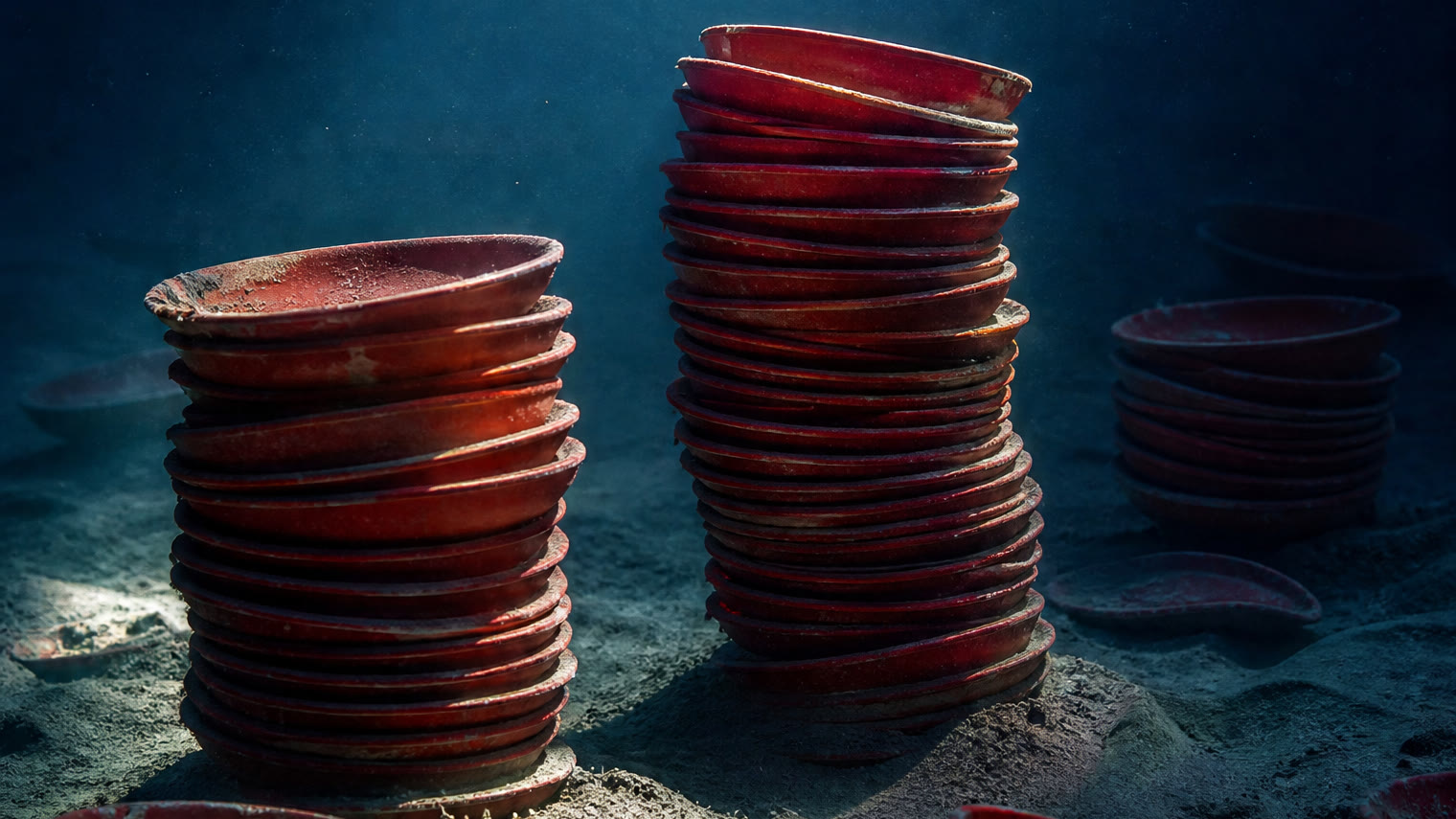
Illustration generated with AI for DomiVerseX
A whole shipment of fancy tableware went down off the coast of Turkey long before anyone could eat from it. Thousands of pieces are still whole, and the reason is something you could dig up in a garden.
This article contains affiliate links. If you buy through them, we may earn a small commission at no extra cost to you.
About 50 meters under the sea off southern Turkey, a lamp sweeps across the sand and stops on something that looks like a kitchen cupboard tipped on its side. Red plates sit in neat stacks. Bowls sit inside bowls. This is the Adrasan shipwreck, and its cargo never reached the people who were going to buy it.
The wreck lies off the village of Adrasan, in the Kumluca district of Antalya, on the Mediterranean coast. The ship went down about 2,100 years ago. If a new generation is born about every 25 years, that is about 84 generations of parents and children.
Digging started in 2025. The team comes from Akdeniz University and works with Antalya Museum. Its leader is the underwater archaeologist Hakan Öniz, and underwater robots help the divers.
Then came the number. After the find was announced in late September 2026, news reports gave the count: 6,511 unbroken pieces, so far. Arkeonews ties that figure to the 2025 season, the first season of digging. The digging is still going on, so the total could grow.
Why does this matter to you? You have probably seen a plate break on the short trip from the table to the sink. These ones went through a shipwreck and about 2,100 years of salt water.
Almost six years of clean plates
The 6,511 are not all plates. The count covers plates, bowls and trays. If one person used three clean dishes every day and never washed up, the pile would last almost six years.
They are not all alike either. The team sorted them into 122 different shapes and sizes. That works out at about 53 pieces of each kind on average.
Many shapes had a job. There were dishes for nuts, bowls for soup, plates for fish and trays in several sizes, as Smithsonian Magazine also reports. The divers found some storage jars too, called amphorae, which were probably made on islands in the Aegean Sea.
Turkey's culture and tourism minister, Mehmet Nuri Ersoy, announced the find in one sentence: "We are bringing 2,100-year-old tableware to light from the depths of the Mediterranean."
Why does this matter to you? Somebody 2,100 years ago wanted one plate for fish and a different one for nuts. People were fussy about their dinner tables long before you were.
The trick was mud
So how did the dishes survive? The best answer the team has is the packing.
Before the dishes went into wooden crates, somebody put clay between them. Minister Ersoy said the pieces had reached us in good condition "because of the clay placed between them when they were packed into crates."
Gizmodo calls the clay a shock absorber. It kept one plate from knocking against the next during the trip. And after the ship sank, Arkeonews adds, the same packing helped the dishes last on the seabed.
It worked so well that some stacks are still standing on the sea floor, in the same order in which they were loaded.
Why does this matter to you? It is the same idea as wrapping glasses in newspaper when your family moves house. The cleverest thing in this story is not a robot. It is mud, used by a careful packer.
Small coins, big clue
How does anyone know when the ship sank? The divers found coins. They come from Antioch, a city now called Antakya, and they were made in the first century BC.
From those coins the team dates the ship to the middle of that century. If you take the year 50 BC, the dishes have been down there for 2,075 years. The "2,100" you see in the headlines is the ministry's round number.
The team also has a best guess about the last trip. If Gizmodo is right, the ship set out from a town called Rhosus, where most of the plates and bowls were probably made. The town is now called Arsuz. It was probably heading for Rome. Then, probably in a storm, it hit a shallow patch hidden under the water near the coast.
Enjoying this story?
Get a short teaser by email whenever we publish something new. No spam.
Why does this matter to you? The coins in your pocket would tell a stranger about when you lived. Small, boring things are often the best clocks.
The twist: a famous customer
Here is the part that turns a pile of dishes into a detective story.
A famous Roman, the speaker and statesman Cicero, was governor of a region called Cilicia around 50 BC. In a letter to his friend Atticus he wrote about "Rhosica vasa". That means dishes from Rhosus. The reports do not agree on what he said about them. Arkeonews and Gizmodo say he had ordered some. Smithsonian Magazine says he praised them as fine pottery.
Look at what lines up. It is the same town and the same kind of goods. The time is about the same too. This ship could have been carrying exactly the product that Cicero wrote about.
No source says these were Cicero's own dishes, so do not picture his name on a crate. If Gizmodo has the letter right, it also shows how much these people cared about tableware: Cicero teased Atticus for serving "vegetarian fare on fern-pattern plates and in magnificent baskets."
There is one more catch. Archaeologists have their own name for the red tableware on this ship: Eastern Sigillata A. Scholars have proposed that it is the same thing as Cicero's Rhosian ware. But Arkeonews notes that this match is still debated.
Why does this matter to you? A letter is only words, and a wreck is only objects. Here the two could be describing the same kind of dishes, about 2,075 years later.
As deep as a tower is tall
The team works at 42 to 55 meters below the surface. Turn a building of 14 to 18 floors upside down and push it into the sea, and its roof would be touching the dishes.
An older scientific paper about the wreck, from 2023, gives a slightly different depth: 38 to 46 meters. That is about 13 to 15 floors. Both figures come from the same university, three years apart.
The story of who found the wreck is not settled either. Nautilus says a member of a local dive club found it in 2007. Smithsonian Magazine says university researchers found it in 2023 during a survey. The two accounts do not match, and this article cannot tell you which is right.
Why does this matter to you? Nobody can pop down for a quick look. Every single dish had to come up from a place as deep as a tall building is high.
Where the dishes are
The unbroken pieces went to Antalya Museum. If Nautilus has the distance right, that is about 55 miles from Adrasan, which is about 90 kilometers. Thousands of broken pieces went to the university's repair laboratory in the town of Kemer.
If a 2025 report in HeritageDaily is right, some of the finds are meant for a new underwater archaeology museum planned near Kemer. The same report says more than 400 wreck sites have been recorded along this coast, between Patara and Mersin. If you explored one of them every week, it would take almost eight years to get through the list.
Why does this matter to you? These dishes are not meant to stay hidden in a store room. If that plan holds, visitors will get to see some of them.
Who was waiting?
A ship full of new dishes means there were buyers. If the ship really was heading for Rome, then somewhere in that city people were waiting for a delivery. The Roman dinner tables these plates were made for stayed empty of them.
The digging is not finished, and 6,511 is only the count so far. So here are the questions nobody can answer yet. Was this really the Rhosian ware that Cicero wrote about? And who was waiting for thousands of red dishes that never arrived?
Sources
- A Ship Carrying Stacks of Ancient Dishware Sank Off the Coast of Turkey 2,100 Years Ago. Its Ceramic Cargo Is Still Remarkably Intact, Smithsonian Magazine
- A 2,100-Year-Old Shipwreck Is Revealing the Tableware Even Cicero Wrote About, Arkeonews
- This 2,100-Year-Old Shipwreck Carried 6,511 Luxury Dishes, and They're Somehow Still Intact, Gizmodo
- Thousands of Fancy Dishes Have Survived a 2,100-Year-Old Shipwreck, Nautilus
- Akdeniz Üniversitesi Ekibi, 2 Bin 100 Yıllık Gemi Batığından Binlerce Seramik Eseri Gün Yüzüne Çıkarıyor, Akdeniz University
- Akdeniz'den 2.100 yıllık sofra takımları çıkarıldı: Binlerce seramiği kil korumuş, Euronews Türkçe
- Preserved shipwreck contains 2,000-year-old ceramic treasures, HeritageDaily
- Adrasan "Eastern Sigillata A" Plate Shipwreck, Journal of Maritime Archaeology, record at Akdeniz University