Twenty five tonnes. Eighteen kilometers. No wheels.
AI-generated illustration
Britain's tallest prehistoric standing stones weigh more than 25 tonnes each, and scientists just traced their source to a quarry 18 kilometers away, skipping a much closer one entirely, on purpose.
This article contains affiliate links. If you buy through them, we may earn a small commission at no extra cost to you.
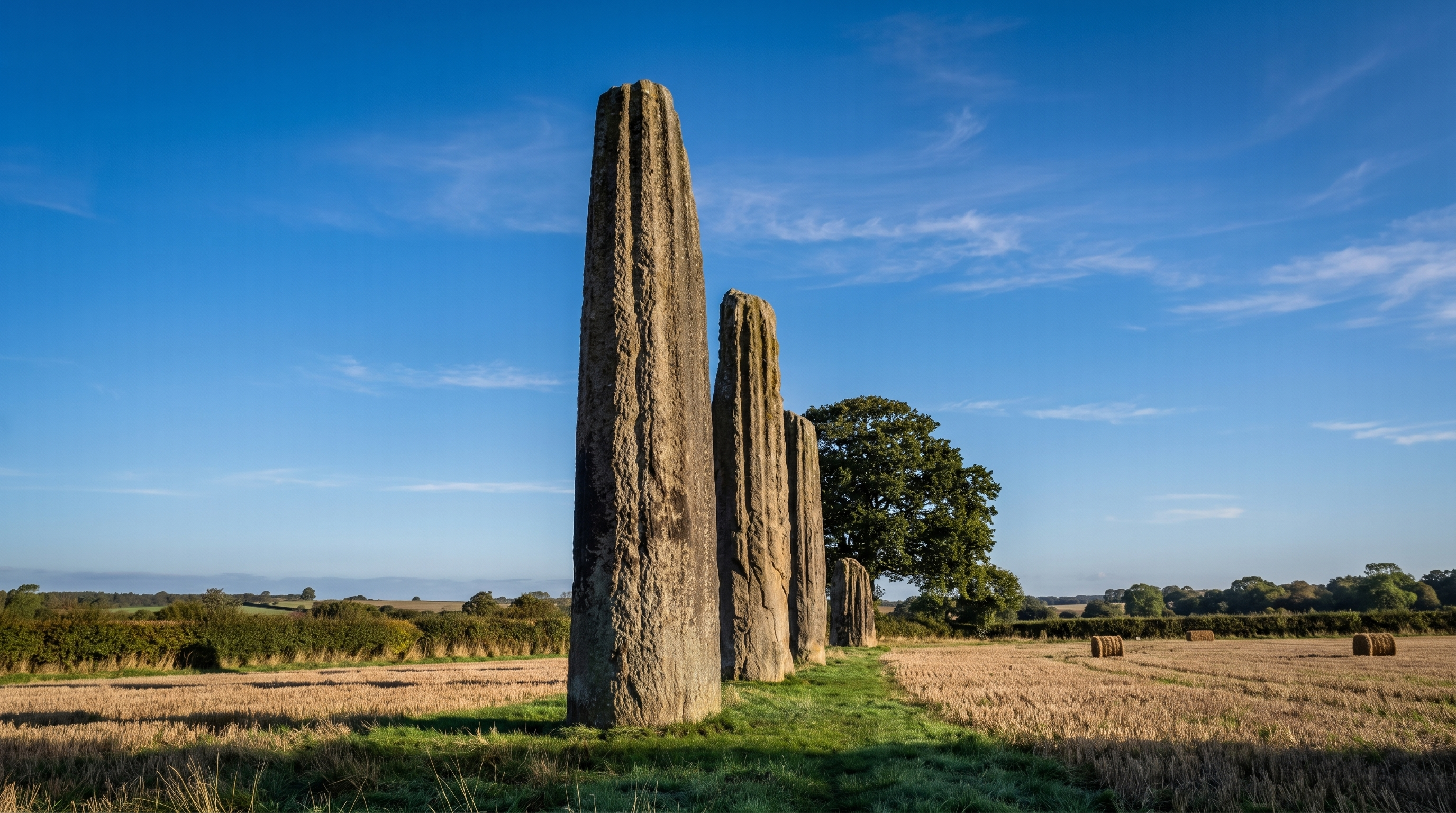
On the edge of Boroughbridge, a small market town in North Yorkshire, England, three huge grey-brown stones rise out of a field beside a roundabout. Cows sometimes graze near their bases. Rain has carved deep grooves down their sides, and from a distance they look less like monuments and more like the ribs of a shipwreck stranded on dry land. Locals call them the Devil's Arrows, and legend says the devil hurled them at a nearby church and missed. For more than a century, archaeologists had a good guess about where the rock came from. That guess was wrong.
Reading a Rock's Fingerprint
To figure out where a stone this size actually came from, you cannot exactly cut a piece off and ship it to a lab, not from a protected ancient monument. So a team from Curtin University in Australia and the University of York in England used a gentler trick. They pressed sticky tape onto the stones' weathered surfaces to lift off tiny mineral grains called zircon and apatite. These grains formed deep underground over millions or even billions of years, and their exact age works like a fingerprint tied to one patch of ground. By comparing that fingerprint to rock at possible source sites, the team, led by geologist Anthony Clarke, could tell which quarry the Devil's Arrows had actually come from. Their findings were published in the journal Proceedings of the Royal Society A. If monuments like this one interest you, a build-your-own miniature Stonehenge kit is a small hands-on way to explore how ancient stone monuments were assembled.
The Stones Skipped Their Closest Neighbor
For over a hundred years, the leading guess was Plumpton Rocks, an outcrop close to Boroughbridge. The fingerprint test said no. The real source was Brimham Rocks, a dramatic cluster of wind-carved boulders about 18 kilometers, roughly 11 miles, to the west, a noticeably longer haul than the nearer option would have required. Each of the three surviving stones weighs more than 25 tonnes, about as heavy as four adult elephants stacked together, and the tallest stands nearly 7 meters high, about as tall as a two-story house. Moving that much stone that far, without wheeled carts and without draft animals bred for hauling loads, would have taken serious planning and a lot of people pulling together.
Why Not Take the Easy Option?
Enjoying this story?
Get a short teaser by email whenever we publish something new. No spam.
This is the part that puzzled the researchers most. The team also checked whether the stones might have arrived near Boroughbridge naturally, dragged there by glaciers during an ice age and simply picked up nearby. The pattern of ancient ice flow across the region ruled that out too. Someone chose Brimham Rocks specifically, walked or scouted past closer stone, and decided it was worth the extra distance. As Clarke put it, the location the stone came from "likely held meaning" for the people who built the monument, beyond simple convenience. That is a strange thing to imagine: a work crew four thousand years ago passing a perfectly good quarry to keep hauling a 25 tonne block another several kilometers, because the place it came from mattered as much as the stone itself.
Two Different Questions About Age
It helps to keep one thing separate here. The study figured out where the rock came from, not exactly when the stones were stood upright. Researchers estimate the Devil's Arrows were raised sometime in the Late Neolithic or Early Bronze Age, with many favoring a date around 2000 BCE, though other estimates for that broader period range from about 2500 to 1000 BCE. The quarry itself, and the mineral grains inside it, are far older than any of that, older than humans by a long stretch. The new discovery is about geography, not a new birthday for the monument.
A Fourth Arrow, Long Gone
Only three stones stand today, but records say there used to be a fourth. A 16th century writer named John Leland described it still standing. By the end of that same century, another visitor found it lying on the ground. Sometime after that it was broken up, and one piece reportedly went into the foundation of a bridge over a local river in 1621, according to the Historic England listing for the site. So even after the builders went to all that trouble to bring the stone from Brimham Rocks and stand it upright, one of their four arrows eventually got dismantled and repurposed by people who had no idea what it once meant.
Nobody currently knows exactly why Brimham Rocks was worth the extra distance when closer stone sat right there. Was it the color of the rock, its height on the landscape, a story tied to that specific hill, or something else that has not survived in any record. The stones can still be visited today, standing in that field outside Boroughbridge, and for now that question is one they are keeping to themselves.
Sources
- Britain's Tallest Standing Stones Traced to Their Geological Source | Sci.News, https://www.sci.news/archaeology/devils-arrows-source-15054.html
- Devil's Arrows: Ancient builders hauled 55,000-pound stones 11 miles for Britain's tallest stone row | ScienceDaily, https://www.sciencedaily.com/releases/2026/09/260909005152.htm
- Stone alignment west of Boroughbridge known as the Devil's Arrows | Historic England, https://historicengland.org.uk/listing/the-list/list-entry/1014705
- Deliberate prehistoric sourcing of the Devil's Arrows, Britain's tallest stone row | Proceedings of the Royal Society A, https://royalsocietypublishing.org/rspa/article/482/2345/20260504/483254/Deliberate-prehistoric-sourcing-of-the-Devil-s