Somewhere Under This Valley There May Be a Sleeping Giant
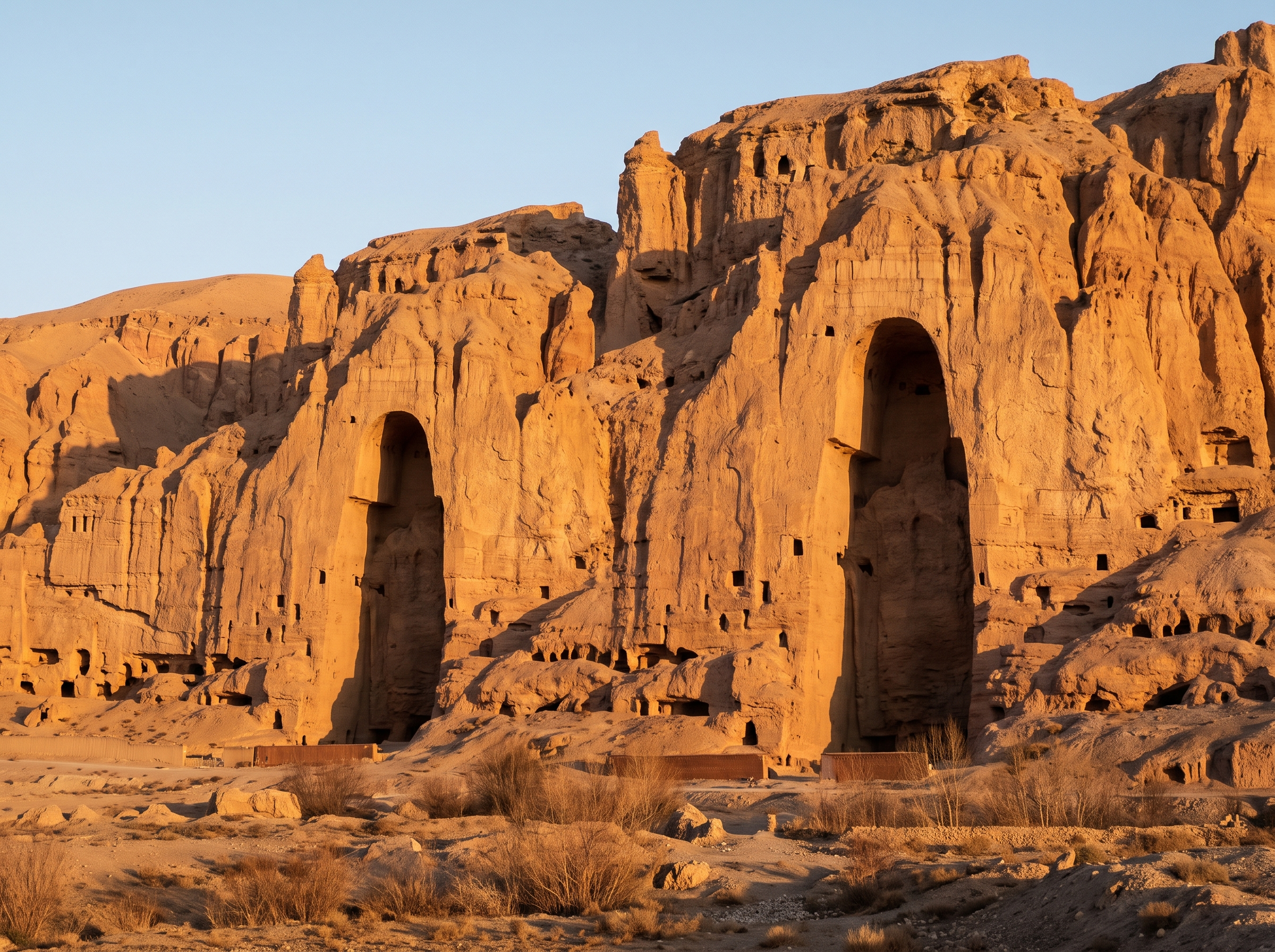
AI-generated illustration
A seventh-century monk described a reclining Buddha hundreds of metres long in the Bamiyan valley. One archaeologist has spent decades looking for it.
This article contains affiliate links. If you buy through them, we may earn a small commission at no extra cost to you.
Around 630 CE a Chinese Buddhist monk named Xuanzang walked into the Bamiyan valley in what is now central Afghanistan. He was sixteen years into a journey that would last nineteen, and he wrote down what he saw.
He described two colossal standing Buddhas cut into the cliff. Those existed. The world watched the Taliban destroy them over several weeks in early 2001.
Then he described a third.
What the monk wrote
In the account compiled in 646 CE as the *Great Tang Records on the Western Regions*, Xuanzang placed a monastery twelve or thirteen *li* east of the city. Inside it, he wrote, was a figure of the Buddha lying down as if asleep, in the posture of entering nirvana.
He gave its length as about a thousand feet. That is roughly 300 metres.
If it existed as described, it was larger than anything of its kind ever built, and nothing like it has ever been found. Bamiyan was not a remote outpost but a major hub of Buddhist learning on the Silk Road, drawing monks and pilgrims from as far as China.
The man who went looking
Zemaryalai Tarzi was Afghanistan's Director of Archaeology in the 1970s. He spent three decades studying Bamiyan and personally reinforced the two standing Buddhas with steel to protect them. He fled the Soviet invasion in 1979.
Twenty-three years later, after the Taliban were driven out in late 2001, he came back and started digging.
The statues he had protected were gone. So he began searching for the one he had never seen.
What was actually found
In the summer of 2008, Tarzi's French-Afghan team uncovered a reclining Buddha within the foundations of a Buddhist temple less than two kilometres from the empty niches.
Enjoying this story?
Get a short teaser by email whenever we publish something new. No spam.
It is real, and it is a genuine find. It is also 19 metres long.
That is a large statue by any ordinary standard and a very small one against a thousand feet. The head and other parts were largely destroyed, possibly by invaders in the ninth century. Tarzi was explicit about what it was and was not: this was found in the eastern temple where he had been excavating for seven years, he thought there could be more reclining Buddhas like it, and he was still looking for the 300-metre one.
He has never found it. As of the most recent reporting, nobody has.
Three possibilities, and none of them is silly
The first is that it is still there. Bamiyan's valley floor has accumulated metres of sediment over fourteen centuries, and the region has been dug, looted and fought over without systematic survey. Something very large could be under it.
The second is that Xuanzang exaggerated, or that his measurement was garbled in transmission or translation. Ancient travel accounts routinely inflate dimensions, and a figure like "a thousand feet" has the shape of an impression rather than a measurement.
The third is that the statue existed and was destroyed long ago, leaving nothing coherent enough to recognise. Mud-brick and plaster colossi do not survive neglect the way carved cliff faces do.
There is a fourth reading that specialists take seriously: that Xuanzang described something he was told about rather than something he measured, which would make the account accurate as a report and wrong as a survey.
Why keep digging
Because the rest of the valley keeps producing. Tarzi's excavations have turned up Buddha heads more than 1,500 years old, the feet of half a dozen standing statues in the Eastern Monastery, and clay sculptures now being restored for Afghan museums.
Tarzi's own stated reason for the work was not the giant. It was that these objects give Afghans a way back to their own history after decades in which that history was bombed, looted and denied.
The sleeping Buddha may be a mirage in a seventh-century manuscript. It is also the only reason anyone was digging in the right place.
Sources
- Archaeologists Find Giant 'Sleeping' Buddha In Afghanistan | RFE/RL
- Afghanistan: Archeologist Hunts For Third Bamiyan Buddha | RFE/RL
- Could There be a Third Bamiyan Buddha, Hidden for Centuries? | Ancient Origins
- Archaeologists search for Afghanistan's third giant Buddha (National Geographic via Buddhist Channel)