Scanners just picked up signs of a hidden passage behind the most famous tomb on Earth. Where does it lead?
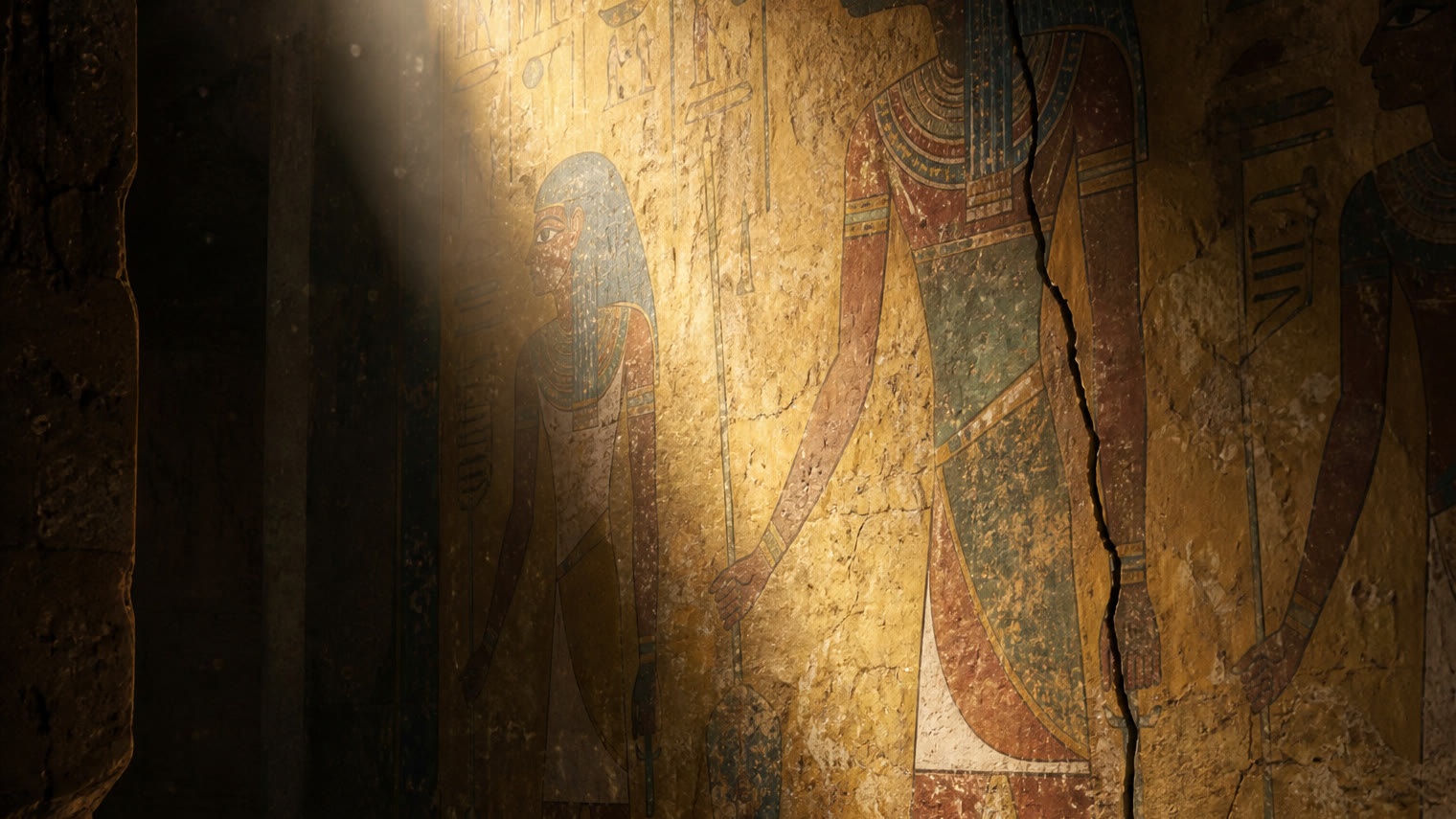
AI-generated illustration
A buried corridor, a missing queen and a ten-year scientific fight. New scans around King Tut's tomb have reopened one of archaeology's biggest arguments.
This article contains affiliate links. If you buy through them, we may earn a small commission at no extra cost to you.
Most people picture Tutankhamun as a single object: the shining gold face you have seen on a thousand posters. That famous golden mask came out of a tomb in Egypt's Valley of the Kings that Howard Carter opened in November 1922, more than a hundred years ago. For a century, that tomb has been treated as a finished story. Now a team of scientists says the walls may not be the end of it.
In September 2026, researchers reported that the ground right next to the tomb shows something shaped like a corridor. It is about two meters wide, roughly the width of a parked car, and it seems to be stuffed with rubble. Where it goes, nobody knows yet. One member of the team has a very bold guess.
What the scanners actually found
The team did not dig. Instead, they "listened" to the rock in three ways, as Nature reported in an exclusive. First, they used ground-penetrating radar, which works a bit like a bat's echo: it sends signals into the rock and records what bounces back. Second, they took more than 1,200 tiny gravity readings over an area of about 35 square meters, around the size of a small one-bedroom apartment. Empty or loose spaces weigh less than solid rock, so they pull very slightly less. Third, they went back to electrical measurements a different team had collected in 2017 and looked at them again.
Put together, the data shows low-density shapes with straight edges and right angles lined up with the tomb's north wall. Rock does not usually crack into neat rectangles, which is why that detail matters. One spot, which the team calls Anomaly 7, looks like a mostly hollow zone with a denser square area inside. Another possible room may sit just west of the burial chamber.
The work was led by Mamdouh Eldamaty of Ain Shams University in Cairo, a former Egyptian antiquities minister. The results were analysed by structural engineer George Ballard of the GBG Group, and the team includes British Egyptologist Nicholas Reeves. The paper appeared on 17 September 2026 in the Occasional Papers of the Amarna Royal Tombs Project. That is important to know: it is a specialist paper series, not a peer-reviewed journal, so outside experts have not formally checked it before publication.
Why the tomb looks too small for a king
To see why this matters, you need to know one strange thing about King Tut's resting place, known to archaeologists as KV62. It is small. Egypt's own Ministry of Tourism and Antiquities describes it as "quite modest compared to the other tombs" in the valley. On a map of ancient Egypt, the Valley of the Kings is a tiny dot near Luxor, but it holds dozens of tombs, and the royal ones are often far bigger. The roughly 5,000 objects inside, about as many as the books in a small school library, were stacked tightly, like a moving van packed by someone in a hurry.
The usual explanation is simple. Tutankhamun became king as a child and ruled for only about nine years, then died young. Many scholars think his builders grabbed a smaller tomb that already existed, maybe one made for a non-royal person, and enlarged it quickly. Some suggest a bigger tomb meant for him went to his successor, Ay.
That is the "normal" story. Nicholas Reeves, a British Egyptologist who has written about Tut's tomb for decades, has a more dramatic one.
The big idea: a queen behind the wall
In 2015, Reeves studied very detailed wall scans made by the art-replica workshop Factum Arte. He thought he saw faint straight lines in the painted plaster, the kind of ghost outlines that could mark sealed doorways. His theory: KV62 is not a small tomb at all. It could be just the outer part of a much larger tomb, built for someone more important, with Tut squeezed into the front rooms.
His candidate is Nefertiti, the powerful wife of the pharaoh Akhenaten, who may have been Tut's stepmother. Her painted bust in Berlin's Neues Museum is one of the most recognizable faces from the ancient world, and a Nefertiti bust replica still sits on shelves around the planet. Yet her burial place has never been identified. If Reeves is right, the most famous missing queen of Egypt could have been lying a few meters from the most famous tomb for all this time.
That is the twist, and it is a big "if." Reeves is part of the team making the new claim, so his hopes and the data come from the same group. Other members of the team are more careful. Ballard said they were "looking at the very limits of detection," according to ZME Science. In plain words: there is a signal, but it is faint.
A ten-year radar fight
Enjoying this story?
Get a short teaser by email whenever we publish something new. No spam.
This is not the first time scanners have promised a secret room. This one small tomb has produced one of archaeology's longest arguments.
In November 2015, Japanese radar specialist Hirokatsu Watanabe scanned the burial chamber and reported signs of empty spaces behind the north and west walls. Excitement exploded. In 2016, a second radar team backed by National Geographic could not repeat his results. Then in 2018, a team from the Polytechnic University of Turin led by physicist Franco Porcelli spent about three years on the most thorough radar study yet. Their conclusion, reported by NPR, was that hidden chambers were "not supported" by the radar data, with "a very high level of confidence."
So why try again? The new team argues that earlier scans mostly hunted for large empty rooms right behind the painted walls. A corridor packed with rubble is much harder to spot, because loose stone does not look very different from solid rock to a radar beam. Think of trying to find a hallway filled with sand by knocking on the wall: you would not hear the hollow sound you expect. The team also scanned from outside, above the rock, instead of only from inside.
What the doubters say
Not everyone is convinced. Christopher Gaffney of the University of Bradford called the findings "fascinating" but said, in comments reported by Nature, that they do not provide enough information for firm conclusions. Peter Styles of Keele University said the chambers are "plausible" but wanted to see more detail.
That caution is fair. Rock in the Valley of the Kings is full of natural cracks and layers, and geophysics can only say that something is less dense, not what that something is. A rubble-filled natural fissure and a man-made passage can look alike in gravity data. Also, the 2018 Turin scan was careful and well respected. Any new claim has to explain why earlier work missed this, and the paper has not yet gone through formal peer review.
Why should you care? Because this is how science is supposed to work in public. One group sees a pattern, others push back, and the only real judge is a direct look.
How they want to check it
The team has a plan that avoids smashing Tut's painted walls. According to Ballard, they would drill a few narrow holes from the surface, each about seven to eight centimeters across, a bit wider than a tennis ball. If a hole breaks into an open space, tiny remote-controlled vehicles carrying 360-degree cameras could roll inside and film. It is a little like the gentle digging in a kids' Egypt dig kit, only with far higher stakes.
Nothing can happen without permission from Egypt's Supreme Council of Antiquities. Ballard has said the work could start as early as November 2026 if approval comes. That is a possibility, not a promise. Egypt has been careful with KV62 before, and a no, or a long delay, would not be surprising.
What would be at stake
If the camera finds only rubble and bare rock, the mystery of the small tomb goes back to its quiet, ordinary answer. That would still be useful, because it would end a decade of guessing.
If it finds a sealed room, the story changes. An intact royal burial from Tut's era would probably be the biggest find in Egypt since 1922. It could tell us who Nefertiti really was, how the royal family around Tutankhamun handled a religious revolution and its collapse, and why the young king ended up in such a cramped grave. And even a room without Nefertiti would show that the most studied tomb on Earth still had secrets.
For now, the honest answer to "where does it lead?" is: nobody knows. The scanners see a shape. Only a camera can see a door. So what would you bet on: rubble, an empty room, or a queen who has been waiting 3,300 years?
Sources
- Nature: Exclusive: New evidence for hidden chambers beyond Tutankhamun's tomb
- ZME Science: Hidden Chambers Near King Tut's Tomb Could Lead to Nefertiti
- Archaeology Magazine: New scans point to possible hidden chambers beyond Tutankhamun's tomb
- NPR: In King Tut's Tomb, Hope For Hidden Chambers Is Crushed By Science (2018)
- National Geographic: Tut's Tomb Radar Scan Proves There Are No Hidden Chambers
- Egypt Ministry of Tourism and Antiquities: Tomb of Tutankhamun
- Factum Arte: Nicholas Reeves's hypothesis, Nefertiti: A possible discovery?