Yellowstone, One of America's Most Dangerous Volcanoes, Isn't Powered by Heat
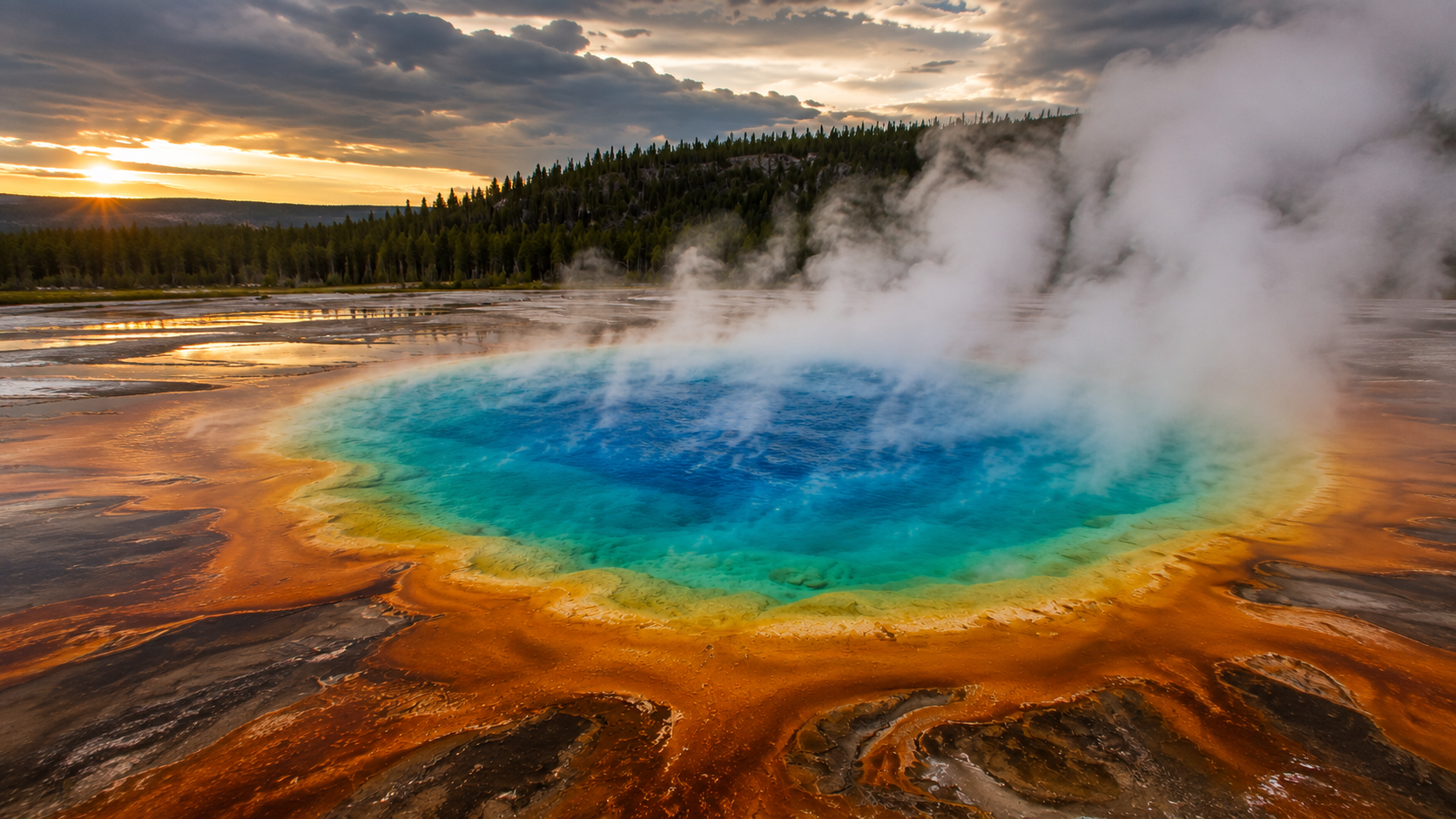
Illustration by Domi Verse X
For fifty years the answer was a plume of hot rock rising from deep inside the Earth. A 2026 study says it may never have been there.
This article contains affiliate links. If you buy through them, we may earn a small commission at no extra cost to you.
# Yellowstone, One of America's Most Dangerous Volcanoes, Isn't Powered by Heat
Close to five million people walked through Yellowstone National Park in each of the last two years to watch Old Faithful blast boiling water into the sky, snap photos of bubbling hot springs, and stand next to steaming ground in the middle of a Wyoming forest. Almost none of them think about what that means. All of that heat is coming from somewhere, and the "somewhere" is one of the biggest volcanoes on the planet, sitting quietly under their feet.
For about fifty years, scientists thought they knew exactly where that heat came from. A study published in 2026 says they were probably wrong about the most basic part of the story: not whether Yellowstone is dangerous, but what is actually feeding it.
This isn't a normal volcano
Picture a normal volcano and you probably imagine a mountain with a hole in the top, throwing lava a few hundred meters into the air. That's a volcano. Yellowstone is a supervolcano, and the difference isn't size, it's scale. A regular eruption can flatten a town. Yellowstone's last big eruption, around 631,000 years ago, threw out enough ash to blanket much of North America and left behind a crater roughly 80 kilometers long, so huge that you can't even see its edges from the ground. You'd need a plane and a map to notice you were standing inside a crater at all.
That eruption is also why the park looks the way it does today. All those hot springs and geysers exist because there is still an enormous amount of heat sitting close to the surface, left over from a volcanic system that never really turned off.
The old story: a straight pipe from deep inside the Earth
Here's what scientists believed until recently. Almost 2,900 kilometers straight down, roughly 260 times deeper than the ocean's deepest point, there's a boundary where the Earth's rocky mantle meets its metal core. The old theory said a column of superheated rock rises from around there, in one continuous pipe, all the way up toward the surface, like a blowtorch that never moves. North America has been sliding slowly over the top of that fixed blowtorch for millions of years, which is why there's a trail of old, dead volcanic craters running in a line across Idaho before it reaches Yellowstone today.
That part is real. You can drive across that trail of old craters. What scientists are no longer sure about is the blowtorch itself.
The new discovery: a wind, not a pipe
The 2026 study, led by researchers at the Chinese Academy of Sciences, argues that Yellowstone isn't sitting on top of a rising column from deep inside the planet at all. Instead, the heat comes from something much closer to the surface: a slow, sideways current of hot rock, more like a wind blowing sideways underground than a flame shooting straight up.
This "wind" moves unbelievably slowly, likely no faster than your fingernails grow, through a layer of the Earth called the asthenosphere, roughly the top 100 to 200 kilometers of the mantle, where rock is hot enough to flow a little like thick honey without ever actually melting into liquid. According to the study, this current has been drifting eastward for millions of years, dragged along by the sinking remains of an ancient ocean plate that disappeared under North America long before humans existed.
When that slow-moving current runs into the unusually thick chunk of solid rock sitting underneath Yellowstone, it can't get past. It gets shoved downward and squeezed sideways instead, at a slant, like a rug bunching up against a wall. And here's the part that surprised the researchers: rock doesn't need to get hotter to melt when that happens. It just needs the pressure on it to drop. Think of cracking open a can of soda: nothing about the liquid gets hotter when you open it, but the sudden drop in pressure makes it fizz instantly. Geologists call this decompression melting, and the study argues it's doing most of the real work under Yellowstone, not heat rising from near the planet's core.
Enjoying this story?
Get a short teaser by email whenever we publish something new. No spam.
Not a lake of lava, more like a slushie
There's a second myth this research chips away at too: the idea of Yellowstone sitting on top of one giant underground lake of liquid lava, like something out of a disaster movie. Earlier scans of the crust beneath the park, using instruments sensitive to how melted rock messes with Earth's natural magnetic field, already showed that what's down there is mostly a "mush," a mix of solid and partly melted rock, more like a thick slushie than a swimming pool of lava. This new study adds to that picture: instead of one tank sitting on top of one pipe, there's a slanted, connected system of slushy rock running from deep underground up toward the shallower pockets that feed the park's geysers and hot springs.
So is it about to erupt?
No, and the scientists who watch Yellowstone for a living are very direct about that. The U.S. Geological Survey puts the odds of any eruption at Yellowstone in a given year at roughly 1 in 100,000, and says current monitoring shows no signs that anything is building toward one. They've also pushed back on the popular idea that Yellowstone is "overdue," pointing out that volcanoes don't work on a fixed countdown the way library books or oil changes do. This new discovery changes the story of how Yellowstone's magma is made. It doesn't move up the timeline for what happens next.
What still doesn't add up
What the 2026 study really does is take away Yellowstone's simplest explanation. For fifty years, people were told a fixed torch from deep inside the Earth was slowly burning its way toward Wyoming. If that torch was never really there, and the real story is a slow underground wind nobody could see or feel, it raises an uncomfortable question about every other famous "hotspot" volcano on Earth explained the exact same way. If Yellowstone's real story turned out to be tectonics wearing a plume's costume, how many of the others are wearing one too?