A Volcano Grounded 270,000 People. 8 Airports Went Dark
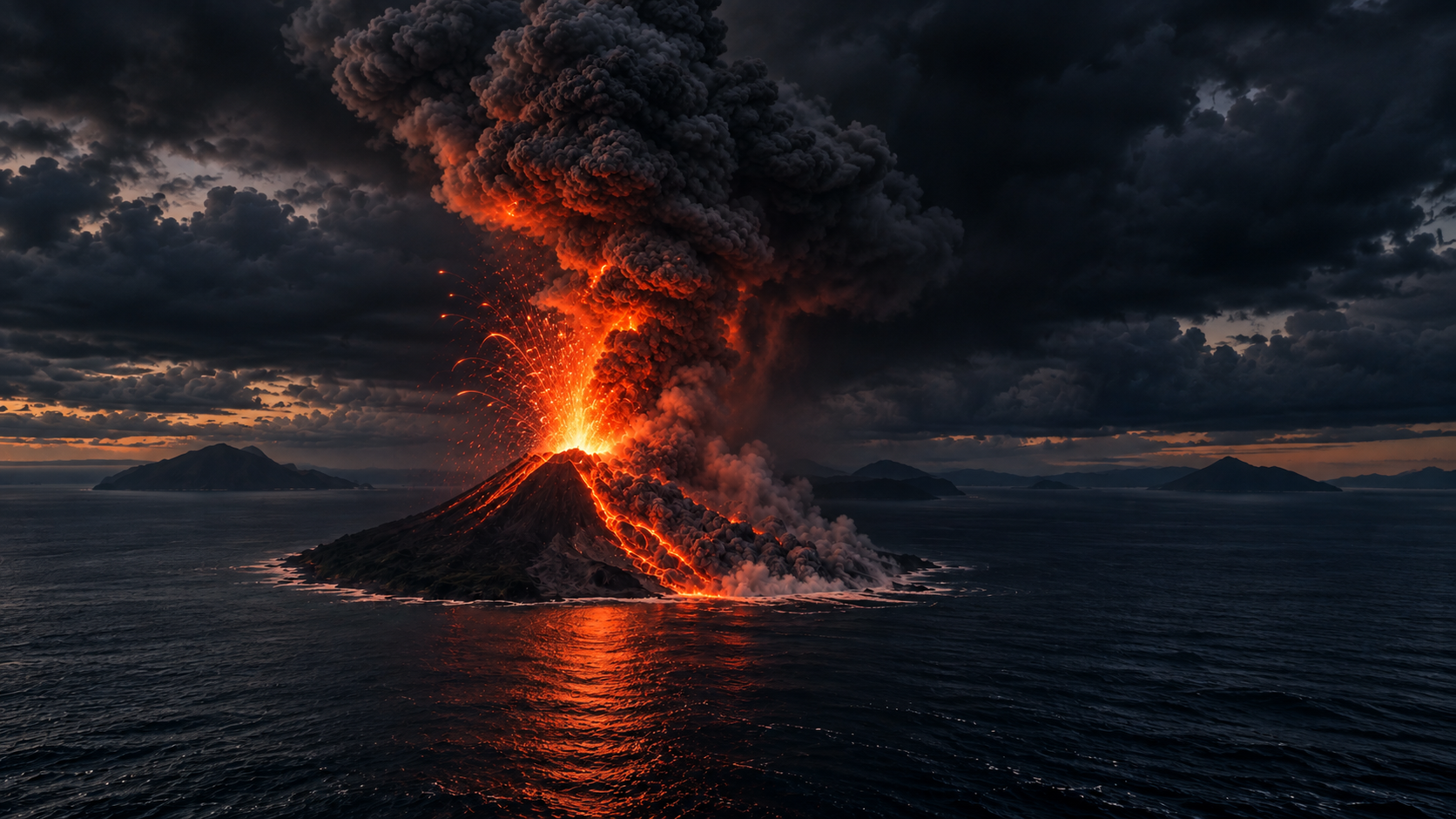
Illustration generated with AI for Domi Verse X
Every plane was working perfectly. Not one of them was allowed to move.
This article contains affiliate links. If you buy through them, we may earn a small commission at no extra cost to you.
Anak Krakatau erupted in the small hours of Saturday 5 September 2026, and by the following morning the floor of Indonesia's busiest airport looked like a campsite. People were lying against their suitcases in the departure hall at Soekarno-Hatta, phones plugged into every socket they could find, waiting for an announcement that kept not coming. Outside, the runways were empty and the sky looked hazy but otherwise ordinary. Nothing was on fire. Nothing was broken. Every plane worked perfectly.
And not one of them was allowed to move.
Within two days of the eruption, Indonesia's transport ministry counted more than two hundred and seventy thousand stranded passengers across eight closed airports, with roughly one and a half thousand flights delayed or cancelled. That is more people than live in most European cities, all sitting in terminals at the same time, because of a mountain in the sea about one hundred and fifty kilometres away.
What actually came out of the mountain
The mountain is Anak Krakatau, sitting in the Sunda Strait between Java and Sumatra. It has been restless since early July, when Indonesian authorities raised it to alert Level III. Then, in the small hours of Saturday 5 September, it did something much bigger.
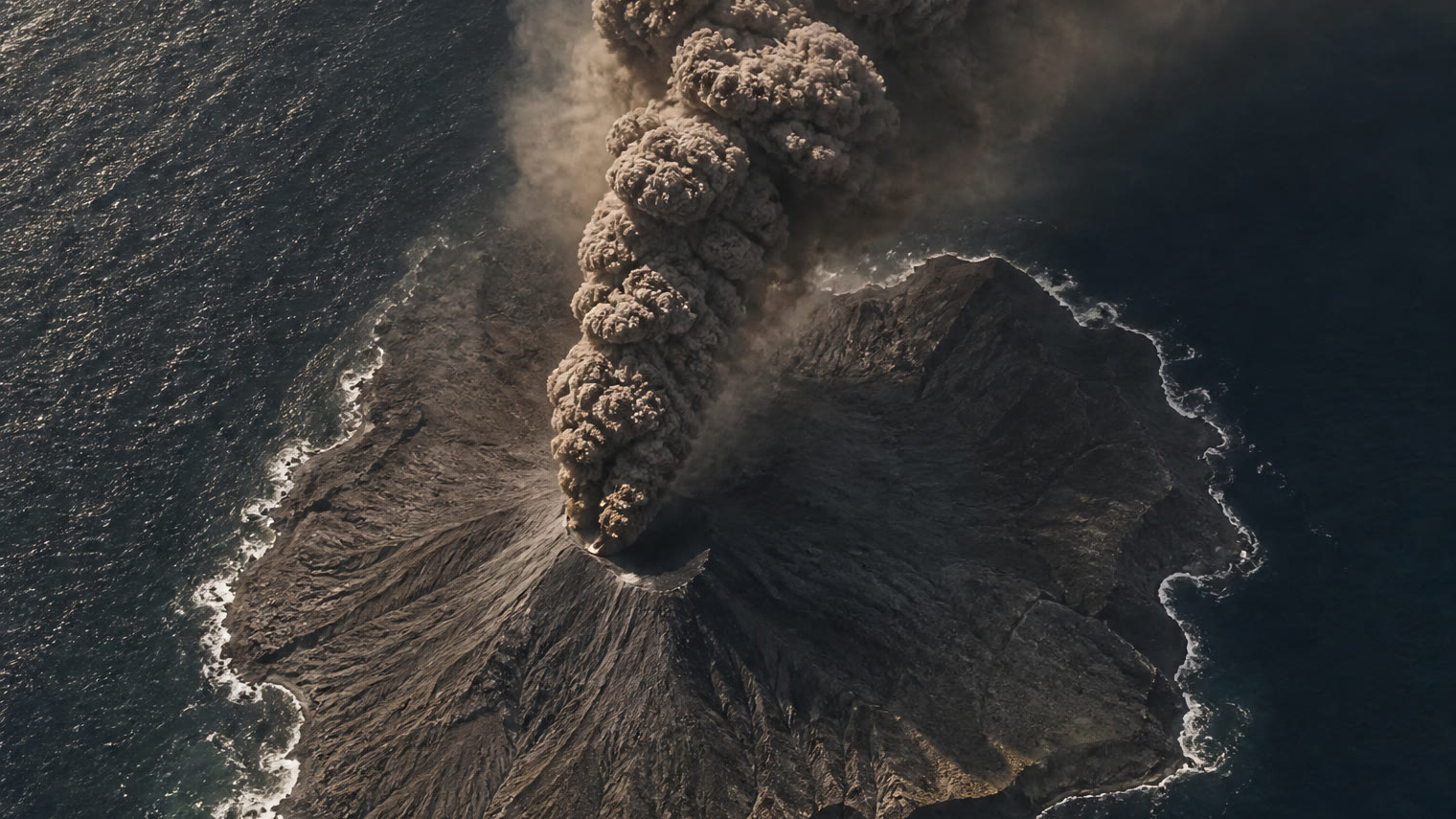
The Darwin Volcanic Ash Advisory Centre, which watches this part of the sky for aviation, tracked an ash column reaching roughly fifteen kilometres above sea level. To put that in everyday terms, a passenger jet cruises at about eleven kilometres. The ash went up past the height where planes live, and then it started to travel sideways at around seventy kilometres an hour, which is motorway speed.
On the ground it was less dramatic and more miserable. Indonesia's meteorology agency told people in the affected areas to wear masks outdoors, schools cancelled activities, and residents reported eye irritation. If you have ever lived through a bad wildfire season, you already know this drill, and you probably already own the answer: a proper N95 respirator does far more against fine mineral particles than a cloth mask, which is essentially a scarf with ambition.
The eye problem is the one people underestimate. Volcanic ash is not soft. Sealed safety glasses with a foam gasket exist for exactly this reason, and they cost less than an airport sandwich.
Then the wind turned. Transport Minister Dudy Purwagandhi explained that the plume had been drifting west during the day and then swung east instead, at about five knots, which is why closures kept getting extended in four hour increments rather than lifted. Nobody could promise an end time, because nobody controls the weather.
Whose child this is
The name Anak Krakatau means "child of Krakatau," and the parent is the reason the name still makes people flinch.
In August 1883, the original Krakatau destroyed itself in an explosion that killed roughly thirty six thousand people, almost all of them by tsunami rather than by the eruption. The sound is usually described as the loudest in recorded history, reportedly audible around four thousand eight hundred kilometres away, which is roughly the distance from London to Khartoum. If you want the full story told properly, Simon Winchester's book on the 1883 eruption is the standard popular account and reads like a thriller.
The child arrived quietly. Underwater eruptions began in the same collapsed crater in late 1927, and the new cone broke the surface and kept building until it reached about three hundred and thirty three metres, roughly the height of the Eiffel Tower. Then in December 2018 its southwestern flank slid into the sea, halving the island and generating a tsunami that killed four hundred and thirty seven people.
So this is a volcano that has been growing, collapsing and regrowing within living memory. Indonesia's disaster agency has said there is no imminent tsunami risk from the current activity, and PVMBG ended the alert for the twenty five hour continuous eruption while keeping Level III and a three kilometre exclusion zone in place.
None of which explains the airports. Tsunami risk does not close a runway one hundred and fifty kilometres inland.
Ash is not smoke
Here is the part almost everyone gets wrong, including people who have flown through smoke haze and assumed this is the same thing.
Smoke is mostly soot and unburnt carbon: soft, light, and largely harmless to an engine in the quantities you would meet in the air. Volcanic ash is not burnt anything. It is rock. When gas dissolved in magma expands violently, it shatters the molten rock into billions of microscopic fragments, and what falls out of the sky is pulverised stone and volcanic glass, generally under two millimetres across, with edges sharp enough to scratch a windscreen opaque.
Enjoying this story?
Get a short teaser by email whenever we publish something new. No spam.
That difference alone would be a nuisance. It sandblasts paint, clouds landing lights, and clogs the small tubes that tell the pilot how fast the aircraft is going.
But the real problem happens inside the engine, and it is a coincidence of two numbers.
The temperature coincidence
The glassy silicate in volcanic ash melts at roughly eleven hundred degrees Celsius, while the core of a modern jet engine runs at around fourteen hundred.
Sit with that for a second. The engine is hotter than the ash's melting point. So an engine does not simply ingest ash the way it ingests dust. It melts it.
The molten material is then thrown backwards onto cooler parts of the engine, where it does the obvious thing: it solidifies again. Now there is a layer of glass on the turbine blades and in the cooling passages, narrowing the gaps the air has to flow through. Airflow drops. Thrust drops. If enough of it builds up, combustion stops altogether, which pilots call a flameout.
An engine that has been running perfectly for ten thousand hours can do this in a couple of minutes. And the aircraft has no reliable way to see it coming, because weather radar is built to detect water droplets. Dry ash is not water. The radar looks straight through it, and on a dark night the cloud is invisible to the eye as well.
The night a 747 became a glider
This is not theoretical, and it happened over this same country.
On 24 June 1982, British Airways Flight 9, a Boeing 747 with two hundred and sixty three people aboard, was cruising at thirty seven thousand feet between Kuala Lumpur and Perth. Passengers noticed the engines glowing an odd blue and a smell like sulphur in the cabin. Then engine four surged and quit. Within about a minute, so did the other three.
The crew had flown into an ash cloud from Mount Galunggung, around one hundred and eighty kilometres southeast of Jakarta, and had no idea, because the radar showed clear sky. They worked out that the aircraft could glide for roughly twenty three minutes and cover about one hundred and sixty nine kilometres, and they pointed it at Jakarta.
They got the engines restarted on the way down. The windscreen had been sandblasted so badly that the captain landed largely on instruments. Everybody survived.
That flight is the reason volcanic ash advisory centres exist at all, and it is the reason nobody in Jakarta this weekend was willing to gamble on a runway that had tested positive for ash. The eight closures were not caution for its own sake. They were the direct descendant of a night when four engines went quiet over Java.
What happens next is a wind question
In the days after 5 September, some airports reopened in stages while others extended closures again, and backlogs were expected to ripple through schedules for days even after the sky clears. Anak Krakatau remains at Level III, and PVMBG has said further eruptions in the near term are possible.
Which leaves an odd situation. The volcano itself may calm down. The exclusion zone is only three kilometres wide. And yet the thing that decides whether hundreds of thousands of people get home this week is not the mountain at all.
It is which way the wind happens to be blowing at fifteen thousand feet.
Sources
- Al Jazeera, Thousands stranded as Anak Krakatau eruption shutters Indonesian airports
- The Watchers, High-level eruption at Anak Krakatau ejects ash over 15 km
- ABC News, Volcano eruption causes flight suspensions in Indonesia
- Asia News Network, Jakarta airport closure extended as Anak Krakatau eruption disrupts flights
- Jakarta Globe, Anak Krakatau's 25-hour eruption ends, volcano remains on alert
- Gulf News, Why is volcanic ash so dangerous to aircraft?
- Nature Communications, Submarine landslide megablocks show half of Anak Krakatau island failed on December 22nd, 2018
- Britannica, Krakatoa
- Wikipedia, British Airways Flight 009