The wave you are watching is moving, but the water is not.
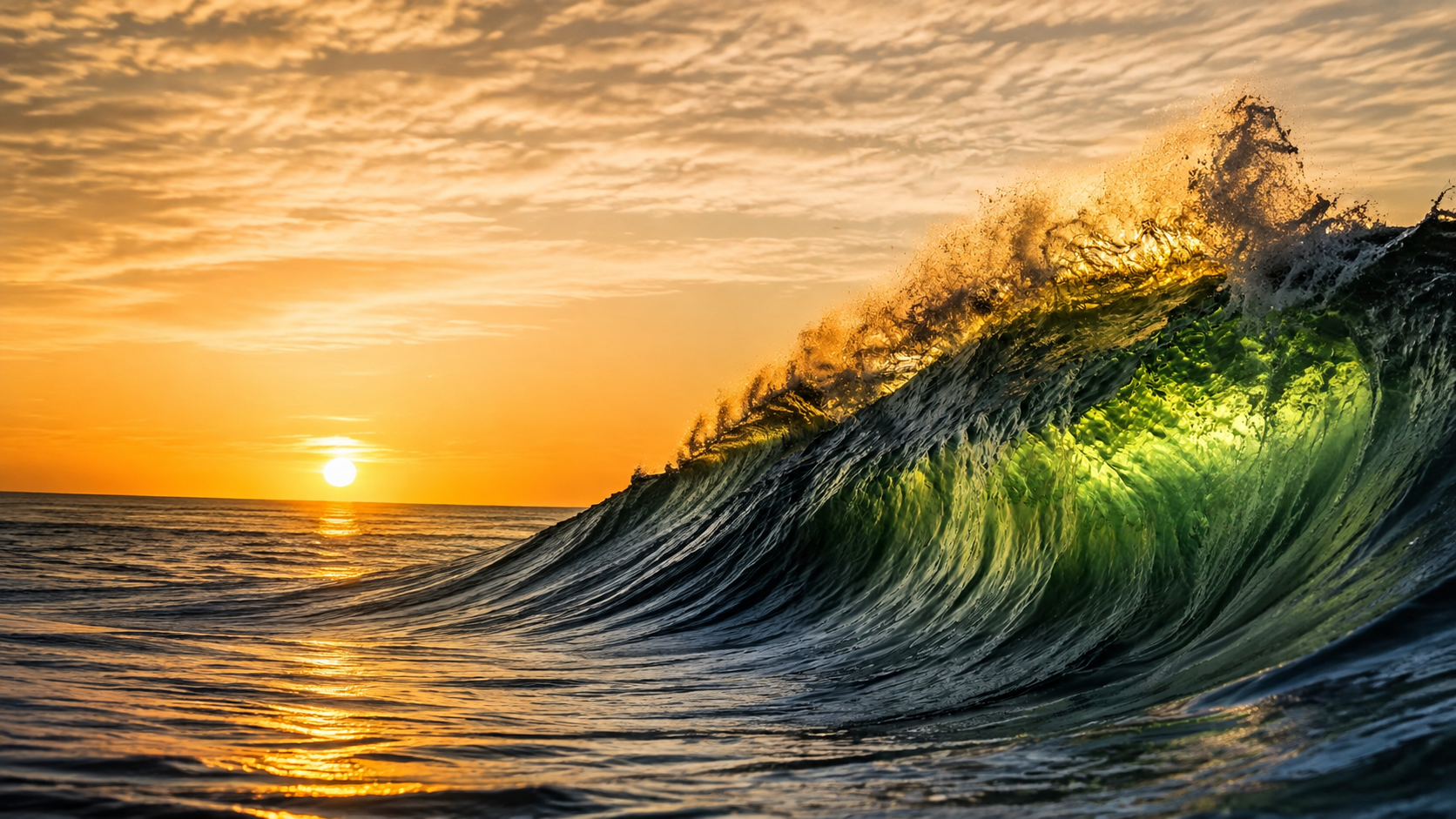
Illustration by Domi Verse X
The sea is not moving toward you. Only the shape is.
This article contains affiliate links. If you buy through them, we may earn a small commission at no extra cost to you.
Stand at the edge of the sea and watch one wave come in. It has a shape, a speed, a direction. It looks like a moving object, the way a car is a moving object. It looks like a piece of the ocean that decided to travel.
It is not. The shape travels. The water does not go with it. This is not a technicality or a clever way of phrasing something, it is the single fact that explains almost everything a wave does, including why it curls forward at the end and why it looks the way it looks. It is also easy to watch happen, which is why desktop wave tanks exist at all: tip one, and you can see the shape run from end to end while the water inside stays roughly where it was.
What a wave actually is
A wave is energy passing through water. The water is the material the energy moves through, not the thing that moves.
When a wave passes, a drop of water near the surface does not slide forward. It goes up and forward as the crest arrives, then down and backward as the trough follows, and it traces a circle. Oceanography textbooks describe this the same way almost word for word: the water of a wave does not travel with the wave, the waveform does, and the energy is handed along by water particles moving in circles below the surface.
You have already seen the proof without noticing it. A seabird sitting on open water bobs up and down as waves pass underneath. It does not get carried along by the crest and dropped at the beach. Neither does a buoy, a raft, or anything else floating out past the surf.
The size of those circles is not random. At the surface, the diameter of the circle is equal to the height of the wave. A 2 meter wave spins the surface water in a 2 meter circle. That is the whole vertical drama of a wave: a circle the size of itself, repeating.
If that is hard to picture, the cheapest demonstration is the sort of sealed liquid paperweight that sits on office desks. Tilt it once and let it settle. The little wave runs back and forth across the whole length of the case, but the liquid ends up at the same level it started at. Nothing was transported. Something was transmitted.
The circles get smaller until they stop
Go down and the circles shrink fast. At a depth equal to half the wavelength, the motion is essentially gone. Oceanographers call that depth the wave base, and below it the water simply does not notice the surface.
This is why divers report the strange calm of being 15 meters down while a boat is being thrown around above them. You do not need tanks to notice it either. A cheap pair of swim goggles and one deep breath is enough: duck under a choppy surface and the violence overhead simply is not there a metre down. It is also a useful sanity check on the whole idea. If a wave were a moving mass of water, it could not switch off at a specific depth like that. A current does not stop just because you went a little deeper. A wave does.
The numbers here are worth holding onto because they are unusually neat. A wave with a 6 meter wavelength has stopped mattering by 3 meters down. A long ocean swell with a 300 meter wavelength still stirs the water 150 meters below the surface, which is deeper than most of the continental shelf. The bigger the wave, the deeper it reaches, in a fixed and predictable ratio.
Then why does anything ever reach the shore?
Here is the objection, and it is a good one. If the water only goes in circles and comes back, nothing should ever wash up. Driftwood should sit offshore forever. Plastic should stay where it fell. Every beach on Earth is evidence against the simple version of the story.
The simple version is slightly wrong, and the correction is the interesting part.
The circles do not quite close. A water particle spends a little more time in the forward moving part of its orbit, underneath the crest, than in the backward moving part underneath the trough. It also does its forward travel higher up, where the motion is stronger. Add those two together and every single orbit leaves the particle a fraction ahead of where it started. Not back at the start. Slightly past it.
That leftover is called Stokes drift, after George Stokes, who worked it out in 1847. The particle paths are not closed loops, they are loops that creep. The size of the creep depends on how steep the waves are, roughly on the square of the steepness, so gentle swell barely drifts anything while a steep confused sea moves things noticeably.
So the honest version of the headline is this: the water does not travel with the wave, but it does not end up exactly where it began either. It ends up almost exactly where it began. The gap between "exactly" and "almost exactly" is what puts things on beaches.
Enjoying this story?
Get a short teaser by email whenever we publish something new. No spam.
The part where this stops being trivia
Stokes drift is not a footnote in a textbook. It is a working number that people calculate when the answer matters.
Search and rescue models for people lost at sea include it, because a person in the water is carried by a combination of current, wind, and this slow wave driven creep, and leaving one of the three out puts the search box in the wrong place. The same maths applies to anything else floating. A dropped phone in a floating waterproof pouch does not sit still waiting to be found, it creeps shoreward with everything else on the surface. Oil spill models include it too. During the Deepwater Horizon spill, Stokes drift is credited with driving much of where the oil actually came ashore.
There is a second consequence, closer to home. All that water creeping shoreward has to go back somewhere, because the beach is in the way. The return flow runs seaward underneath, and that is a large part of what swimmers experience as undertow. The pull you feel dragging at your legs is not the ocean being malicious. It is the bookkeeping of a system that has been pushing water at the sand all day and has to balance the ledger.
This is the sort of thing people who live on a coast learn to read rather than guess at, which is why a tide clock is still a normal object to have on a wall in a fishing town. The sea in front of a house is not the same sea twice in one day, and the people who swim in it every morning tend to know exactly which hour is which.
Why the wave curls forward
Now the shape. Out in deep water, a wave is a smooth rounded hump, close to a sine curve. It only becomes the thing on postcards in the last few seconds of its life, and it does that because of the seafloor.
When the water gets shallower than half the wavelength, the bottom of the wave starts to feel the ground and slows down. The top of the wave does not feel anything and keeps going. The crest gets ahead of its own base, and at some point there is no longer enough water underneath to hold it up. It pitches forward and collapses.
Two rules of thumb tell you when. A wave becomes unstable once its height passes about one seventh of its wavelength. And it generally breaks when it reaches water roughly 1.3 times as deep as the wave is tall, so a 1 meter wave breaks in around 1.3 meters of water. These are engineering estimates rather than laws, and real surf breaks are messier than either number suggests, but they are close enough to explain the beach in front of you.
The shape of the break is a readout of the ground underneath. This is the part a rocking wave tank on a desk cannot show you, because its floor is flat and its wave never trips over anything. A gentle sandy slope slows the wave gradually and gives a spilling breaker, the soft crumbling kind. A steep slope or a shallow reef slows it all at once, the crest outruns the base violently, and you get a plunging breaker with a hollow barrel. The famous waves are famous because of what is on the seabed, not because of the water. Change the bottom and you change the wave. The same swell arriving at two beaches a kilometre apart produces two completely different shapes.
The wave in front of you is not from here
One more thing about the wave you were watching. It probably did not start anywhere nearby.
Wind blowing over open ocean makes a mess: waves of many sizes going in many directions, steep and disorganised. But long waves travel faster than short ones, so as the mess leaves the storm it sorts itself out. The fast long waves run ahead, the slow short ones fall behind, and what arrives at a distant coast days later is a tidy set of similar waves evenly spaced. That sorting is called dispersion, and the tidy result is called swell.
Swell crosses entire ocean basins. In 1963 Walter Munk and colleagues tracked swell across the Pacific using a chain of stations from New Zealand to Alaska and found waves propagating over enormous distances, in some cases something like halfway around the globe, losing surprisingly little energy on the way. A single storm can put waves on a beach a week later and 10,000 kilometres away.
So the clean, evenly spaced set rolling toward you is not local weather. It is the signature of a storm that may have finished days ago and an ocean away, delivered by water that never came with it.
If you want the version of this with ships and surfers in it, and the scientists who chase the biggest waves anyone has ever recorded, Susan Casey's The Wave is the book that made most people care about this subject in the first place.
Pick one wave next time and follow it all the way in. Watch the crest get ahead of its own base at the last second. Once you have seen a wave stop being an object and start being a shape, it is difficult to see the sea the old way again.
Sources
- Waves
- Wave Basics
- Waves on the Shore
- Wave Energy and Wave Changes with Depth
- Understanding Stokes Drift Mechanism via Crest and Trough Phase Estimates
- Stokes drift
- Routine monitoring and analysis of ocean swell fields using a spaceborne SAR
- Dissipative models of swell propagation across the Pacific
- An Operational Search and Rescue Model for the Norwegian Sea and the North Sea
- Horizontal transport in oil-spill modeling