This Might Be the Most Important Discovery About How Life on Earth Began
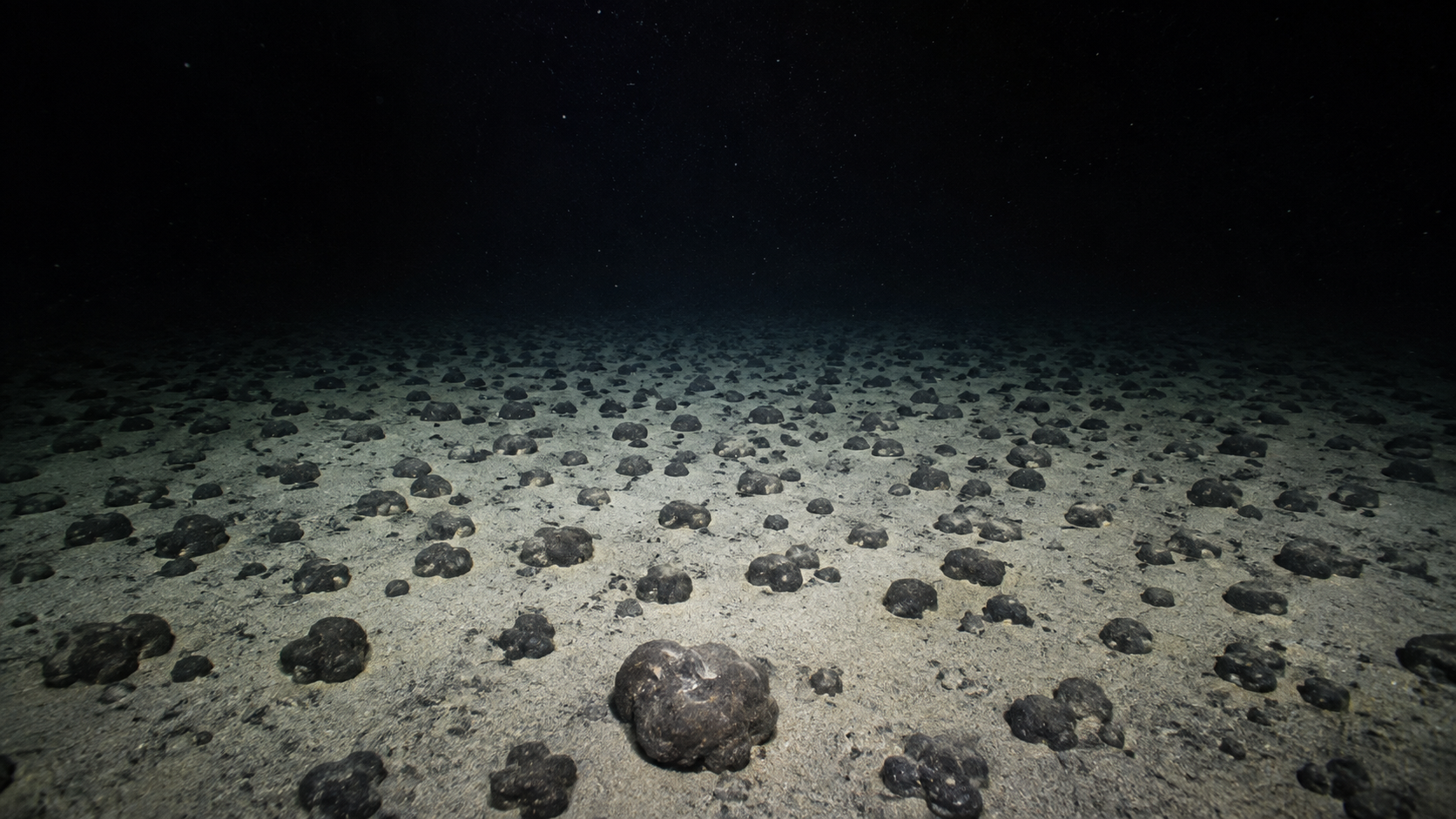
Illustration by Domi Verse X
Deep in the Pacific, oxygen is appearing where nothing alive should be able to make it, and scientists can't agree on why.
This article contains affiliate links. If you buy through them, we may earn a small commission at no extra cost to you.
Four thousand meters down in the Pacific Ocean, there is no sunlight, no plants, and by every rule scientists thought they understood, there should be no oxygen being made either. But in 2024, a team of researchers lowered sensors onto the seafloor of the Clarion-Clipperton Zone, a stretch of open ocean roughly between Hawaii and Mexico, and watched oxygen levels rise in total darkness. The lumps responsible look, at first glance, like ordinary rocks, not unlike the specimens in a starter rock and mineral collection, but what they seem to be doing is anything but ordinary.
Rocks that act like batteries
The lumps are called polymetallic nodules, and they have been sitting on this stretch of seafloor for millions of years, growing at a pace of roughly two millimeters every million years. They are built from layers of manganese and iron oxide, mixed with cobalt, nickel, copper, and lithium, the same metals used in rechargeable batteries. According to the study, led by Andrew Sweetman of the Scottish Association for Marine Science along with Franz Geiger of Northwestern University and published in Nature Geoscience in July 2024, individual nodules can generate up to about 0.95 volts of electric charge, more than half the voltage of a standard AA battery. The proposed idea is that when enough of these charged nodules sit close together on the seafloor, they act like a natural, wired-together battery pack strong enough to split seawater into hydrogen and oxygen through electrolysis, the same basic chemistry used to split water in a school science demonstration.
If the mechanism holds up, it would mean oxygen is being produced at the bottom of the ocean with no light, no plants, and no living organism doing the work at all.
Why this could rewrite where life began
For as long as modern science has studied it, the story of Earth's oxygen has had one starting point: photosynthesis. Roughly 2.4 billion years ago, cyanobacteria in shallow, sunlit water began releasing oxygen as a byproduct of turning sunlight into energy, in what scientists call the Great Oxidation Event, and that slow buildup eventually made the air breathable for everything that came after, including us. Deep, dark water was never supposed to be part of that story, because without light there is no photosynthesis, and without photosynthesis there was assumed to be no oxygen.
Sweetman has said plainly that this changes the question. "For aerobic life to begin on the planet, there had to be oxygen, and our understanding has been that Earth's oxygen supply began with photosynthetic organisms," he explained, "but we now know that there is oxygen produced in the deep sea." If that is right, then oxygen-breathing life would not necessarily need to have started near the surface at all. It could, in theory, have had a second possible birthplace, in the crushing dark at the bottom of the ocean, sitting on top of metal.
It is the kind of find that makes a good case for keeping a glow-in-the-dark ocean puzzle around the house, if only as a reminder of how much of the seafloor is still a near-total mystery even in 2026.
Enjoying this story?
Get a short teaser by email whenever we publish something new. No spam.
A discovery that scientists are still fighting over
Not everyone agrees this is real, and the disagreement is not a quiet one. In December 2025, a group of marine scientists and electrochemists, including Anders Tengberg, Per Hall, and Angel Cuesta Ciscar, published an opinion piece arguing that the 2024 study should be retracted altogether. Their objection is about basic physics: splitting water into oxygen and hydrogen takes energy, and critics argue the nodules, as described, could not generate anywhere near enough of it without breaking the laws of thermodynamics. One electrochemist involved put it bluntly, calling the proposed explanation "simply impossible" and comparing it to claiming energy could be created out of nothing.
Sweetman has pushed back, saying he has more evidence than critics realize, some of it currently under peer review at Nature Geoscience, and that his team is not finished making its case. He and his colleagues are reportedly planning another expedition to the Clarion-Clipperton Zone to gather fresh data with more specialized equipment, aiming to settle exactly how, or whether, these rocks are doing what the original study claims.
There is money riding on the answer, too
This fight is not happening in a vacuum. The Clarion-Clipperton Zone is one of the most valuable known deposits of these battery metals on the planet: by some estimates, its nodules alone contain more nickel and cobalt than every land-based reserve combined, which is exactly why mining companies have already been securing exploration contracts there. If it turns out these nodules are quietly producing the oxygen that deep-sea ecosystems depend on, that would give regulators and conservationists a powerful new argument against scraping them off the ocean floor, right as the industry is racing to do exactly that.
For anyone who wants to go deeper into how strange the chemistry of life's origins really gets, long before there were lungs, leaves, or anything resembling a plant, The Vital Question by biochemist Nick Lane is one of the more accessible places to start, tracing how energy itself may have shaped the first steps toward complex life.
Whether these metal lumps turn out to be a genuine second source of Earth's oxygen or a measurement artifact that does not survive its next expedition, the argument itself says something the ocean keeps proving over and over: after decades of exploring it, we still do not know what the deep seafloor is capable of.
Sources
- Live Science: Discovery of 'dark oxygen' from deep-sea metal lumps could trigger rethink of origins of life
- Northwestern University: Deep ocean floor produces its own "dark oxygen"
- Nature Geoscience: Evidence of dark oxygen production at the abyssal seafloor
- Smithsonian Magazine: Scientists Discover 'Dark Oxygen' on the Ocean Floor
- Live Science: 'Dark oxygen' discovery on the seafloor is 'fundamentally at odds with thermodynamics' and should be retracted, experts say
- phys.org: 'Dark oxygen': a deep-sea discovery that has split scientists
- ASM.org: The Great Oxidation Event: How Cyanobacteria Changed Life
- Silicon Canals: The Clarion-Clipperton Zone's nodules are estimated to contain more nickel and cobalt than all terrestrial reserves