Climate Change Is Destroying History. It Is Also One of the Biggest Reasons We Are Finding It.
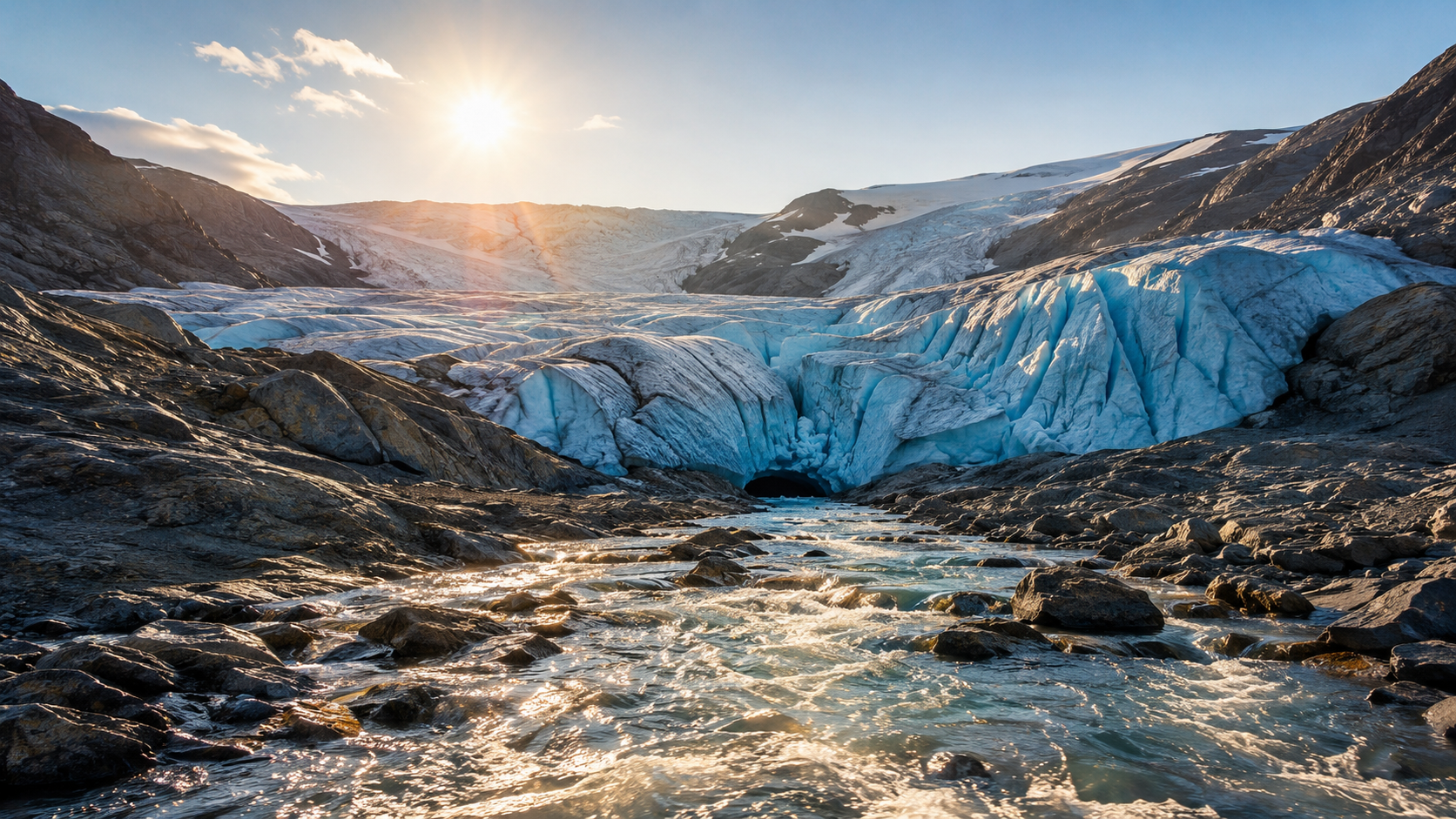
Illustration by Domi Verse X
Melting mountain ice is handing back objects that vanished centuries ago, and most of them will rot before anyone gets there.
This article contains affiliate links. If you buy through them, we may earn a small commission at no extra cost to you.
On a warm September day in 2006, a hiker in Norway's Innlandet mountains spotted something brown lying on a patch of ice. It was a shoe. He wrapped it in paper and plastic, carried it down the mountain, and phoned an archaeologist.
The shoe turned out to be somewhere between about 3,300 and 3,400 years old, according to Smithsonian Magazine's May 2026 report on the find. Somebody walked up into those mountains wearing it, at a time when the pyramids at Giza were already ancient, and never walked back down with it.
That shoe should not exist. Leather rots. In normal soil it would have been gone in a few years, and nobody would ever have known that person had been up there at all. It survived because it landed on ice and stayed there for more than 30 centuries.
And it came back to us for one reason, which is the uncomfortable part of this whole story: the ice is disappearing.
The best storage box anyone ever built
Think about what happens if your freezer loses power for a week. Everything inside turns into a mess. Now run that in reverse. Ice does to a leather shoe exactly what a freezer does to a chicken breast. It keeps things cold, keeps oxygen out, and slows down the bacteria that would otherwise eat the object in a matter of months.
There is an important detail here that gets missed. Glaciers move. They creep downhill and grind whatever is inside them into fragments. The good stuff comes from something different, called an ice patch: a smaller lump of ice that sits still, frozen to the mountain, going nowhere for thousands of years. Those are the ones that hand things back in one piece.
Archaeologists usually get bones, stone and metal, because that is all that survives. Ice gives them the rest of a life: wool clothing, rope, shoes, wooden tools, food, animal dung. The boring things. The things nobody writes down.
Why should that matter to you? Because the written record of the past is mostly kings and wars. What melts out of the ice is ordinary people going to work.
The road that came back
In 2011, a hot summer melted a patch of ice at a place called Lendbreen in central Norway, and a lost mountain pass appeared out of it.
Not a ruin. A road. Over 1,000 objects have come out of that one site, and radiocarbon dating shows the route was in use from around 300 CE to about 1500 CE, with its busiest period around the year 1000, according to glacial archaeologist Lars Pilø writing in the UNESCO Courier. Along it: shoes, a mitten, sled parts, horseshoes, bones from pack horses, and a walking stick with runes carved into it.
There is a stone shelter near the top. Somebody built that so travellers would not die up there. Then everybody stopped using the route, and it froze over, and for 500 years it was nothing but a white slope.
The pattern repeats everywhere the ice is going, and most of it is spotted by someone scanning a far-off slope rather than digging. In the Swiss Alps, the Schnidejoch pass at 2,756 metres has produced several hundred objects covering roughly 6,000 years of use, starting after an extreme summer in 2003 melted the ice back. In Mongolia's Altai mountains, ice has given up arrows, rope and animal remains that show hunting was part of herding life there for over 3,000 years, work described by archaeologist William Taylor in The Conversation.
The clock starts the second you see it
Here is the cruel bit.
The moment an object comes out of the ice, the countdown starts. Air, sun, rain and frost begin doing what they were prevented from doing for 3,000 years. A Norwegian archaeologist showed the Smithsonian's reporter fragments of a leather basket used to carry game, and the strips began crumbling as soon as he set them down.
Enjoying this story?
Get a short teaser by email whenever we publish something new. No spam.
In northern Mongolia, exposure to oxygen has already destroyed many artifacts before anyone reached them. Taylor has warned that much of the cultural material stored in mountain Asia's ice could be gone within a handful of years, simply because nobody is there to pick it up.
So this is not really archaeology as most people picture it. Nobody is digging. It is closer to walking a beach after a storm, knowing the tide comes back tonight.
And the staffing is not remotely equal to the problem. Norway's programme, which is the biggest in the world and has recovered about 4,500 objects, runs with a core team of five archaeologists working against a backlog from roughly 70 sites, the Smithsonian reports. Worldwide, Pilø notes that only two regions on the planet, the Yukon in Canada and Innlandet in Norway, have permanently funded rescue programmes at all. Everywhere else it is short-term money, or nothing.
The part nobody quite wants to say out loud
Now the opinion, and it is worth being honest that it is an opinion.
This whole field is a windfall sitting on top of a disaster. Pilø has called it "a tiny silver lining to global warming", which is about as clear-eyed as it gets. Archaeologists are getting the best decade of finds in the history of their discipline, and they are getting it because the planet is running a fever.
It is tempting to file that under "well, at least something good came of it". That would be a mistake, and here is the arithmetic of why.
The same melt that returned the shoe is emptying the water towers. Mountains supply somewhere around 55 to 60 percent of the world's annual freshwater flow, and roughly 2 billion people depend on that water, according to the UN's 2025 World Water Development Report. Meanwhile the numbers on the ice itself are not ambiguous. The World Glacier Monitoring Service recorded a net loss of about 408 billion tonnes in 2025, and total losses since 1975 of roughly 9,600 billion tonnes.
So the trade is this. We get one Bronze Age shoe. We lose a chunk of the water supply for something like a quarter of humanity. If that is a silver lining, it is a very thin one.
A science with an expiry date
Most sciences expect to still be there in 200 years. This one probably will not be, at least not in the field.
In Norway, Pilø writes, somewhere between 60 and 80 percent of mountain ice is projected to be gone by the end of this century even if greenhouse gas emissions stopped completely today, because mountain ice reacts slowly and the warming already in the system is still working through it. Under current national climate pledges, the figure could reach 90 percent. One archaeologist on the Norwegian programme told the Smithsonian he expects few ice patches to be left within about 20 years, and that the sites he works on have already lost roughly half their ice in 15 years.
That means glacial archaeology may turn out to be a discipline that is born and buried inside a single human lifetime. Objects had been turning up on melting ice since at least 1914, but the field really began in 1991, when two hikers in the Alps found a body they assumed was a lost climber and it turned out to be Ötzi, a man who died 5,300 years ago. It might effectively finish this century, when there is no more ice to walk up to.
Which puts an odd weight on right now. As one of the Norwegian archaeologists put it: if we don't do it now, we will never get the chance again.
Here is the thing that stays with me. Everything found so far came from ice that happened to melt while somebody was standing there. Every summer, in mountains nobody is surveying, objects are coming out of the ice, sitting in the open for a season or two, and quietly rotting back into nothing. We will never know what they were. And the only way to have saved them would have been to keep the ice, which would have meant never finding them at all.
Sources
- Smithsonian Magazine: Melting Mountain Ice Is Bringing Ancient Secrets to the Surface (21 May 2026, updated 26 May 2026)
- UNESCO Courier: Lars Pilø, Melting ice reveals the past (6 January 2025)
- Scientific American: Melting Ice Reveals a 'Lost' Viking-Era Pass in Norway's Mountains
- Arctic (journal): Hafner, Archaeological Discoveries on Schnidejoch and at Other Ice Sites in the European Alps
- The Conversation: William Taylor, Melting Mongolian ice reveals fragile artifacts
- World Glacier Monitoring Service: Global glacier mass change in 2025
- Carbon Brief: Glacier melt threatens water supplies for two billion people, UN warns (21 March 2025)
- Popular Science: 4 archaeological discoveries from melting ice
- Atlas Obscura: Mongolia's Disappearing Ice Patches Threaten Both the Past and the Present
- WMO / UN-Water: State of the Global Climate 2024