For 400 years, sailors reported a sea that glowed.
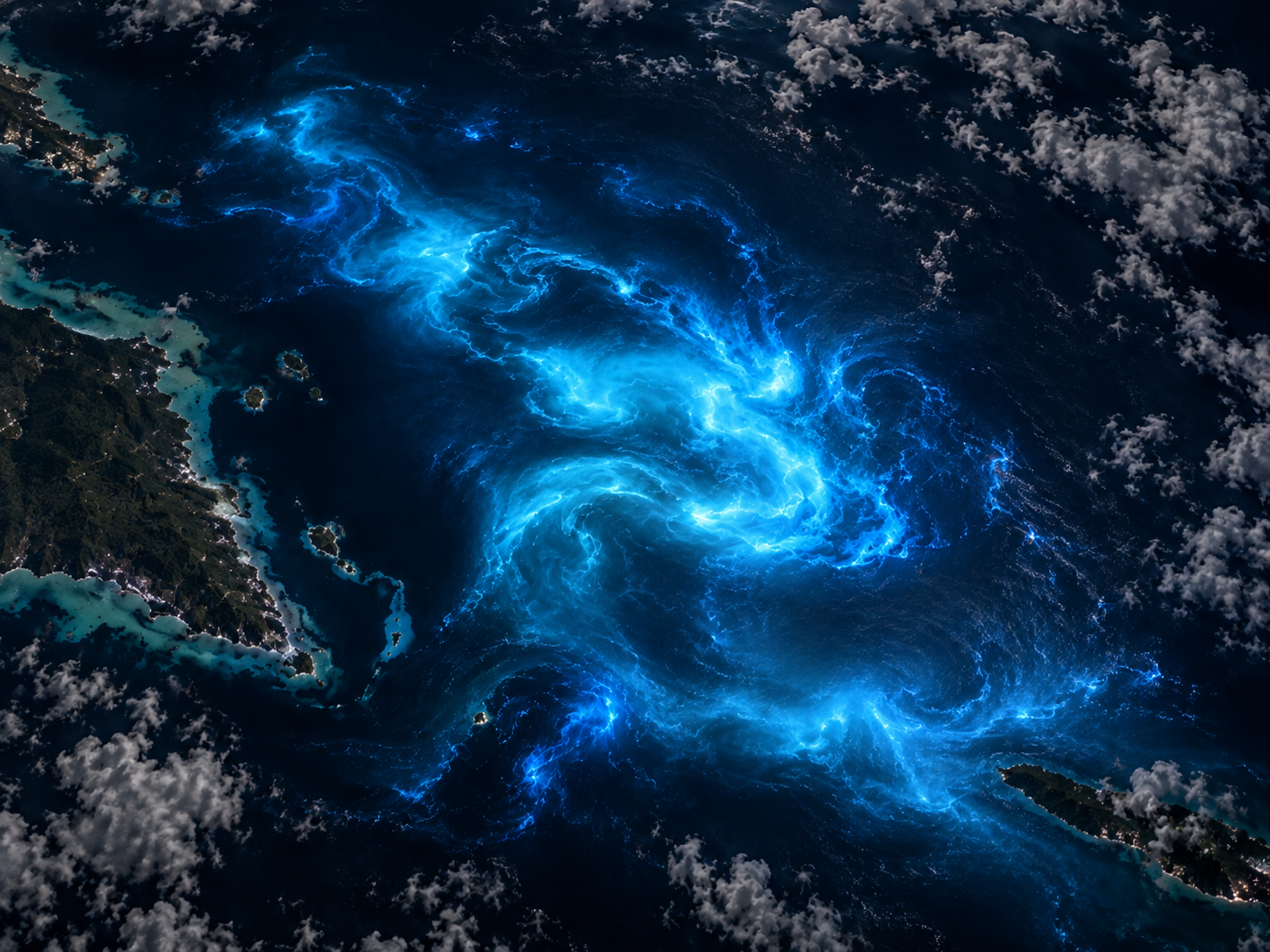
Illustration generated with AI for DomiVerseX
An ocean lit white to the horizon, for weeks at a time. One ship sailed through it for six hours before it found the far edge.
This article contains affiliate links. If you buy through them, we may earn a small commission at no extra cost to you.
They were not describing sparkles in the wake. They were describing an entire ocean, from the side of the ship all the way to the horizon, lit up a steady white, with no moon and no storm. Some crews sailed through it for six hours without reaching the far edge. The light was bright enough that the deck was visible, and it came from the water itself, from the same kind of glowing bacteria you can grow in a jar on your own desk. For most of those four hundred years, nobody on land took the reports seriously.
Sailors called it a milky sea.
The reports nobody could check
The problem with a milky sea is that it happens far from anywhere, at night, and it does not wait around for scientists.
The written record goes back a long way. Captain Newland presented one of the first scientific accounts to the Royal Society in 1772, and guessed the light came from "an unknown animalcule," which was close to right by accident. In 1854 Captain W. E. Kingman of the Shooting Star wrote that the sea had "turned to phosphorus, and the heavens being hung in blackness." Melville put one in Moby-Dick, where a mariner meets a "shrouded phantom of the whitened waters" and finds it as horrible as a real ghost.
Between 1915 and 1993, 235 sightings were logged, most of them in the northwestern Indian Ocean near Somalia. That sounds like a lot until you consider what those reports actually are: a line in a ship's log, written by someone with a job to do, who was not carrying instruments and had no reason to expect anyone would ever ask. Almost none of them recorded a position accurate enough to check later. Nobody took a water sample. A good light is useless here, because the whole point is that the sea is producing its own.
The frustrating part is that the underlying chemistry is not exotic. You can keep a living colony of glowing plankton in a glass sphere on a shelf and watch it light up on demand. What nobody could do was reach an event that only happens in open ocean, at night, hundreds of kilometres from land, and take one jar of it home.
So the phenomenon sat in a strange category for centuries. Too many independent accounts to dismiss. Not one of them solid enough to build science on.
The night one ship wrote down its position
On 25 January 1995, a British merchant vessel called the SS Lima was off the coast of Somalia when it sailed into one.
The crew did something almost nobody had done before. They logged the time and the coordinates on the way in, and again on the way out. They had been inside the glow for six hours.
Years later, a researcher named Steven Miller went back to satellite archives from that night and looked at the same patch of ocean. The Defense Meteorological Satellite Program had been quietly recording low light images the whole time. The glow was there, exactly where the Lima said it was, covering roughly 15,400 square kilometres, about the size of Connecticut. It stayed lit for three consecutive nights.
That was the moment the sailors stopped being unreliable witnesses. The satellite had been watching all along. Nobody had thought to look.
Then a satellite found one the size of Iceland
The 1995 event turned out to be small.
In 2019, a newer sensor called the Day/Night Band, flying on the Suomi NPP and NOAA-20 satellites, picked up something south of Java. Published in Scientific Reports, it covered around 100,000 square kilometres, which is roughly the land area of Iceland. It was detectable across two separate stretches, from late July into August and again from late August into September, adding up to more than 40 nights.
Enjoying this story?
Get a short teaser by email whenever we publish something new. No spam.
The brightest parts reached light levels comparable to a crescent or quarter moon. In some satellite frames the clouds above show up as dark shapes against the water, because the ocean underneath was brighter than they were. The researchers estimated that producing that much light would take somewhere between 6 x 10^22 and 6 x 10^23 luminous bacteria, a number with no useful comparison.
And one yacht happened to sail into it. That encounter produced what is, as of the 2025 review, the only known sea level photograph of a milky sea in existence.
One picture. Of the largest one ever measured.
What is actually making the light
The best current answer is bacteria, most likely Vibrio harveyi, and the honest version of that answer is thinner than it sounds.
The evidence is essentially one water sample, taken in the Arabian Sea in 1985, which found luminous bacteria living on an algal bloom. That is it. Everything else is inference from how the light behaves. A firsthand account from a marine biologist of how bioluminescence works up close explains the chemistry well, but chemistry in a lab is not the same as proving what is happening across an area the size of a country.
Two details are worth knowing. First, the light these bacteria make is blue, not white. It looks white because at night your eyes are running on rod cells, which are good at detecting dim light and useless at telling colours apart. Second, this is not the flash you see in breaking waves. That kind is made by dinoflagellates, single celled organisms that light up when disturbed, one blink at a time. A milky sea does not blink. It stays on, steadily, for weeks.
That difference matters more than it sounds. A blink is a defence reaction. A glow that holds steady for more than 40 nights across 100,000 square kilometres is something else, and nobody has confirmed what the bacteria are getting out of it.
Why we still cannot answer this
In April 2025, a team at Colorado State University led by PhD student Justin Hudson published the first new database of milky seas in thirty years, pulling together four centuries of accounts: sailors' reports, eighty years of submissions to the Marine Observer journal, and modern satellite detections.
The patterns that came out are the most useful thing anyone has found so far. Nearly 60 percent of known events happened in one region, the northwest Indian Ocean around Somalia and Socotra. The rest cluster around Southeast Asia. Statistically, sightings line up with the Indian Ocean Dipole and the El Niño Southern Oscillation, and with the wind driven phases of the Indian monsoon, all of which drive nutrients up toward the surface.
That is a correlation, not a cause. It tells you where and roughly when to look. It does not tell you why the ocean turns on.
And that is the part that is hard to sit with. This is not a phenomenon hiding in the deep sea or on another planet. It is visible from orbit, it can last a month and a half, it has been written about since before the Royal Society existed, and the entire physical evidence base for what causes it is one jar of seawater from 1985 and one photograph taken by a passing yacht.
The database exists now. The next time the conditions line up, somebody may finally get a ship out there while it is still glowing.
Until then, it is still four hundred years of people saying they saw the ocean turn white, and nobody able to prove what they were looking at.
Sources
- From Sailors to Satellites: A Curated Database of Bioluminescent Milky Seas Spanning 1600-Present, Hudson et al., Earth and Space Science, 2025
- Researchers develop database of bioluminescent milky seas, Colorado State University
- Honing in on bioluminescent milky seas from space, Scientific Reports, 2021
- Milky seas effect, historical accounts and the SS Lima observation
- And Then the Sea Glowed a Magnificent Milky Green, Hakai Magazine