The Sahara Has Not Always Been a Desert
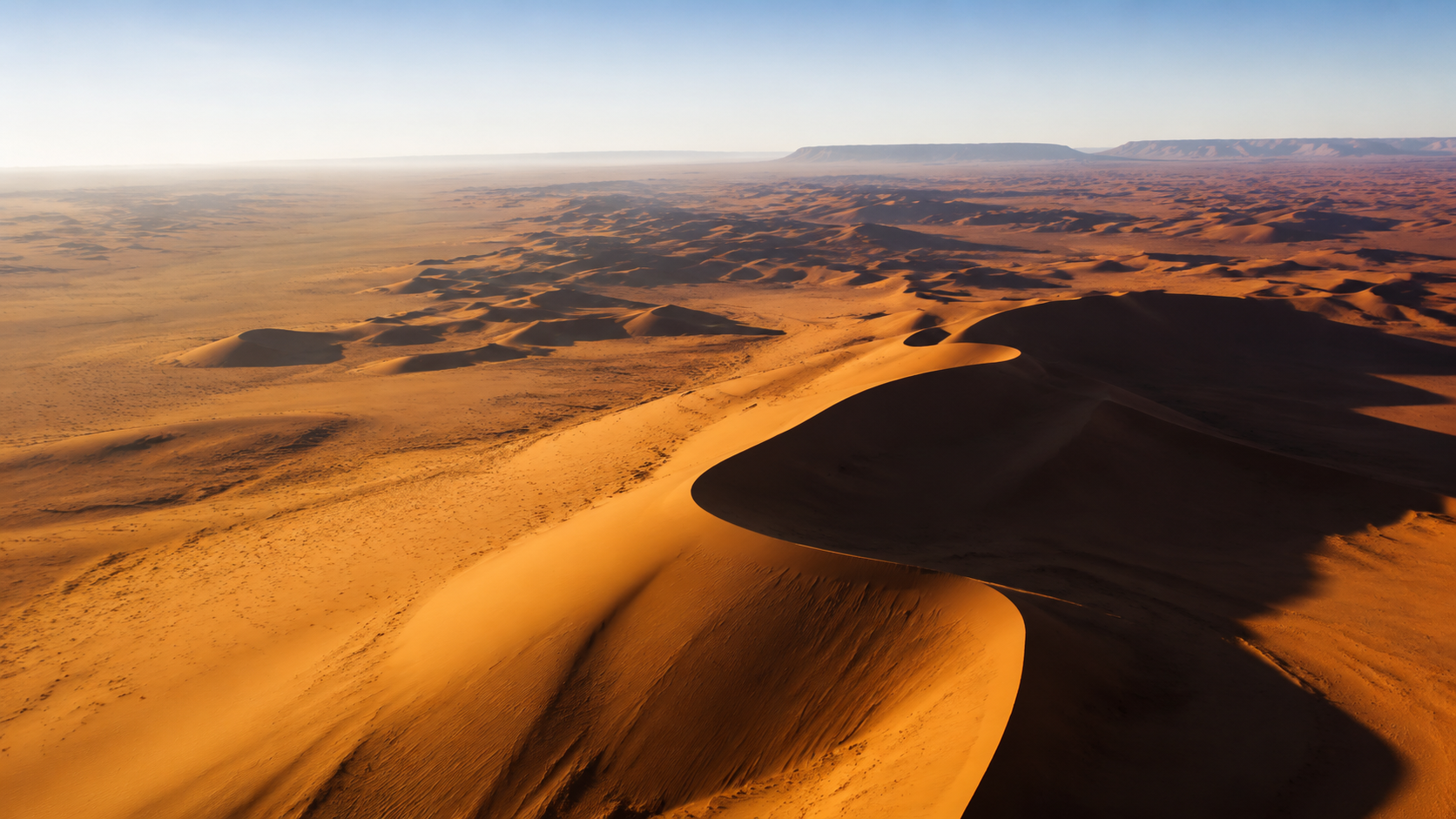
Illustration by Domi Verse X
Radar looked through the sand and found rivers underneath.
This article contains affiliate links. If you buy through them, we may earn a small commission at no extra cost to you.
The Sahara is the largest hot desert on Earth. Across most of it, rain is close to nonexistent. There are places where a person could stand for years and never feel a drop. It looks like the most permanent landscape on the planet.
It is not. Sand does not hold a shape, and anyone who has watched a desktop sand art frame settle into a completely different scene with every turn has seen the miniature version of what this continent does over thousands of years. Within the span of human history, this same ground held rivers, lakes, grassland and animals that need water every single day. People lived here. And the reason it stopped is not a mystery. It is a clock.
There Are Rivers Under the Sand
In November 1981, the space shuttle Columbia carried a radar instrument called SIR-A over the eastern Sahara. Radar has a property ordinary cameras do not: in extremely dry ground, it passes straight through loose sand and bounces off whatever is underneath.
What came back surprised the people reading it. Beneath the Selima Sand Sheet were buried valleys nobody knew existed, and some of them were nearly as wide as the valley of the Nile. Think about what that means for a moment. Not a stream. Not a seasonal wash. A river system on the scale of the one that feeds Egypt, sitting invisible under a few metres of sand.
It was not a one-off. Later missions mapped more, and researchers working on the other side of the continent traced a dried channel in Mauritania running more than 300 miles toward the Atlantic. Geologists call these fossil rivers. They are dry now, but the shape of a riverbed does not lie: water carved them, and a lot of it, for a long time. The mineral evidence is easier to get hold of than you would think, since specimens like desert rose show up in ordinary beginner rock and mineral collections alongside quartz and pyrite.
What Actually Lived Here
Scientists call the most recent wet phase the African Humid Period. It ran from roughly 14,500 to 5,000 years ago, with the wettest stretch somewhere between 11,000 and 6,000 years ago. During it, large parts of North Africa were wooded savannah with lakes and wetlands, closer to modern Kenya than to modern Libya.
The animals tell the story better than any number. Hippos lived here. So did crocodiles and fish. These are not animals that tolerate dryness. A hippo needs standing water essentially every day or it dies. Their remains turn up in places that are now among the driest on Earth.
People lived here too, and not as visitors. In 2025, researchers published DNA from two women buried about 7,000 years ago at a rock shelter called Takarkori in southwestern Libya. They belonged to a North African lineage nobody had identified before. This was a settled population in a place that today could not support one.
The Cave of Swimmers, and an Honest Caveat
The most famous evidence is also the most argued-about, so it is worth being straight about it.
In 1933, the Hungarian explorer Laszlo Almasy came across painted figures on a rock shelter wall in Wadi Sura, on the Gilf Kebir plateau in southwestern Egypt. He had spent years crossing the desert by truck, cataloguing rock art with little more than a map and a baseplate compass. The figures he found have their arms and legs bent outward in a way that looks, to most people seeing it for the first time, exactly like swimming. The site picked up the name Cave of Swimmers and later became famous through The English Patient. The paintings are usually dated to somewhere between 6,500 and 9,000 years ago.
Here is the part that often gets left out: the swimming interpretation is disputed. Hans Rhotert, one of the early researchers on the site, read the figures as depictions of the dead. The modern researcher Andras Zboray has questioned the swimming reading as well and argues the meaning is genuinely unknown. The figures are prehistoric art, not a photograph, and nobody can ask the artists what they meant.
So the honest version is this. The paintings are not proof that people swam in the Sahara. The buried rivers and the hippo bones are the proof. The paintings are what makes it feel real.
Enjoying this story?
Get a short teaser by email whenever we publish something new. No spam.
Why It Stopped
The Sahara did not dry out because of anything anyone did. It dried out because of the shape of Earth's motion through space.
Earth wobbles on its axis like a spinning top slowing down, completing one full wobble roughly every 21,000 years. That wobble, called precession, changes which season lines up with Earth's closest approach to the Sun. Around 11,000 years ago, that closest approach fell in the northern summer instead of the northern winter, so North Africa received noticeably more summer sunlight than it does today.
More summer sun means a hotter continent. A hotter continent pulls the West African monsoon much further north than it reaches now, dumping rain across ground that currently gets none. When the wobble carried on and the extra summer sunlight faded, the monsoon retreated south, the lakes shrank, the vegetation died back, and the sand took over.
How fast the collapse happened is genuinely contested, and it is worth knowing that before anyone quotes you a confident number. A 2024 study in Nature Communications led by Martin Trauth, based on sediment cores from the Chew Bahir basin in southern Ethiopia, describes the wet-to-dry shift as roughly a thousand-year transition with severe droughts of 20 to 80 years recurring inside it. Other work, including an earlier Nature Communications paper using leaf-wax chemistry from the Gulf of Guinea, argues for a rapid termination instead. The direction and the cause are agreed on. The speed is still an open argument.
It Has Happened Hundreds of Times
This is the part most people have never heard.
The green Sahara was not a one-time accident. Because it is driven by an orbital cycle, it repeats. According to the research team behind a 2023 Nature Communications study on North African humid periods, marine and lake sediments record more than 230 separate greenings over the past eight million years, spaced at roughly 21,000-year intervals.
The Sahara, in other words, is not really a desert with one strange wet chapter. It is a landscape that flips back and forth, and we happen to be alive during a dry one.
One of the leftovers of the last flip is still shaping the planet. The Bodele Basin in Chad, the dried floor of what was once a vast lake, is now the single largest source of dust on Earth. Wind lifts that old lakebed into the atmosphere and carries it across the Atlantic. The Sahara's wet past is still travelling, in powder form, over the ocean.
Will It Come Back?
Precession keeps turning, so northern summer sunlight will eventually climb again. It is tempting to add half a cycle to today's date and announce a year.
Resist that. Earth's current orbital position is moving the wrong way for a natural green phase, the strength of each greening depends on more than precession alone, since ice sheets, oceans, vegetation and dust all feed back into it, and the cycle is not a precise timer that turns a continent green on schedule. The pacing is regular. The outcome is not.
What can be said is narrower and, honestly, stranger. The Sahara has been green before, many times, and there is no physical reason it cannot be again.
Next time you see an aerial shot of endless dunes, it is worth remembering you are looking at the lid, not the box. A few metres down, the rivers are still there.
Sources
- Green Sahara: African Humid Periods Paced by Earth's Orbital Changes
- Subsurface valleys and geoarcheology of the eastern Sahara revealed by shuttle radar
- Early warning signals of the termination of the African Humid Period(s)
- Rapid termination of the African Humid Period triggered by northern high-latitude cooling
- North African humid periods over the past 800,000 years
- Ancient DNA from the Green Sahara reveals ancestral North African lineage
- British Museum African Rock Art archive: Cave of Swimmers, Egypt