The Northern Lights Are Not Supposed to Be Visible This Far South.
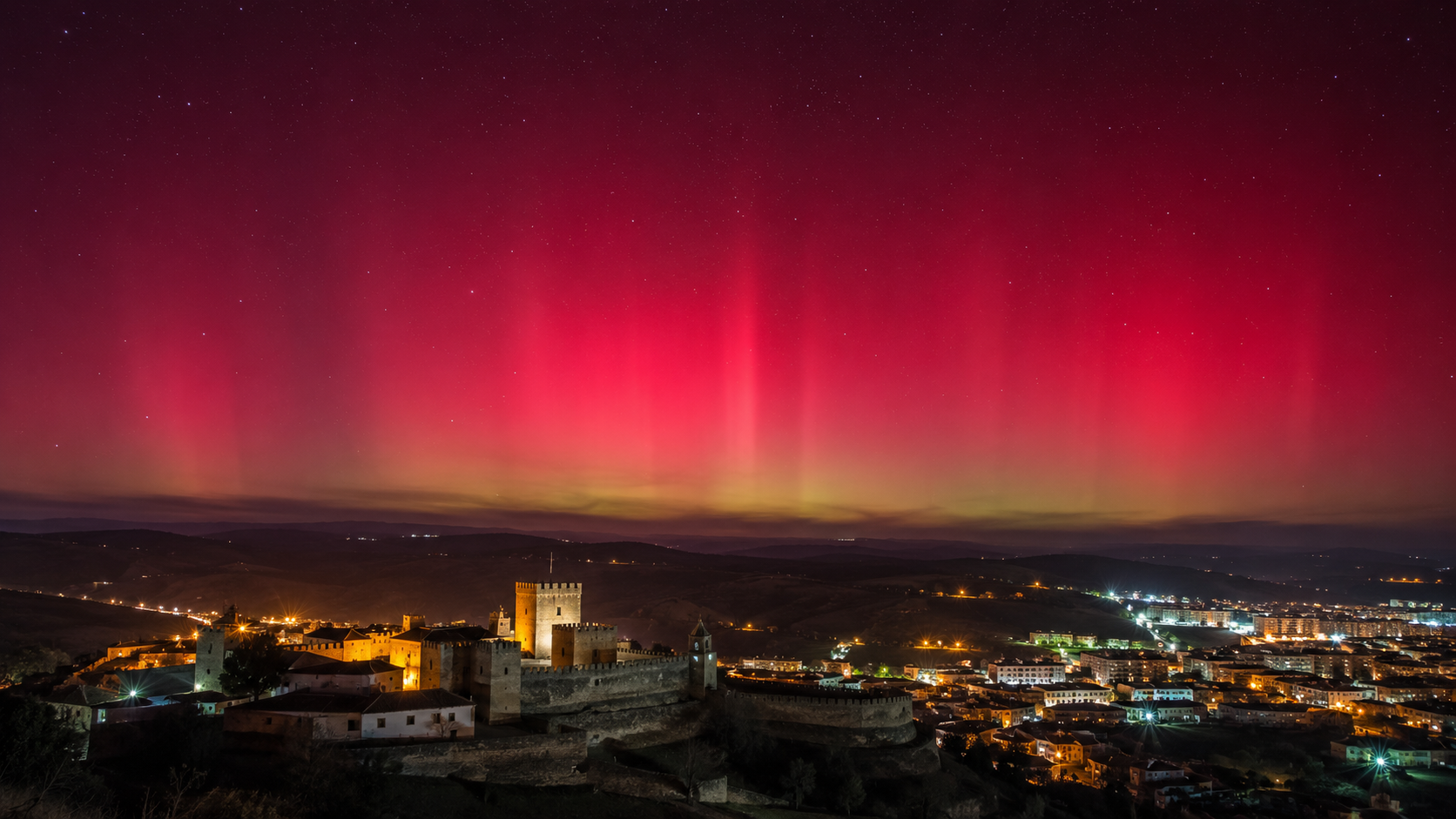
Illustration by Domi Verse X
In May 2024 the strongest solar storm in over twenty years pushed the aurora over southern Europe. Most people watching could barely see it with their own eyes.
This article contains affiliate links. If you buy through them, we may earn a small commission at no extra cost to you.
On the night of 10 May 2024, people across southern Europe stood in car parks and on beaches pointing their phones at the sky. Many of them could barely see anything with their own eyes. A faint grey smudge, maybe a wash of colour if they were lucky. Then they looked at the screen, and the screen was full of pink and violet.
That gap between what the eye sees and what the camera records is why half the internet spent that night arguing about whether the photos were real. They were. If you have ever tried to photograph a dark sky handheld, you already know the problem: the phone needs a long exposure, and a long exposure needs the phone to stay perfectly still, which is why the people who got the good shots that night were the ones who had propped their phone on a wall or clipped it to a small flexible tripod. The camera was not lying. It was just more patient than a human eye.
What actually hit us
The sun had spent that week throwing everything it had.
A single sunspot region, catalogued as AR3664, had grown to many times the width of Earth and fired off a run of powerful flares. Each flare came with a coronal mass ejection, a cloud of magnetised plasma launched into space. Several of those clouds left the sun within hours of each other, and on the way here the faster ones caught up with the slower ones and merged into one enormous shock front.
When it arrived, the American space weather forecasters at NOAA rated it G5, the top of their scale. It was the first G5 storm since October 2003, which is the whole reason the aurora ended up somewhere it has no business being.
Why Portugal
The northern lights are usually stuck in a ring around the magnetic pole. The particles from the sun follow Earth's magnetic field lines down into the atmosphere near the poles, hit oxygen and nitrogen, and make them glow.
A strong enough storm squashes that field. The auroral ring stretches south, and suddenly the glow is over places that go their entire recorded history without seeing it. That night it was reported from Mexico, Florida, the Caribbean, and across Europe from Britain down to Spain, Portugal, Italy and Greece.
The colour matters too. The green most people picture happens at around 100 to 300 kilometres up. The deep red comes from oxygen much higher, roughly 300 to 400 kilometres, and because it sits so high it can be seen from much further away, peeking over the horizon like a distant fire. That is what most of southern Europe was actually looking at.
It was not just a light show
Space weather stops being charming the moment it touches infrastructure, and this one did.
The storm arrived in the middle of the American planting season, and modern tractors steer themselves using precision GPS accurate to a couple of centimetres. That accuracy depends on satellite signals passing through a calm ionosphere, and the ionosphere was anything but calm. Across the Midwest, self guiding tractors wandered off their lines or shut down entirely. Farmers described machines behaving as if they were possessed. One later study put the cost to American farmers at around 500 million dollars.
Enjoying this story?
Get a short teaser by email whenever we publish something new. No spam.
Satellite operators had their own night of it. Starlink reported degraded service, and dozens of satellites in low orbit had to fight extra atmospheric drag as the storm heated and puffed up the upper atmosphere.
None of it required anyone to be in the dark for long, but it is a decent reminder of why a charged power bank and a headlamp are worth keeping in a drawer rather than on a shopping list for later. Neither costs much, and neither depends on anything working.
The storm has a name
Hurricanes get names. Geomagnetic storms normally do not.
This one is now widely called the Gannon storm, after Jennifer Gannon, a space weather scientist who died suddenly in May 2024. Naming a storm after a researcher is unusual enough that it tells you something about how the field saw this event: not as a curiosity, but as the reference case they will be comparing everything against for years.
The part that should keep you up at night
The Gannon storm was the strongest in over twenty years. It was not, by any reasonable measure, the strongest possible.
In September 1859 a solar storm now called the Carrington Event hit a world that had almost no electrical infrastructure. Telegraph lines sparked, operators got shocks, and some machines kept working after their batteries were disconnected because the wires themselves were carrying current from the sky. Aurora were reported near the equator.
Nobody can tell you exactly what the same storm would do to a planet running on satellites, undersea cables and continent wide power grids, because it has not happened yet in that world. The honest answer is a range, and the range is wide. If you want the story of the man who first connected a flash on the sun with chaos on Earth, Stuart Clark's The Sun Kings is the readable version.
What we do know is that the sun is currently near the peak of its eleven year cycle, and that the last time it produced something this big, the warning we got was measured in hours.
So the real question is not whether the lights come back to Portugal. It is what else comes with them.
Sources
- NASA Science, How NASA tracked the most intense solar storm in decades
- NASA Earth Observatory, Historic geomagnetic storm dazzles
- Space.com, May 2024 solar storm cost 500 million dollars in damages to farmers
- Space.com, Geomagnetic storm named to honor space weather scientist
- CBS News, Solar storms cause GPS in tractors to break during planting season