A Mountain Came Down on the Swiss Village Named Blatten.
The Guardian
In May 2025 a mountain came down on a village in the Swiss Alps and buried it in minutes. The strangest part of the story happened nine days earlier.
This article contains affiliate links. If you buy through them, we may earn a small commission at no extra cost to you.
The Lötschental is a narrow valley in the Swiss Alps, the kind of place that ends up on calendars. Wooden houses with stone roofs. A river down the middle. Steep green walls running up to rock and ice on both sides. About 300 people lived in the village at the top of it, in Blatten.
At 3:24 in the afternoon on 28 May 2025, seismometers across Switzerland registered a magnitude 3.1 event in that valley. It was not an earthquake. It was the sound of the valley wall arriving at the bottom.
Anyone who has hiked the Lötschental knows the shape of the place. Marked trails, cold streams running off the ice, huts where you top up a bottle from meltwater through something like a pocket water filter because the water looks clean and usually is. That whole picture, the trails and the streams and most of the village they lead to, is no longer there.
What came down
Above Blatten sat the Birch glacier, and above the Birch glacier stood a peak called the Kleines Nesthorn. On that Wednesday afternoon the glacier let go completely.
The team that reconstructed the event in Communications Earth and Environment put the moving mass at roughly 20 million tonnes, about 6.4 million cubic meters of rock and 2.9 million cubic meters of ice. It fell around 1,200 meters and reached speeds of up to 200 kilometers an hour. That is faster than any car is allowed to drive on a European motorway, and this was not a car.
The whole thing was over in minutes.
What was left
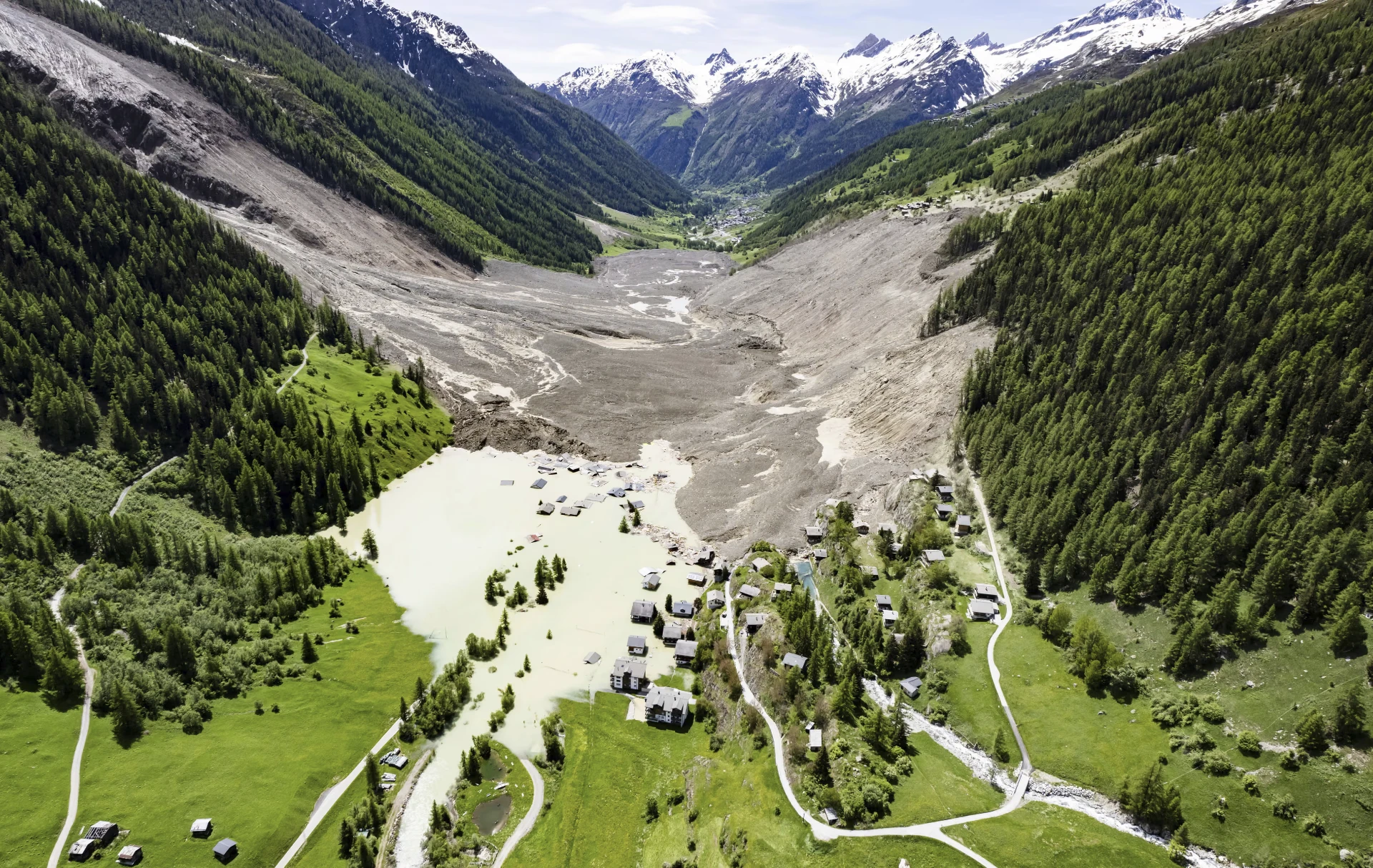
About 90 percent of Blatten disappeared. Roughly 130 houses and the church went under, along with farms, hotels, bridges and the road.
What replaced the village is a field of rubble running about 2 kilometers along the valley floor, up to 35 meters deep in places, roughly the height of a ten story building. Around a third of that pile is not rock at all. It is glacier ice, buried and insulated under debris, and experts expect it to keep melting out slowly for years and possibly decades.
Satellite images taken days apart show it plainly. A village, then a grey tongue of nothing.
The part that makes Blatten different
Here is what almost nobody knows about this disaster, and it is the reason it is worth telling.
The village was empty when the mountain hit it.
Nine days earlier, on 19 May, the authorities ordered Blatten and the neighbouring hamlet of Ried cleared. Around 300 people were given two hours to get out. Cattle went out by helicopter. Families packed what fitted in a car, which is the exact moment people find out whether their passports, deeds and insurance papers are in one grabbable place or spread across three drawers. A flat fireproof and waterproof document pouch is the boring version of that lesson and costs less than a tank of fuel.
They were told to leave because the glacier had started doing something glaciers do not do. Monitoring teams measured the Birch glacier creeping forward at about half a meter a day on 21 May. Three days later it was moving four meters a day. On 27 May, the day before it collapsed, it was travelling around 10 meters a day. A body of ice that normally shifts a few centimeters had begun to run.
The evacuation did not end on 19 May either. When the debris dammed the river and a lake started rising behind it, hundreds more people from Wiler and Kippel further down the valley were moved out in the middle of the night. Alpine valleys in May are cold after dark, the power was gone and the road was gone, and this is the unglamorous scenario a head torch and a stack of foil emergency blankets actually exist for. Both fit in a glovebox and neither needs you to be an outdoors person.
The evacuation was not perfect. A 64 year old shepherd was working in the Tännmattä area, roughly 300 meters outside the evacuation zone, when the mountain came down. His body was recovered on 24 June. About a hundred sheep died with him. He is the only person Blatten lost, out of a village that no longer exists.
Enjoying this story?
Get a short teaser by email whenever we publish something new. No spam.
For everyone else, the warning arrived in time. Local alerts carried the order, and once the road closed and the valley power plant went down for what turned out to be months, a hand crank emergency radio stopped being a camping toy and became the only thing still talking.
Why does a glacier fall over
Glaciers melt and retreat. They do not usually run down a valley in one piece, so something had to push this one.
The push came from above. Through May 2025 the Kleines Nesthorn was breaking apart. Around 19 and 20 May alone, roughly 1.5 million cubic meters of rock crashed onto the glacier below. By 25 May the pile of fresh rock sitting on the ice stood about 81 meters high, and in the final three days instruments recorded part of the mountain flank sliding 17 meters.
That load did two things at once. It pressed down on the ice and it covered it. Researchers at WSL and ETH Zurich point out that the Birch glacier had actually been growing while nearly every other Swiss glacier shrank, advancing about 50 meters at its front between 2019 and 2023. It was being fed and buried by falling rock. Then the ice failed and everything went down together.
Why the mountain above was crumbling is the harder question, and this is where honest scientists get careful. The Alps are warming fast. The same study records the decade from 2015 to 2024 as the warmest in an Alpine reconstruction reaching back to the year 742, and notes that Swiss Alpine permafrost, the frozen ground that acts like glue inside high rock faces, lost roughly 15 percent of its ice between 2015 and 2022. Warming is considered a likely contributor. A direct causal link between thawing permafrost at the Kleines Nesthorn and this particular collapse has not been proven.
The lake behind the rubble
The debris did not stop at burying a village. It landed across the Lonza, the river that drains the valley, and dammed it.
Water pooled immediately. On 29 May the new lake was rising by around 80 centimeters an hour, and by the next day it held roughly a million cubic meters before the water carved its own way through the debris. The lake is still there. The cantonal geologist has compared the danger to the Giétro disaster of 1818, when an ice dam in the same canton gave way and the flood killed dozens of people downstream. Draining it and putting the river back into a controlled channel is one of the main jobs for 2026.
Blatten is being rebuilt, just not where it was
The village is not going back on top of the rubble. According to SWI swissinfo.ch, the plan is to grow a new Blatten around the hamlets of Eisten and Weissenried, which the landslide missed.
The timeline reads like a decade cut in half. Cleanup and lake drainage through 2026. Temporary buildings in 2027. A new village centre from 2028. The first residents expected to sleep at home again around 2030.
The question nobody has answered
Blatten got the best possible version of this. Instruments on the slope, geologists reading them, and an authority willing to empty a village on a Monday morning before anything had visibly happened.
The scientists who studied it end on the uncomfortable part. They argue that a warming climate may be making these events more frequent and more violent, and that the safety of settlements, farmland and infrastructure across glaciated mountains worldwide needs to be looked at again. If you want the long version of how quickly ice can rewrite a landscape, Jon Gertner's The Ice at the End of the World is the readable one.
There are thousands of villages living under high frozen rock. Nobody can say how many of them have their own Kleines Nesthorn quietly letting go, with no instruments on it, and nobody watching to give the order.
Sources
- Communications Earth and Environment, The 2025 Blatten disaster in the Swiss Alps followed exceptional warming
- WSL, What glacier researchers know about the collapse of the Birch Glacier
- ETH Zurich, What ETH glacier researchers know about the collapse of the Birch Glacier
- SWI swissinfo.ch, The devastating glacier collapse in Blatten: what next?
- The Guardian, This is ground zero for Blatten, the tiny Swiss village engulfed by a mountain
- NASA Earth Observatory, Glacier collapse buries Swiss village