Something the Size of a Small Country Was Just Found Hidden Under Antarctica
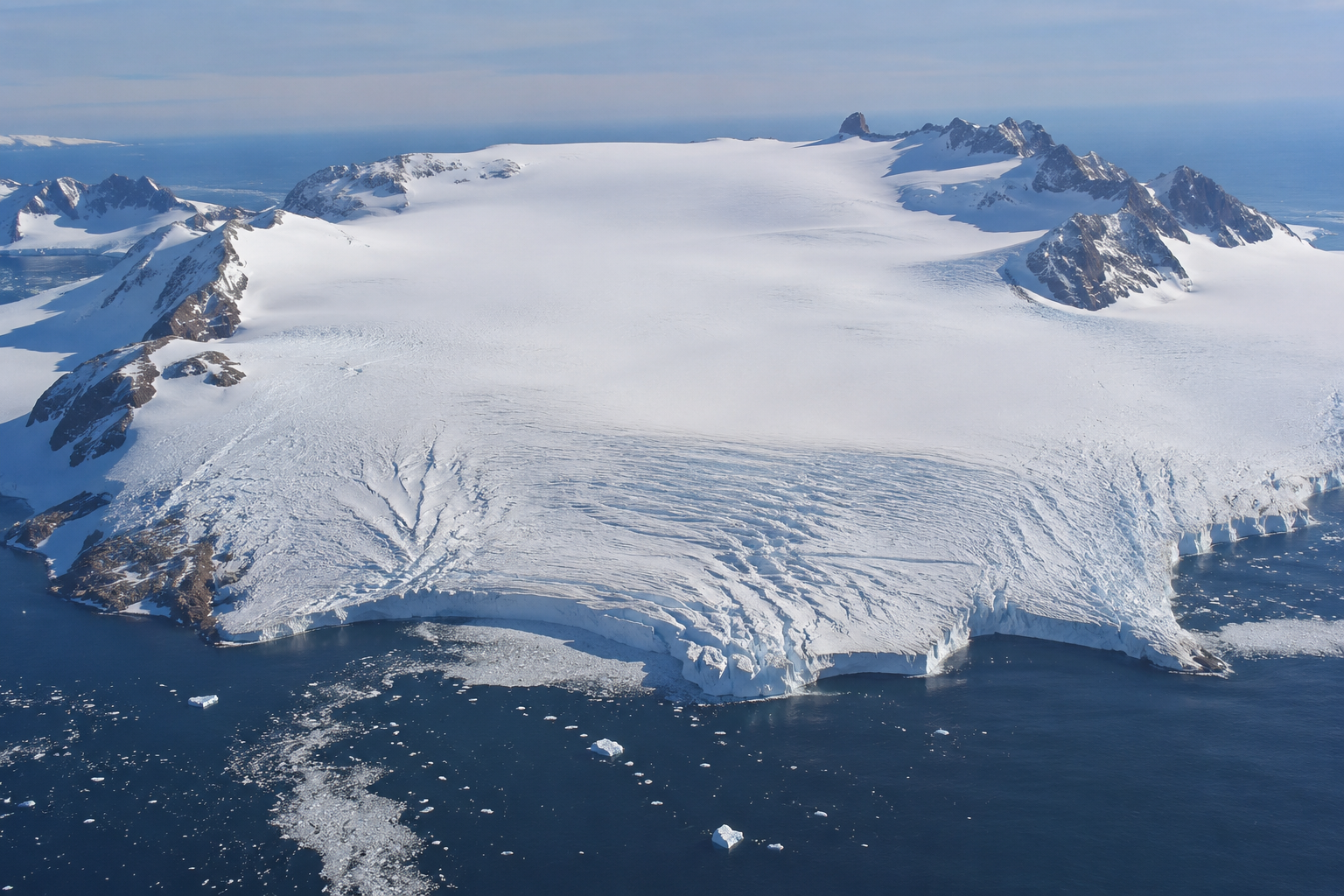
Illustration by Domi Verse X
A handful of pink rocks scattered across a remote Antarctic mountainside just led scientists to something nobody expected: a landmass roughly the size of a small country, buried so deep that no living person has ever seen it, and hasn't been touched by open air in 175 million years.
This article contains affiliate links. If you buy through them, we may earn a small commission at no extra cost to you.
It started small. Researchers walking the ridges of the Hudson Mountains in West Antarctica noticed loose boulders with an unusual pink tint scattered among the grey local rock. Pink granite doesn't belong there. It forms differently, cools differently, and simply shouldn't be lying around on the surface of that particular mountain range. So a team from the British Antarctic Survey did what geologists do with a rock that doesn't fit: they took it back to the lab.
The Clue Nobody Understood, Until Now
Dating the mineral crystals inside the pink boulders through radioactive decay gave the team an answer they weren't expecting. The granite had formed around 175 million years ago, during the Jurassic period, long before Antarctica looked anything like it does today. That told researchers the rock came from somewhere specific and somewhere big, but a handful of loose boulders on a hillside couldn't prove where. For that, they needed to look underneath the ice itself.
That meant flying over the region in a Twin Otter aircraft fitted with gravity sensors sensitive enough to detect subtle differences in the density of rock buried kilometers below the surface. Granite has a distinct density signature, different from the surrounding bedrock. When the survey data came back, it lined up almost perfectly with the boulders on the mountainside. The pink rocks hadn't just fallen from nowhere. They had been carried there by the glacier itself, plucked from something enormous sitting directly beneath it.
"It's remarkable that pink granite boulders spotted on the surface have led us to a hidden giant beneath the ice," said Dr Tom Jordan, the geophysicist at the British Antarctic Survey who led the research, in the team's announcement.
A Landmass the Size of a Small Country
What the surveys revealed is a single, continuous body of granite roughly 100 kilometers across and 7 kilometers thick, sitting underneath Pine Island Glacier. To put that in perspective, it covers an area close to the size of Jamaica or Lebanon, and researchers describe it as roughly half the size of Wales. It's not a boulder field or a scattering of rock. It's one connected mass, the size of a small country, hidden directly beneath one of the most closely watched glaciers on the planet.
The thickness is just as hard to picture. Seven kilometers of solid granite is deeper than Mount Everest is tall, if you flipped the mountain upside down and buried it. And this entire structure sits underneath ice that is, in places, more than a kilometer thick on its own. Nobody walking across that stretch of Antarctica today would have any way of knowing what's directly beneath their boots, aside from a few oddly colored rocks that most people would walk straight past.
Older Than the Ice Sitting on Top of It
Enjoying this story?
Get a short teaser by email whenever we publish something new. No spam.
The age of the granite is where the story gets a little disorienting. At 175 million years old, this rock formed during a period when the earliest true dinosaurs were still relatively new, tens of millions of years before anything resembling a Tyrannosaurus rex existed. Back then, Antarctica wasn't a frozen continent at all. It was still connected to other landmasses as part of the ancient supercontinent Gondwana, and the region that would eventually become Pine Island Glacier had an entirely different climate.
In other words, this piece of rock has been sitting in roughly the same spot since long before Antarctica froze over, long before the ice sheet above it existed in any form. The ice came later. The granite was already there, waiting.
Why a Buried Rock Matters to a Melting Glacier
This wouldn't be much more than a geological curiosity if Pine Island Glacier weren't one of the fastest-changing glaciers in Antarctica. It has lost ice at a rapid pace over recent decades, and it's considered one of the more important pieces in the puzzle of future sea level rise. What sits underneath a glacier, its bedrock, its texture, how smooth or rough it is, directly affects how fast the ice above it can slide toward the ocean.
According to Dr Jordan, combining the rock dating with the gravity survey data did more than solve the mystery of the pink boulders. "We've not only solved a mystery about where these rocks came from," he explained, "but also uncovered new information about how the ice sheet flowed in the past, and how it might change in the future," as reported by ScienceDaily. Granite tends to be smoother and more resistant than the surrounding rock, which can change how meltwater drains underneath a glacier and how easily ice slides across it. Knowing exactly where this mass sits, and how large it is, gives scientists a clearer picture to plug into the computer models used to predict how quickly Pine Island Glacier, and the ice sheet behind it, might respond to a warming climate.
Dr Joanne Johnson, a BAS geologist and co-author on the research, put it simply: rocks like these are a record. "Rocks provide an amazing record of how our planet has changed over time," she said, "especially how ice has eroded and altered the landscape of Antarctica," according to Earth.com. Every boulder scattered across that mountainside is a small piece of a much larger, much older story, one that happened to still be legible 175 million years later.
What Scientists Still Don't Fully Know
For all the detective work, this discovery raises as many questions as it answers. Researchers now know the granite is there, how big it is, and roughly how old it is, but there's still no complete picture of its exact shape and edges, and no certainty yet about exactly how much influence it has had on the glacier's past movement or how much it will shape its future. The team's own conclusion is less an ending than an invitation to keep looking. A mountain-sized mass of 175-million-year-old rock just turned up under one of Antarctica's most closely watched glaciers, entirely by accident, because a few loose rocks happened to be the wrong color. It raises the obvious question nobody can fully answer yet: what else is still sitting down there, waiting for the right piece of evidence to notice it?
Sources
- British Antarctic Survey: Hidden giant granite discovered beneath West Antarctic Ice Sheet
- ScienceDaily: These strange pink rocks just revealed a hidden giant beneath Antarctica
- Earth.com: Pink granite rocks lead to the discovery of an enormous formation under Antarctica's ice
- Discover Wildlife: 100km-wide "hidden giant" discovered beneath Antarctic ice sheet
- Nature Communications Earth & Environment: Subglacial geology and palaeo flow of Pine Island Glacier