The Ground Doesn't Open Without Warning. Nobody Is Required to Map the Risk or Predict Where It Happens Next.
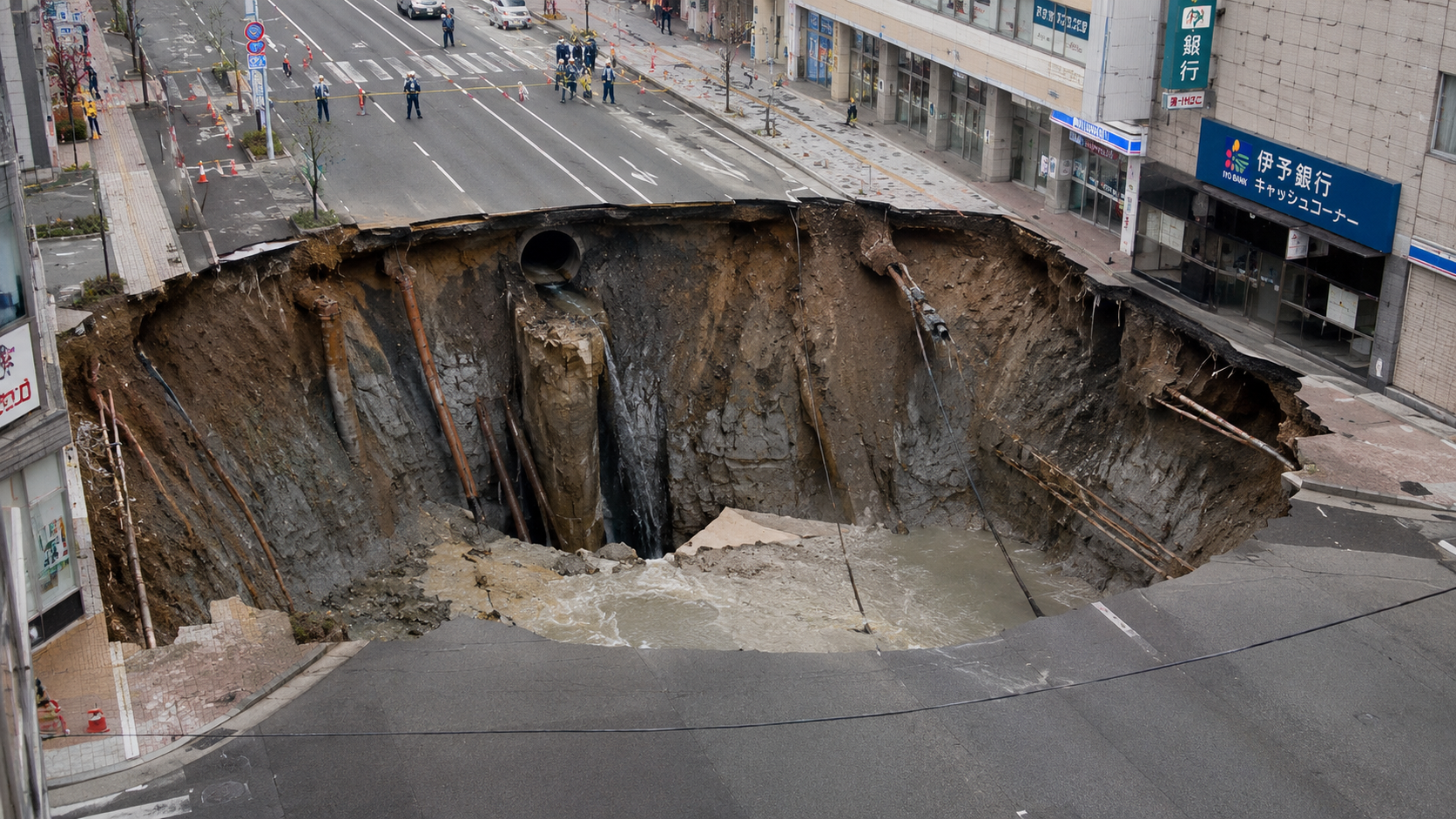
Illustration by Domi Verse X
A hollow can grow under a street for months before anything shows on the surface. In most of the United States, nobody is required to look for it, and nobody adds up the ones that already happened.
This article contains affiliate links. If you buy through them, we may earn a small commission at no extra cost to you.
There are places where the ground under a street is not as solid as it looks. It might be fine wind-blown soil, or soft river sediment, or limestone that groundwater has been quietly dissolving for thousands of years. In those places the ground gives way regularly, and almost all of it happens without anyone hearing about it. Omaha, Nebraska is one of them. According to a Flatwater Free Press analysis of city Public Works data, the city has averaged more than 400 cave-ins a year since 2021, over 2,100 in five years, ranging from a soft dip in the asphalt to a hole big enough to lose a car in. Every reported one gets investigated. What nobody does is read the pile as a whole, because the United States has no national sinkhole database and no national sinkhole hazards programme. That is not an accusation. It is the US Geological Survey's own description of the situation.
Three seconds on Pacific Street
On 24 February 2026, a pickup truck and an SUV were waiting at a red light at 67th and Pacific in Omaha. A university security camera on top of a parking garage was pointing at the intersection. In the video, the road under both vehicles simply stops being a road. Two university basketball players driving home from practice pulled over and helped drag both drivers out. Nobody was hurt. The clip has been watched more than twenty million times.
Then came the part that did not go viral. Months later, the two organisations that own the pipes under that street still do not agree on what made the hole.
The city says a pressurised water main had been leaking for months, washing soil into a storm sewer and hollowing out a space under the pavement. The Metropolitan Utilities District, which owns that main, says there was no evidence of a leak before the collapse, that the city's own deteriorated storm sewer caused it, and that the main broke only because the street and two cars landed on top of it. Both sides have filed claims against the other. The city engineer has said publicly that the utility's version defies logic, common sense and science. There is no independent referee, and as of the most recent reporting there is still no agreed answer.
Two details are worth sitting with. Late the previous year, city workers had already looked at that exact spot because the surface was settling. They ran a dye test, the standard first check, and it showed nothing. And on the morning of the collapse, hours before it happened, a creek two blocks away was running thick with sediment. A retired geology professor walking past assumed it was construction runoff. It was the street.
One more thing, because precision matters. What happened in Omaha is not a sinkhole in the strict geological sense. Nebraska has very little karst, the dissolving limestone terrain that produces textbook sinkholes. This was soil washed away by water from a pipe. The city engineer's own point is that the end result is identical: something removes the support, and eventually the surface comes down. The same thing can happen slowly under a house, where a leak nobody sees for months does the quiet part of the work, and a water leak alarm that sounds at the first drip is the cheap way to hear it early.
It is not just Omaha
Florida had the greatest sinkhole damage of any state in the last national comparison, and it does keep a statewide database of what it calls subsidence incidents. Read the state's own fine print and two things stand out. Most entries have never been checked in the field by a geologist. And there has never been a legal requirement that a sinkhole, or an insurance claim for one, be entered into it. Florida is not alone in trying: about ten states keep some form of sinkhole or karst database and four let the public report one. Forty states have nothing, and nobody joins any of it together.
Shanghai shows a different failure mode. In February 2026, groundwater breached a subway tunnelling site under Qixin Road in the Minhang district. The leak was reported, the state company overseeing the project issued an emergency notice that evening, and roads were closed. The ground still gave way the next morning, taking a site office, lampposts and several lanes of road into a pit dozens of metres across. A dental hospital less than a hundred metres away was evacuated. Nobody was killed. This is the honest counterweight to everything else here: the warning was seen, reported and acted on, and it still was not enough time.
Then there is the Dead Sea. The lake level drops by more than a metre a year, exposed salt layers dissolve, and the shore collapses. In 1990 the Geological Survey of Israel counted a little over a hundred sinkholes there. Today there are more than six thousand, and beaches, a spa complex and stretches of road have gone into them. The interesting part is what the Survey built in response: a semi-automatic satellite radar system that watches the shore for the movements that come before a collapse and assigns escalating alert levels. They can do it because someone decided it was worth paying for.
The warning is usually there, and it is often readable
In the summer of 2012, residents near Bayou Corne, Louisiana spent weeks reporting gas bubbling up through the swamp and odd tremors underground. Officials could not work out the cause. On 3 August a watery hole roughly the size of a tennis court appeared. Around 350 people were told to leave, the governor declared a state of emergency, and the hole kept growing for years until it was a lake of more than thirty acres. The cause was the collapsing wall of an underground salt cavern that a company had mined out beneath them.
Afterwards, NASA scientists went back through radar data an aircraft had already collected over the area, and found something uncomfortable. More than a month before the collapse, the ground had been creeping sideways toward the future hole by up to 260 millimetres. That is roughly the length of a shoe, moving across a swamp, in advance, recorded, and read only afterwards.
That is the argument of this article. The warning was not missing. The warning was in a file.
Radar satellites of the kind used at the Dead Sea now image nearly every land surface on Earth on a fixed schedule, every twelve days with one satellite and every six with two, and the European data is free to download. It is not a magic wand. Radar at this wavelength loses its grip over dense vegetation and over surfaces that change constantly, which is exactly the problem in swampy Louisiana and on a busy city street. But the reason it is not watching your street is not mainly technical. At house scale the readable warning is usually water where it should not be, and a pin moisture meter will read damp out of a wall or a subfloor in seconds.
What it costs when nobody is counting
The deaths are rare and they are specific.
In February 2013, a sinkhole opened under a bedroom in Seffner, Florida while Jeffrey Bush was asleep in it. His brother jumped in and dug with his hands until a deputy pulled him out. Bush's body was never recovered. The hole was filled, the house demolished, and the same hole reopened in 2015 and again in 2023.
In December 2024, Elizabeth Pollard, 64, went out to look for her cat near a restaurant in Marguerite, Pennsylvania and fell about nine metres into a hole that had opened above a coal mine abandoned since the 1950s. Her granddaughter was asleep in the parked car. It took about eighty hours and more than two dozen fire departments to recover her. Pennsylvania holds roughly a third of the country's abandoned mines, and there may be as many as half a million of them nationwide.
In January 2025, a road collapsed at a junction in Yashio, Japan during the morning rush. Video shows a truck turning left and dropping into the hole about four seconds after it appeared. The 74-year-old driver was alive and talking to rescuers at first. His body was recovered on 2 May, three months later, from inside the sewer pipe.
How many people has this killed in total? Nobody can tell you, and that is the point. There is no national count of sinkhole deaths in the United States because there is no national count of sinkholes. Florida's state geologist has said he is aware of maybe five deaths ever in his state, which is an estimate offered in an interview rather than a figure from a register, because no register exists.
Enjoying this story?
Get a short teaser by email whenever we publish something new. No spam.
What counting actually buys
Japan is the test case, because Japan already counts. Thousands of road cave-ins are reported there every year, most of them shallow dips that nobody outside the local roads department ever hears about. Then one of them killed somebody, and the counting turned into something else.
The Yashio hole was caused by a sewer pipe about forty years old that sulfuric acid had eaten through at a bend. According to a prefectural official, that pipe had passed its last required visual inspection. In March 2025 the transport ministry ordered every relevant local authority to inspect a specific category of pipe: at least two metres wide, in the ground for thirty years or more. That came to 5,332 kilometres across 535 organisations.
The results, published in April 2026, are the answer to what counting is for. Of the 5,121 kilometres inspected by camera and on foot, 748 kilometres needed work. Of that, 201 kilometres was classed as urgent, meaning repair within a year, and 547 kilometres needed full repair within five years after temporary measures. Every single prefecture had some. Separately, crews probed the ground itself along 1,326 kilometres and found 96 voids already forming under the surface, all of which have since been dealt with. The kit for that job is industrial, but the household version of the same idea is a borescope camera on a flexible cable, which is how you look inside a drain without opening it.
That is 96 future holes, found on purpose, before anything fell into them.
Where they get counted is not where they happen
Ask which places have the most of these and you get a strange answer, because the ranking is really a ranking of who bothers to write them down.
Inside the United States the USGS names the states with the most sinkhole damage: Florida, Texas, Alabama, Missouri, Kentucky, Tennessee and Pennsylvania. That list is reliable because those are mostly karst states, and several of them keep records.
Across countries it falls apart. Japan reports thousands of road collapses a year. China's national geological survey recorded 122 ground collapses for 2018, and Chinese cities have had repeated fatal ones, including a bus stop that gave way in Xining in 2020 and killed at least six people. Those two numbers are not comparable in any useful way. They count different things, over different definitions, with different thresholds for what is worth recording. Japan counts a dip in the tarmac. Most countries count a disaster.
So the honest version of "where does this happen most" is: we know where it is counted most. Those are not the same question, and only one of them has an answer.
Two honest caveats. The Yashio pipe passed its inspection, so counting alone is not enough if the inspection method cannot see the problem, and the ministry has said it is revising the standards. And an infrastructure analyst quoted after the survey pointed out the obvious: repairing hundreds of kilometres of buried pipe is enormously expensive, so more collapses, and possibly more casualties, are likely anyway.
So why does nobody do it
The answer is boring, which is exactly why it never changes.
A cave-in in a city is a road repair. It gets paid out of a public works budget, closed as a work order, and filed as maintenance rather than as a geological event. The USGS notes that most state highway departments do not separate this kind of collapse from ordinary road repair in their accounting, that insurance data on sinkhole claims is not readily available, and that no agency has a mandate to gather any of it. The best estimate for damage in the United States is at least 300 million dollars a year, and the same agency says the real figure is probably much higher, because it is assembled from whatever happened to be written down.
Compare that with flooding, hurricanes, tornadoes, landslides, earthquakes and wildfires, which by the USGS's own comparison each average over a billion dollars a year and each have programmes, reporting and money attached. Ground collapse sits below that line for a self-reinforcing reason: it looks small because nobody adds it up, and nobody adds it up because it looks small.
What this means if you live on top of it
You are not in much danger. Being swallowed by the ground is a genuinely rare way to have a bad day, and both Omaha drivers walked away from the most watched example of it in years.
What you can do is feed the part of the system that works, which is reporting. A patch of road that settles twice, a crack that keeps reopening, which a tell-tale crack gauge records better than memory does, a door that stops closing, a creek downstream suddenly running brown: those are the actual signs, and every one of the Omaha cave-ins that got fixed started as somebody making a call. In Pennsylvania there is a state hotline specifically for reporting a new depression above old mine workings. Florida has a public reporting form. If your state has neither, the city engineer's office is the number.
Four months after Pacific Street, another Omaha sidewalk collapsed and exposed a basement. The city and the utility had not settled the first argument yet.
The ground opens without warning far less often than we say it does. It opens without a reader.
Sources
- USGS: How many sinkholes open up in a year?
- USGS: How much does sinkhole damage cost each year in the United States?
- USGS and Hydrogeology Journal: mapping karst areas and public sinkhole-risk resources in the United States
- NASA JPL: radar detected ground movement before the Bayou Corne collapse
- Japan Ministry of Land, Infrastructure, Transport and Tourism: results of the national special sewer pipe survey, April 2026
- Florida DEP, Florida Geological Survey: Subsidence Incident Reports
- Flatwater Free Press: An Omaha sinkhole went viral. Hundreds of others fall under the radar.