There Is a Glacier in Antarctica That Bleeds
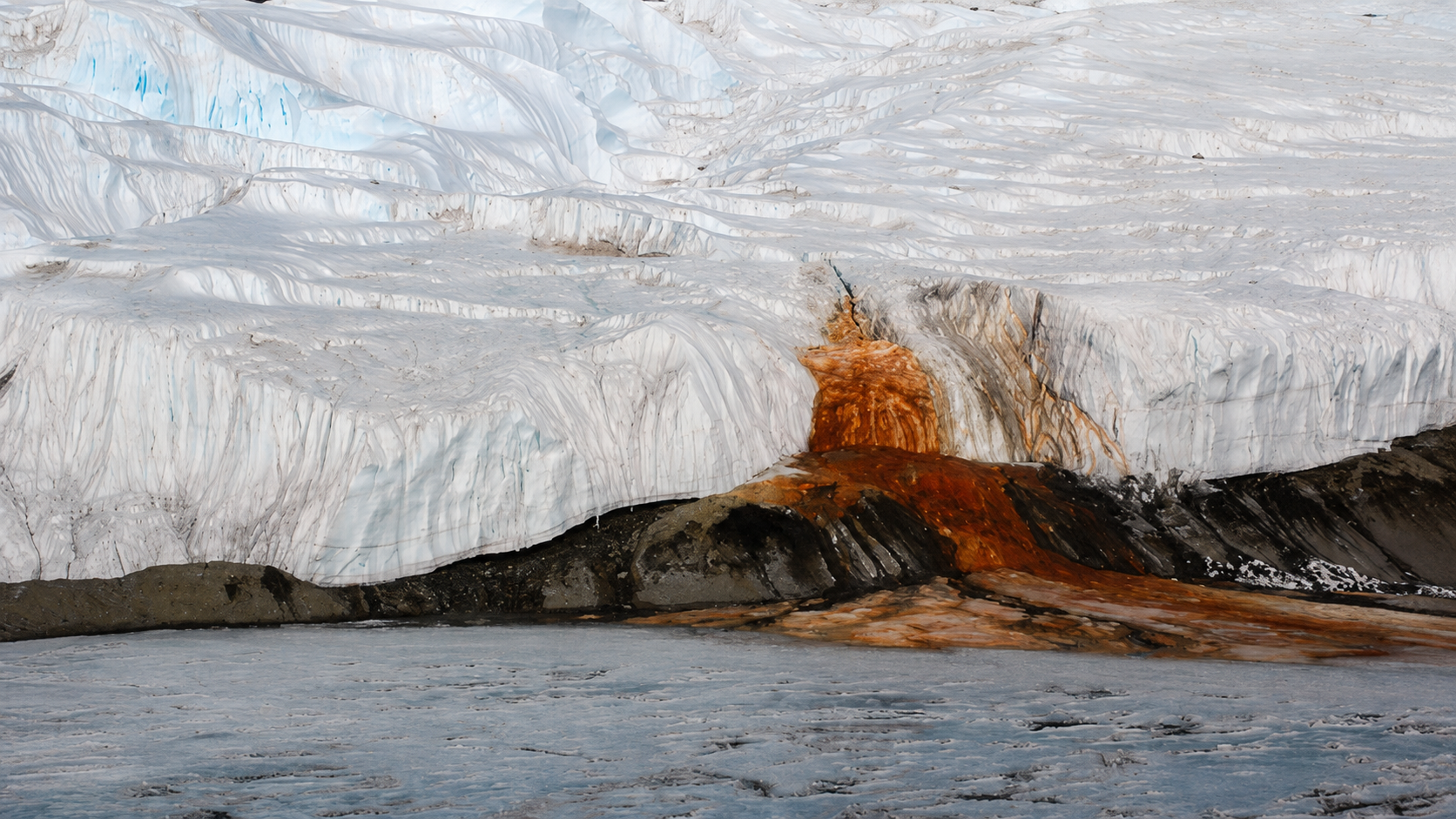
Illustration by Domi Verse X
For a century the color had an obvious explanation. Then researchers went looking for it in the samples, and it was not there.
This article contains affiliate links. If you buy through them, we may earn a small commission at no extra cost to you.
At the far end of Taylor Glacier, where the ice meets a frozen lake, a deep red stain pours down a wall of white. It does not look like geology. It looks like a wound. The color comes from iron, the same element that turns a nail red when you leave it outside in the rain, and if you want to see what that looks like up close you can hold a piece of raw iron oxide in your hand. The people who found this place did not need a scientific name for it. They called it Blood Falls, and the name stuck.
It is roughly five stories high, by EarthSky's description, and nobody has published a formal measurement. It sits in the McMurdo Dry Valleys, a corner of Antarctica that is mostly bare rock and gravel, and the water behind it has been sealed away far longer than our species has existed.
Water That Refuses to Freeze
The strangest thing about Blood Falls is not the color. It is that anything is flowing at all.
The liquid coming out is not meltwater. It is ancient seawater that got trapped under the glacier and then concentrated, over an enormous span of time, into a brine roughly two to three times saltier than the ocean. A published measurement puts it at roughly minus 7 degrees Celsius, around 19 degrees Fahrenheit, well below the point where ordinary water turns solid. Salt is what keeps it liquid, in the same way salt keeps a road clear in winter, and you can measure that effect at home with a salinity refractometer for the price of a pizza.
But salt alone does not explain how the brine crosses the glacier. Ice that cold should seize it up. In 2017 a team led by researchers at the University of Alaska Fairbanks and Colorado College used radar to trace the path and found the answer hiding in something counterintuitive: freezing water gives off heat. As the brine partly freezes on its way through, it warms the ice around it just enough to keep its own channel open. "While it sounds counterintuitive, water releases heat as it freezes, and that heat warms the surrounding colder ice," glaciologist Erin Pettit explained.
The brine is, in effect, melting its own tunnel with the heat of its own freezing. The team behind that work describes Taylor Glacier as the coldest known glacier with water that flows all the time.
The Mineral That Was Never There
Here is the part that almost nobody knows.
For most of the last century the red was explained as iron oxide. Rust. It is the obvious answer, it appears in most popular accounts, and it is close enough to be repeated forever. There was only one problem. When researchers put the samples under X-ray diffraction, the standard method for identifying minerals, the iron oxides were not there. The scan found calcite, aragonite, quartz, feldspar and clay. The one thing the whole story depended on was missing.
The answer came from a much more powerful instrument. Using transmission electron microscopy, a team publishing in Frontiers in Astronomy and Space Sciences found that the iron at Blood Falls is not a mineral in the normal sense at all. It exists as amorphous nanospheres, tiny balls of iron rich material with no crystal structure, which researchers at Johns Hopkins describe as roughly one hundredth the width of a red blood cell. They are far too small for any ordinary lens, though a cheap USB microscope will show you where that scale begins to disappear.
Enjoying this story?
Get a short teaser by email whenever we publish something new. No spam.
Because the spheres are not crystals, mineral analysis simply looked straight through them. The red was in plain sight for a hundred years and the instruments could not see it.
Something Down There Is Alive
The brine does not come from an empty pocket. It comes from a body of water sealed under the ice somewhere between roughly 1.5 and 2 million years ago, with no sunlight and no oxygen, and it is inhabited.
EarthSky puts the count at at least 17 types of microorganism. With no sun to power them and no oxygen to breathe, they run their metabolism on iron and sulfur instead, using sulfate to help pull energy out of the scraps of organic matter that were sealed in with them. They have been doing this, in complete darkness, since long before the first humans.
The red on the ice is, at least in part, that chemistry meeting open air.
Why a Red Stain Matters Off This Planet
This is where it stops being a curiosity.
The instruments we send to Mars are largely built to identify crystalline minerals, because that is what rock usually is. Blood Falls is a warning that a planet can hide its most interesting chemistry in a form those instruments are blind to. As Ken Livi of Johns Hopkins put it, properly understanding a rocky planet's surface would need a transmission electron microscope, and we cannot currently land one on Mars.
The Australian geologist Thomas Griffith Taylor is generally credited with recording the red deposit in 1911, and the first guess at the time was red algae. He was working with his eyes and his assumptions, and the accounts left behind by that generation of Antarctic explorers still make for uncomfortable reading. We now know the guess was wrong, and we also know that our own best instruments walked past the real answer for decades.
Which raises the obvious question. On a world where we cannot send anything better than a rover, how much have we already driven past?
Sources
- A Multi-Technique Analysis of Surface Materials From Blood Falls, Antarctica, Frontiers in Astronomy and Space Sciences
- An englacial hydrologic system of brine within a cold glacier, Journal of Glaciology
- Researchers solve the century-old mystery of Blood Falls, Phys.org
- Blood Falls Explained, Chemical & Engineering News
- Solving the Mystery of Blood Falls, Johns Hopkins Engineering
- Origin of Antarctica's eerie Blood Falls, EarthSky