This turtle has two heads, so which one decides where to go?
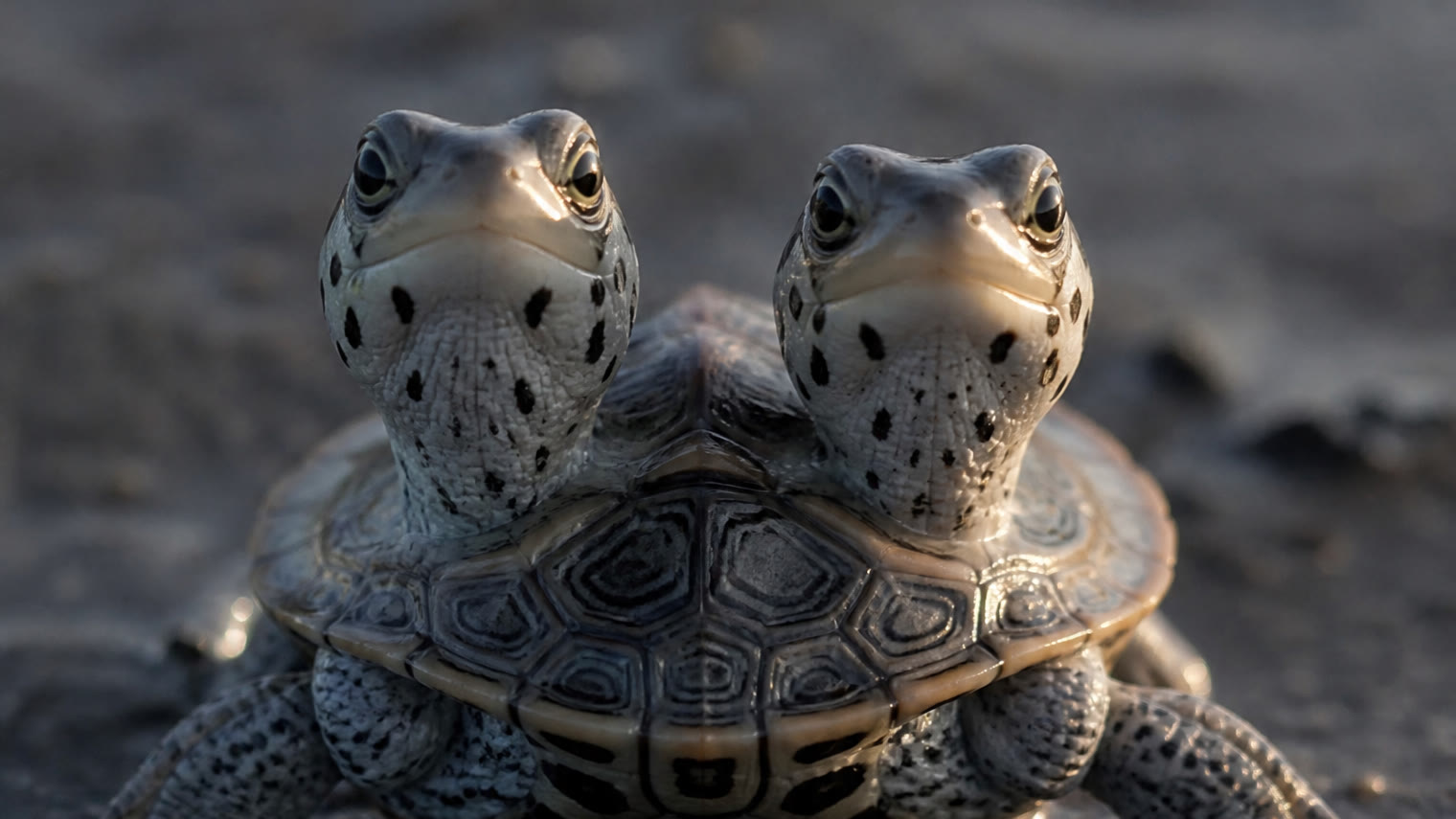
Illustration generated with AI for DomiVerseX
A hatchling that weighed about as much as one coin arrived at a wildlife clinic on Cape Cod in September 2026. It had one shell, two working heads, and a question its vets could not answer yet.
This article contains affiliate links. If you buy through them, we may earn a small commission at no extra cost to you.
On 17 September 2026, a very unusual baby turtle was brought to a wildlife clinic on Cape Cod, in the US state of Massachusetts. It had one shell and two heads, and both heads worked.
Volunteers from Mass Audubon's Wellfleet Bay Wildlife Sanctuary had found it at a protected nesting site in the town of Wellfleet. It went to the Cape Wildlife Center in Barnstable, which is run by New England Wildlife Centers.
One thing to know before you read on. This article was written on 12 October 2026, from reports published in the weeks after the hatchling arrived. Two-headed hatchlings often die young. So everything here describes what was seen and said at that time, and it stays true whatever happened afterwards.
Why should you care? You have one head, and it makes every choice about where your feet go. This animal raises a question you have never had to ask about yourself.
As heavy as a nickel
The hatchling was a diamondback terrapin, which is a kind of turtle. It weighed 5.2 grams, a figure from the clinic that Live Science, Smithsonian Magazine and IFLScience all repeat. One photo caption at IFLScience says 4.89 grams, probably from a different weighing. Either way, call it about 5 grams.
How little is that? The clinic compared it to a US nickel, which weighs 5 grams. One sheet of ordinary printer paper weighs about the same. Hold a sheet of paper flat on your hand, and that is the whole animal.
The reports agree on one shell and two heads that were described as "independent and functional". Smithsonian Magazine alone adds that it had four legs and a short tail, so treat that count as probably right until another outlet confirms it.
What was inside the shell was not known. Scans were planned for when the hatchling was bigger. Its sex was not known either, Smithsonian Magazine reported, and the vets planned to wait until it was older.
This matters because the outside of an animal tells you very little. The real answer to the headline is hidden under the shell.
How one egg ends up with two heads
The name for this is bicephaly. It happens when an embryo begins to split into twins and does not finish. You could think of it as twins that stopped halfway.
Why does it happen? Nobody has one simple answer. Zak Mertz, the CEO of New England Wildlife Centers, is quoted by Live Science as saying that genes and other factors that act on genes probably both play a part. He listed the temperature of the nest, its humidity, the conditions at the nest site and things the parents were exposed to as possible influences.
For you, the useful point is this: a two-headed animal is not a monster and not a magic trick. It is an ordinary start to life that took an unusual turn very early.
What the vets saw in 2021
No report said how the two heads of the 2026 hatchling shared control. Smithsonian Magazine reported only that it was swimming, eating and behaving normally. Zak Mertz said "the left head has the bigger personality", and Robyn Rohm, quoted in the same article, said it was "biting the day he came in".
So the best clues come from an earlier animal. In 2021 the same organization cared for another two-headed terrapin hatchling from the same coast. That one had six legs. Staff watched it move and saw that each head controlled three of the legs, according to posts from the center quoted by WBAY and WRTV.
That sounds like a recipe for going in circles. But in a supervised test in deep water, the two heads worked together to reach the surface and breathe.
Have you ever run a three legged race, tied to a friend at the ankle? Each of you steers your own legs, and you still have to arrive together. That is about what the 2021 hatchling managed. The 2026 hatchling was reported by Smithsonian Magazine to have four legs, not six, so its heads could share the work in a different way.
Enjoying this story?
Get a short teaser by email whenever we publish something new. No spam.
Maybe it is not one animal at all
Here is the part that changes the question. The 2021 hatchling had two spines, which joined into one lower down. A test showed it also had two separate digestive tracts. Each head ate for itself and digested for itself. The center fed it bloodworms and pellets.
So a two-headed turtle could be two animals sharing one shell. If that is the case, "which head decides" is the wrong question. A better one is: how do two animals agree on where one body goes?
A case from the Swiss city of Geneva shows what happens when they do not agree. According to ZME Science, which is the only source we found for this and which cites his keepers at the Geneva museum, a two-headed Greek tortoise named Janus hatched in 1997, and each of his heads probably runs its own side of the body. ZME Science also reports that the two heads sometimes try to walk in opposite directions, and that he probably has two hearts and two pairs of lungs. If that account is right, Janus was about 25 years old when it was written in 2022, more than twice the age of a 10 year old.
Why does this matter to you? Because it shows that "one animal" is not always as clear as it looks. One shell does not have to mean one mind.
Why most two-headed animals do not last
This is the hard part of the story. Two-headed animals often do not live long.
There was a fresh example. A two-headed crested gecko called Simon and Garfunkel hatched in June 2026 and died in August, about two months later, after struggling to eat, IFLScience reported. A 2021 study of two-headed and partly doubled sea turtle embryos found major problems in the skull and spine and a smaller body size, according to Live Science.
Even a survivor has a harder life. ZME Science reports that Janus probably cannot pull both heads into his shell and struggles to get back on his feet if he is flipped over, which is why, in that account, he could not survive in the wild.
For the 2026 hatchling the plan was open. If it was judged strong enough it could be released, Smithsonian Magazine reported. If not, it would live in captivity.
How rare is this?
Rare, but it keeps happening on this one stretch of coast. This was the third two-headed terrapin the Cape Wildlife Center had treated. Here the sources do not quite agree: Live Science and CNN, in a report carried by Cleveland 19, say three in five years, while Smithsonian Magazine says three in six years. The first case was in 2021, so the safe way to say it is three since 2021.
Smithsonian Magazine alone reports that Mass Audubon has seen five two-headed terrapins on Cape Cod since the early 2000s, which, if that count is right, is about one every five years. Live Science alone reports that diamondback terrapins are listed as threatened in Massachusetts, and if so, every hatchling that survives counts for more.
There is a lesson in who found it. Nobody would know about this animal if volunteers had not been watching a nesting site. A lot of what we know about wildlife starts with ordinary people paying attention.
So which head decides?
For this hatchling, the honest answer in October 2026 was: not known yet. Each head could control its own side. They could share. One could lead and the other follow, and the remark about the left head's bigger personality makes that worth watching.
The vets said they would find out as it grew and could be scanned. That depended on the hardest thing for any two-headed hatchling, which is simply staying alive long enough.
If two heads share one body, does one of them have to be in charge?
Sources
- Rare two-headed turtle hatchling discovered on Cape Cod, Live Science
- Two heads are better than one: rare double-headed turtle hatchling discovered on Cape Cod, Smithsonian Magazine
- Rare two-headed terrapin hatchling is a total treasure and weighs about as much as a single sheet of paper, IFLScience
- Rare two-headed turtle hatchling found on Cape Cod, Cleveland 19 News (CNN)
- Seeing double: rare two-headed turtle hatches at protected nesting site, WBAY
- 2-headed baby turtle thrives at Massachusetts wildlife center, WRTV
- Janus, the two-headed tortoise, ZME Science
- Coin specifications, United States Mint