This animal was born before the light bulb was invented
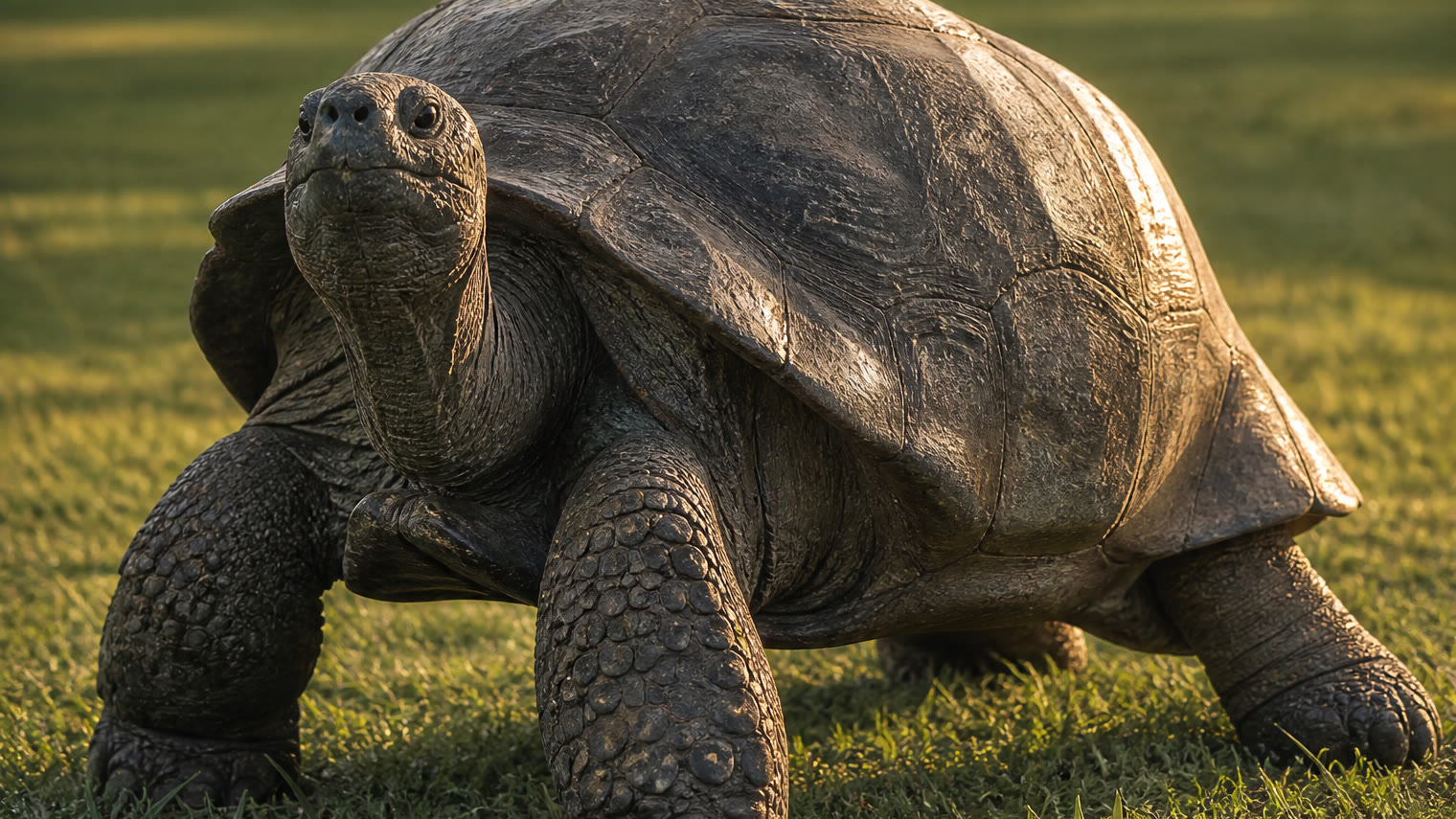
Illustration generated with AI for DomiVerseX
A giant tortoise on a faraway island was already grown up when electric light was brand new. In 2026 scientists read his DNA to look for his secret.
This article contains affiliate links. If you buy through them, we may earn a small commission at no extra cost to you.
On the island of Saint Helena there is a house called Plantation House, and it was home to a giant tortoise named Jonathan. As of October 2026, when this article was written, Guinness World Records listed him as the oldest known living land animal. His age was given as about 194 years.
Think about what a number like that means. Aldabra giant tortoises, his kind, can live into their 90s, according to Live Science. Jonathan had reached about twice that. That is like living two long tortoise lives, one after the other.
This article is careful with dates on purpose. An animal this old will not be here forever, and one day the news about him will be sad. Everything below describes Jonathan as he was known in October 2026.
47 years ahead of the light bulb
Jonathan's hatching is estimated at about 1832. The light bulb in the headline is the practical kind, the one linked to two inventors, Edison and Swan. Edison's first successful test came in October 1879, a date given by both the US Department of Energy and Wikipedia. If Wikipedia's dates are right, Swan showed his lamp to audiences a few months before that, between December 1878 and February 1879.
From 1832 to 1879 is 47 years. To feel how long that is, count 47 years back from 2026. You land in 1979. So when the bulb first worked, Jonathan was already as old as someone born in 1979 was in 2026.
Were there lamps before Edison? Yes, a few experiments. One by Lindsay came in 1835 and one by De la Rue in 1840, and if the 1832 estimate is right, Jonathan was ahead of those too. The only earlier date is 1802, when Humphry Davy made a strip of platinum glow. That was a glowing strip, not a bulb.
And here is the neat part. The headline holds even if the 1832 estimate is thrown away. Jonathan arrived on Saint Helena in 1882, and he was already full-grown. A full-grown tortoise in 1882 was certainly alive in 1879.
Why does this matter to you? Every time you flip a switch, you are using something newer than an animal that was still walking around in 2026.
A gift that arrived already grown
Jonathan came to Saint Helena from the Seychelles in 1882. If Guinness World Records has the detail right, he was a gift to a man named Sir William Grey-Wilson. By 2026 he had spent 144 years on the island. If a new human generation comes along about every 25 years, that is almost six generations of islanders who grew up with the same tortoise as a neighbor.
An early photograph shows him already full-size. It was once dated to 1902 and was later re-dated to 1886, according to Wikipedia's article on Jonathan. Guinness places it between 1882 and 1886. Either way, he looks like an adult in it.
What kind of animal was he? The 2026 science coverage calls him an Aldabra giant tortoise. Wikipedia calls him a Seychelles giant tortoise. The two names belong to the same species, so both are fair.
Among tortoises, the record before him belonged to one named Tu'i Malila, who died in 1966. Guinness gives that tortoise's age as at least 188, and Wikipedia gives 189. Call it about 188. Jonathan passed that mark by about six years. In 2022, Guinness gave him a wider title as well: oldest chelonian ever, a group that takes in every turtle, terrapin and tortoise.
Old age had a price. If Wikipedia's account is right, his vet, Joe Hollins, said in 2015 that Jonathan was blind from cataracts and had lost his sense of smell. He also had a companion tortoise called Frederik, who was thought to be a female named Frederica until 2017, the same article says.
Why does this matter to you? A record like "oldest" is built from small things: a ship's arrival, an old photo, a vet's notes. It is worth asking where any record comes from.
The twist: nobody knows how old he really was
Here is what the headline cannot tell you. Nobody wrote down the day Jonathan hatched. The year 1832 is not a birth record. It is a floor.
Enjoying this story?
Get a short teaser by email whenever we publish something new. No spam.
The reasoning goes like this. When he arrived in 1882 he was described as fully mature, and a tortoise like him was judged to need at least 50 years to get there. Take 50 from 1882 and you get 1832. That makes 1832 the latest year that fits, not the true year. He could have been older, and nobody can say by how much.
It is like meeting a new neighbor and knowing only that he was already a grown-up when he moved in. You can say he is at least a certain age. You cannot say more.
Even his birthday was chosen for him. In November 2022 the island's governor, Nigel Phillips, gave him an official one: 4 December. By that rule he would turn 194 on 4 December 2026, though many reports were already calling him 194 before then, because 2026 minus 1832 is 194. That is why this article says "about".
Why does this matter to you? "About 194" is an honest number, and "194" alone is a little too sure of itself. The word "about" is doing real work.
What scientists found in his DNA
On 7 October 2026 a study of Jonathan appeared in the journal Science Advances. It reported 287 gene variants that were unique to him, all in parts of the body's instructions linked to aging, according to Live Science and Popular Science. To picture 287, count the days of a year from New Year's Day. You would reach the middle of October.
Getting his DNA was not simple. If Live Science's report is right, the island did not allow a blood sample, so Joe Hollins took cells from inside the tortoise's cheek. The first swab gave only mouth bacteria, the same report says, and a second try gave tortoise DNA.
The DNA came out in broken pieces. To fill the gaps, the team used the genome of another Aldabra tortoise, a 36-year-old named Tank. Jonathan was more than five times his age. They also compared him with Lonesome George, the last tortoise of his kind from Pinta Island in the Galápagos.
One of the authors, Justin Gerlach, is quoted by Popular Science as saying that the controls for energy production and DNA repair "have remained incredibly stable in Jonathan over almost two centuries". Popular Science also noted that another author, Stephen Clark, founded the Kallel Foundation, a nonprofit for aging research. That is worth knowing when you read the results.
Why does this matter to you? It shows what one small scrape from a cheek can hold: the full set of instructions for an animal's body, readable in a lab.
A sign, not a cause
Now the second half of the twist. The study found things that go together with Jonathan's long life. It did not show that they caused it.
A biologist who was not part of the work, Vincent Lynch, put it this way: Jonathan could be "just really good at being old". In other words, the calm, stable pattern in his cells could be the reason he lasted. Or it could simply be what a healthy, very old tortoise looks like.
One more thing needs saying plainly. Nothing in this study tells a person how to live longer. It is about one tortoise.
Why does this matter to you? You will meet many headlines that say a gene "explains" something. Two things found together are not the same as one causing the other.
The question he leaves behind
In June 2026 a false story spread that Jonathan had died, Popular Science reported. It was a hoax. If you are reading this long after October 2026, look for a dated report before you repeat anything about him.
Whatever the date, one thing in this story cannot change: he was alive before the first practical light bulb glowed. What nobody could answer in October 2026 was the bigger puzzle. Did those steady genes keep him alive for about 194 years, or did he keep them steady simply by staying alive?
Sources
- 190-year-old Jonathan becomes world's oldest tortoise ever, Guinness World Records
- Jonathan (tortoise), Wikipedia
- Scientists discover the genetic secrets that may have helped Jonathan the tortoise live to 194 years old, Live Science
- Report on the gene study of Jonathan the tortoise, Popular Science
- Epigenetic insights into extreme longevity in the world's oldest terrestrial animal, Jonathan, Science Advances
- The History of the Light Bulb, US Department of Energy
- Incandescent light bulb, Wikipedia