Archaeologists on a construction site found something huge. It was about 27,000 years old
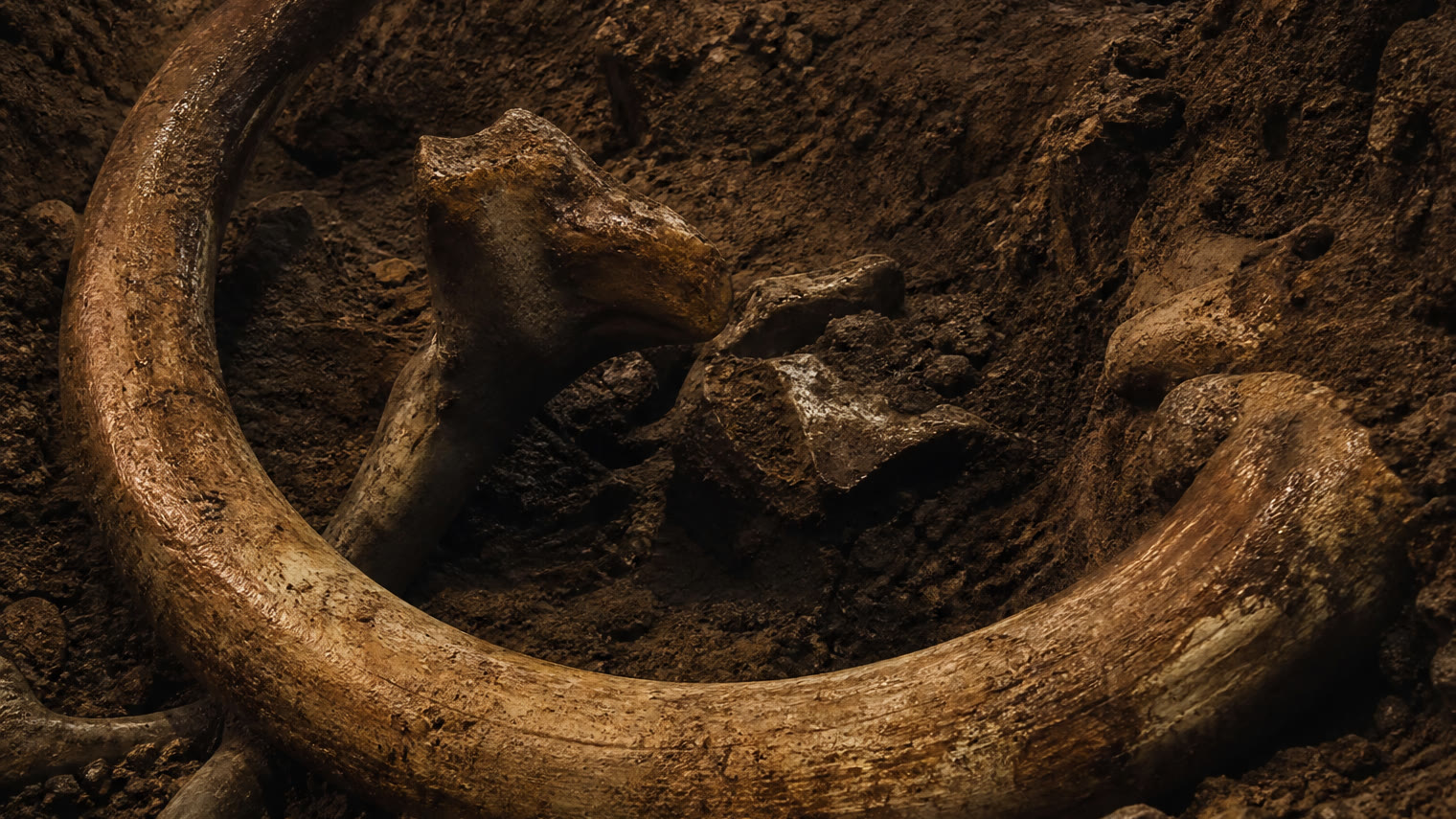
AI-generated illustration
A Czech city wanted a new courthouse. The ground underneath it was hiding the leftovers of an Ice Age feast: bones from at least twenty woolly mammoths.
This article contains affiliate links. If you buy through them, we may earn a small commission at no extra cost to you.
In autumn 2024, builders in the Czech city of Ústí nad Labem started digging foundations for a new Justice Palace, a big courthouse complex. Archaeologists were watching the work, as routine monitoring. On 4 November 2024, according to the local paper Ústecký deník, the first bones appeared about 2.6 metres down. That is roughly as deep as a normal room is tall.
They were not cow bones or old rubbish. They were mammoth bones, lots of them, lying next to stone tools and patches of old fire. The dig that followed turned a building plot into one of the most talked about Stone Age sites in Central Europe.
What came out of the ground
The numbers are big. Over an area of about 1,000 square metres, roughly the size of four tennis courts, the team recorded more than 3,500 animal remains, as ScienceAlert reported from the scientific paper. If you set them down one per step, you would walk for about half an hour before running out.
How do you count mammoths in a pile of broken bones? You look for parts that every animal has only one of. The researchers found 19 lower jaws and one extra tooth that did not fit any of them, so the minimum is 20 woolly mammoths. The real number could be higher.
Mammoths were not alone in the excavation. The paper lists at least two woolly rhinos, plus one horse, one reindeer and one hare.
Then there are the human traces. The team found about 141 stone artefacts bigger than 1.5 cm, which is roughly the size of your thumbnail. Among them were small blades with one blunted edge, a knife of the so-called Kostenki type, and tiny pointed tips called microgravettes. They also found several fireplaces, stains of red ochre (a natural red pigment) and a pendant carved from mammoth ivory.
Why this matters to you: this is not a museum reconstruction. It is a real, almost fully dug site, studied with modern methods, and the first results are already published.
How big is a mammoth, really?
Forget the cartoon giants. According to Professor Adrian Lister of the Natural History Museum in London, woolly mammoths stood about 3 to 3.5 metres at the shoulder and weighed around four to six tonnes. That is taller than a garden shed and about as heavy as three or four family cars.
Now picture twenty of them. Even one animal is tonnes of meat, fat, skin, bone and ivory. For a small group of hunters, a single mammoth could be a food supply for a long time. Twenty is a whole economy.
Hunted or found dead?
This is the big question, and the honest answer is: probably hunted, but not proven.
The charcoal from the fireplaces gives radiocarbon dates of roughly 28,800 to 25,600 years ago. That is more than a thousand human generations back, in a cultural period archaeologists call the Late Gravettian.
The ages of the animals are the strongest clue. ScienceAlert reports that 13 of the 20 mammoths were roughly 13 to 27 years old, which means young adults in their prime. Natural disasters and disease tend to kill the very young and the very old. A pile full of healthy adults looks more like people choosing their targets.
There is more. The researchers found cut marks on mammoth ribs, the kind a stone blade leaves when meat is sliced off. And in the paper in the Journal of Archaeological Science: Reports, led by Dominik Chlachula with co-authors including Petr Lissek and Soňa Herčíková, one microgravette fragment and one bladelet show breakage typical of impact damage. In plain words, they look like spear tips that snapped when they hit something hard.
Still, the authors are careful. They write that the bones were piled up by humans who used fresh carcasses, "possibly obtained by selective hunting", and they say scavenging mammoths that died naturally cannot be ruled out. So "Ice Age butcher shop" fits. "Ice Age slaughterhouse" would claim more than the evidence can carry.
Enjoying this story?
Get a short teaser by email whenever we publish something new. No spam.
For comparison, at the Polish site of Kraków Spadzista, researchers found remains of at least 112 mammoths and a flint point stuck right inside a mammoth rib. That is the kind of smoking gun Ústí does not have yet.
The twist: it is on the wrong side of the map
Here is the strangest part. Big mammoth bone sites of this age are famous in Moravia, the eastern part of the Czech Republic, at places like Dolní Věstonice, Pavlov and Milovice. Ústí nad Labem is in Bohemia, far to the north west.
According to the new paper, mammoth bone deposits like this were "virtually unknown" in Bohemia until now. The authors call the site an outlying occurrence beyond the "core" Gravettian area. In other words, the map of where Ice Age mammoth hunters worked just got bigger.
So why here? Ústí sits on the Elbe river, just north of a narrow valley called Porta Bohemica, the "Gate of Bohemia". Ústecký deník quotes the dig leader Petr Lissek, director of the Institute of Archaeological Heritage of Northwest Bohemia, saying roughly that ancient hunters also travelled through northern Bohemia via Porta Bohemica and Ústí. Our hedged guess: a river valley works like a funnel. Animals moving through a landscape follow easy paths, and people who know those paths know where to wait. That is an idea, not a finding, but it would explain why hunters kept coming back to the same spot.
Why this matters to you: our picture of the past is built from where people happened to dig. Moravia has been dug for generations. Northern Bohemia, apparently, was just waiting for a courthouse.
What a mammoth meant to an Ice Age family
For people in the Gravettian period, a mammoth was not only dinner. Researchers across Central and Eastern Europe have described huts built partly from mammoth bones, and ivory was carved into jewellery and figures. At Dolní Věstonice, for example, archaeologists have studied necklaces made from mammoth ivory.
The Ústí pendant fits that pattern. Someone took time to carve a piece of ivory into something to wear, right next to the place where carcasses were cut up.
One odd detail: according to the paper, tusks at Ústí turn up only as fragments or incomplete pieces. Some tusk pieces were found, but they are rare. Maybe the hunters carried the valuable ivory away. That is our speculation, not the researchers' conclusion.
A courthouse that has to wait
Modern life paid a price too. The courthouse contract is worth about 2.25 billion Czech crowns, roughly 90 million euros, according to Radio Prague and Czech legal news site Česká justice. The second source reports that completion has moved from the first half of 2027 to May 2028, more than a year late. That date comes from one outlet, so treat it as the latest estimate rather than a promise.
And the digging is not over. Česká justice writes that archaeologists returned in spring 2026, with final checks planned for 2027 along a sewer line and a second water basin.
So what else is under our cities?
Ústí is not a one off. The city already had a mammoth find in 2006, and older bones turned up in brick pits over the years, Czech Television reports. On the other side of the world, construction of a new airport near Mexico City uncovered remains of more than 100 mammoths, according to NBC News.
Most of what we know about the Ice Age comes from lucky breaks like these: a road, a sewer, a basement. Every city that sits on an old river valley may be sitting on something similar. The uncomfortable question is how many sites were quietly bulldozed before anyone was watching, and how many are still down there, under the car park you walked across this morning.
Sources
- ScienceAlert: Huge haul of Ice Age mammoth bones unearthed beneath Czech construction site
- Chlachula et al., A new Late Gravettian mammoth bone deposit in Bukov, Ústí nad Labem, North Bohemia (Journal of Archaeological Science: Reports)
- Radio Prague International: Mammoth hunting camp discovered in Ústí nad Labem
- ČT24: Kosti mamutů i kamenné artefakty objevili archeologové v Ústí nad Labem
- Ústecký deník: Dvacet mamutů. Ústí patří k nejvýznamnějším světovým archeologickým nalezištím
- Česká justice: Nález mamutů v Ústí posunul stavbu paláce za miliardy
- Natural History Museum: Were all mammoths woolly?
- NBC News: Airport construction in Mexico unearths more than 100 mammoth skeletons