
This single cell moves two hundred times faster than you can blink.
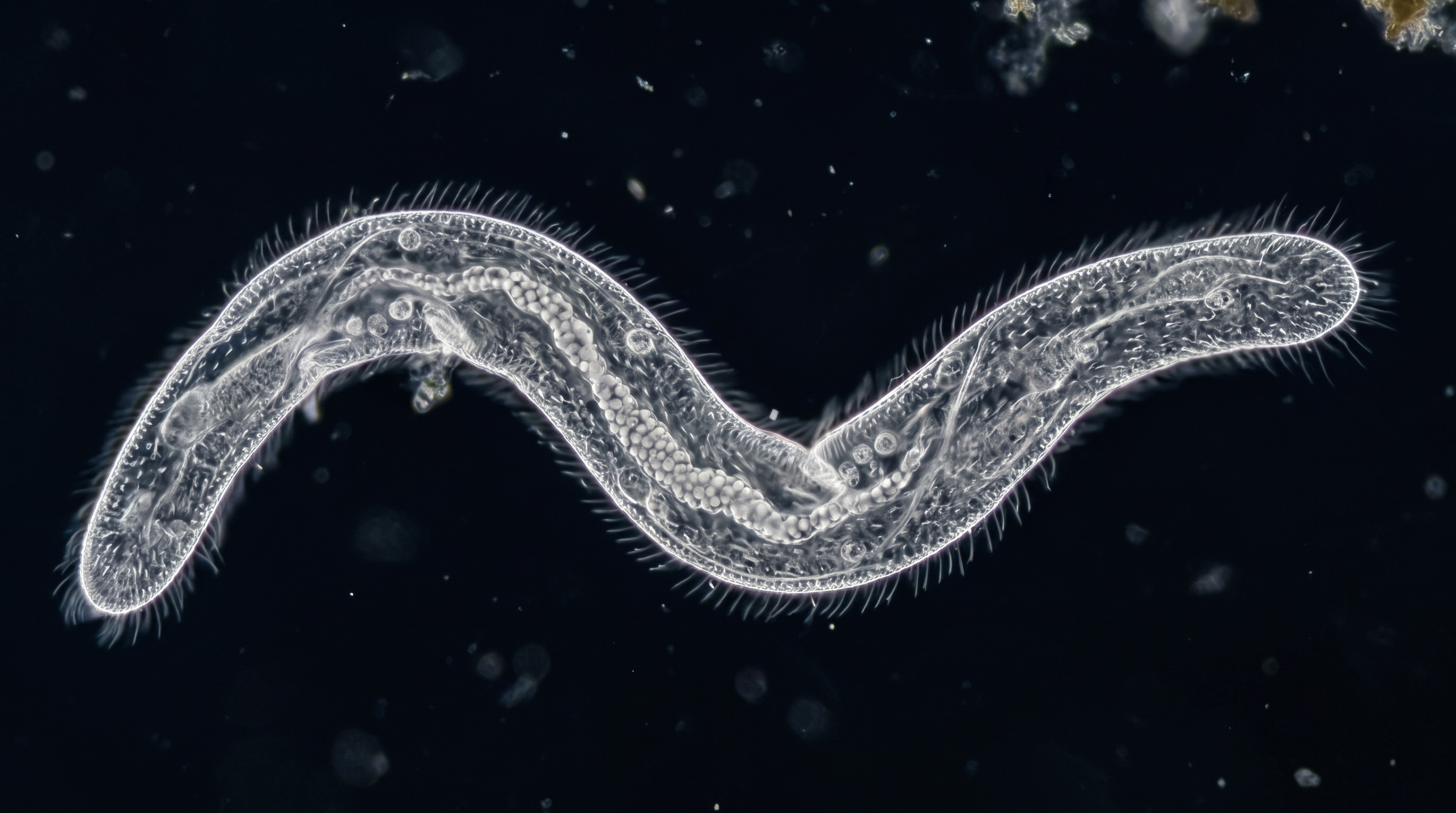
AI-generated illustration
A single cell called Spirostomum ambiguum contracts to a quarter of its length in under five milliseconds, roughly 200 times faster than a human blink, with no muscles, no brain, and no nerves at all.
This article contains affiliate links. If you buy through them, we may earn a small commission at no extra cost to you.
Scoop up a handful of mud from the bottom of a quiet pond and you might spot a thin, wobbling thread drifting through the water. It looks like a tiny worm, gliding and stretching along the muck. It is not a worm at all. It is a single cell, and it is about to do something most animals with actual muscles cannot manage.
A giant of the microscopic world
The creature is called *Spirostomum ambiguum*, and despite being made of just one cell, it is a giant by microbial standards. Depending on how stretched out it is, it typically measures somewhere around 1 to 4 millimeters long, long enough that a patient observer with sharp eyes could, in theory, just barely make one out without a microscope. It lives in freshwater sediment, feeding quietly and minding its own business, until something disturbs it. If you want to see something like it for yourself, a real beginner microscope kit like this one is enough to spot pond life of your own.
The blink you would miss
That is when things get strange. When *Spirostomum* senses danger, it does not swim away. It contracts, yanking its whole body down to about a quarter of its stretched-out length in under five milliseconds, a motion so quick that researchers clocked it at roughly 100 body lengths every second, which news coverage of the discovery translated into a comparison people could actually picture: about 200 times faster than a human eye blink. For comparison, your own muscles, built from specialized fibers with a whole nervous system telling them what to do, need roughly ten times longer to shorten by a similar fraction. This cell has none of that equipment. No muscle fibers, no brain, no nerves. Just one cell, doing it anyway.
So what is actually pulling the trigger
Enjoying this story?
Get a short teaser by email whenever we publish something new. No spam.
For decades, biologists knew *Spirostomum* could do this but not exactly how. That changed with a study published in the journal *PNAS* on May 29, 2026, led by biophysicist Mary Elting at North Carolina State University along with collaborators from the University of Chicago, Drake University, and the University of Colorado Boulder. The team found a mesh-like network running just under the cell's surface, built from two proteins called centrin and Sfi1, arranged like a woven fishnet. When calcium floods into the cell, the Sfi1 protein loses its rigid, rod-like shape and clumps together, described by the researchers as looking like a ball of wet spaghetti. As thousands of these tiny clumps form at once across the net, the whole structure yanks tight in an instant, dragging the entire cell shut like a drawstring bag.
Why it does not just crush itself
Here is the part that makes it more than a party trick. A contraction this violent and this fast could easily tear a cell apart or crush the delicate machinery inside it. Because the fishnet tightens everywhere at once rather than in one spot, the force spreads evenly through the whole cell instead of ripping through it in one place. It is the same reason a net closes smoothly around a catch instead of snapping in one corner. That even distribution is likely a big part of how *Spirostomum* survives doing this over and over, all day, every day, its whole life.
What is still a mystery
The researchers are upfront that they have not solved everything. They still do not know exactly what triggers the electrical signal that lets calcium into the cell in the first place, and they are not yet sure how the cell resets and recharges itself so it can contract again seconds later, sometimes hundreds of times without stopping. The team has suggested this fishnet trick could one day inspire faster, calcium-powered artificial muscles or synthetic cell machinery, though that remains an early idea rather than something built and tested.
So a creature you could almost see with your bare eyes, living in ordinary pond mud, is quietly outperforming your own muscles by a wide margin. If one cell can do this without a single nerve, what else might ordinary pond water be hiding that nobody has thought to look at closely yet?
Sources
- This Tiny Organism Contracts 200 Times Faster Than We Can Blink. Here's How. | NC State News, https://news.ncsu.edu/2026/06/this-tiny-organism-contracts-200-times-faster-than-we-can-blink-heres-how/
- This Tiny Organism Contracts 200 Times Faster Than You Can Blink, Scientists Finally Know How | SciTechDaily, https://scitechdaily.com/this-tiny-organism-contracts-200-times-faster-than-you-can-blink-scientists-finally-know-how/
- A centrin-Sfi1 myoneme fishnet powers ultrafast calcium-triggered contraction in the giant ciliate Spirostomum ambiguum | PNAS, https://www.pnas.org/doi/abs/10.1073/pnas.2601408123
- Spirostomum ambiguum species profile | Real Micro Life, https://realmicrolife.com/spirostomum-ambiguum/