This dinosaur was not running. It was just walking, and its footprints prove it.
AI-generated illustration
A trail of prints from an adult T. rex, each one longer than your forearm, shows the largest predator to ever walk North America moving at an almost casual pace, sixty six million years ago.
This article contains affiliate links. If you buy through them, we may earn a small commission at no extra cost to you.
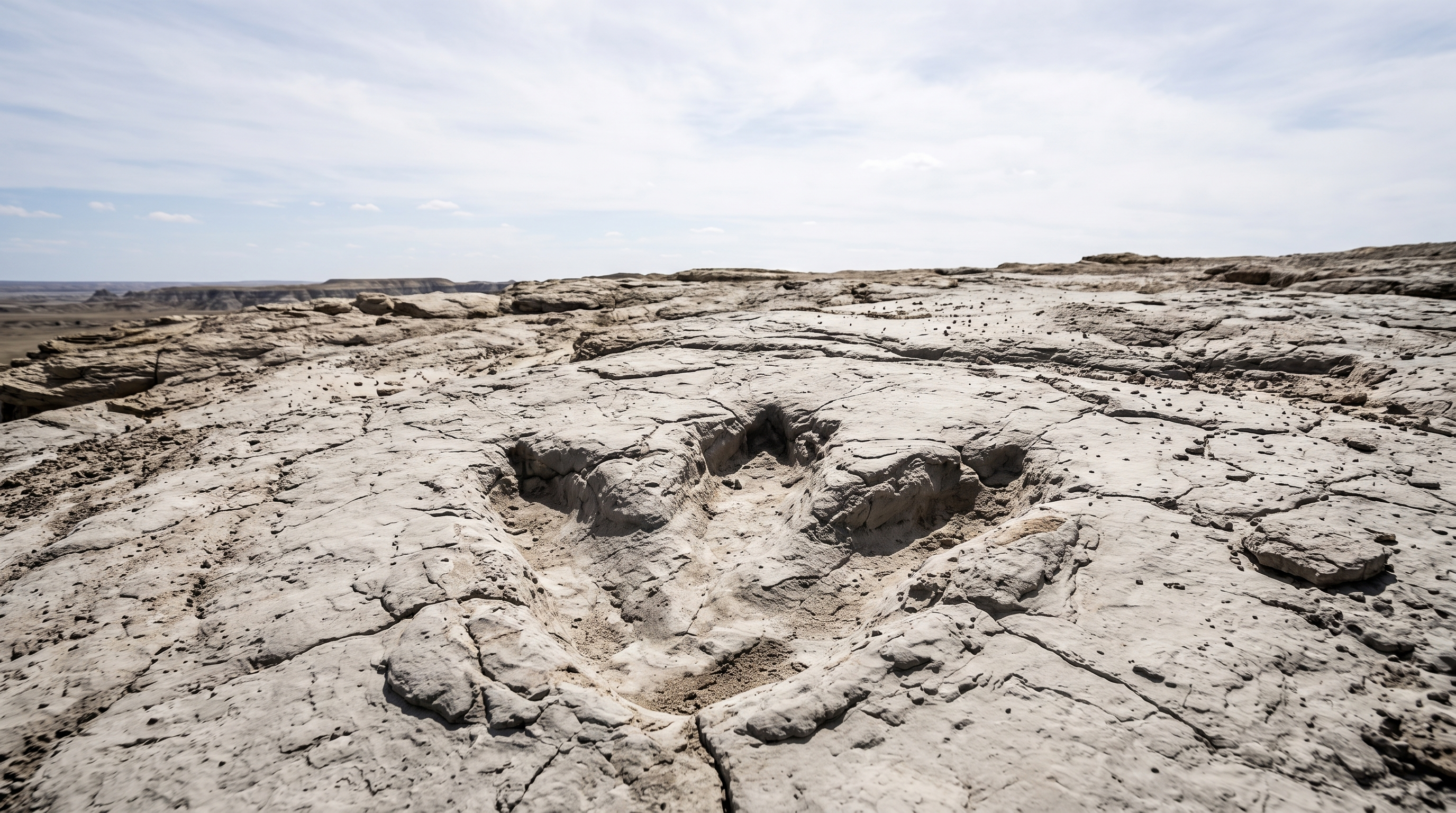
Kent Hups was not looking for dinosaurs that day. He was a high school teacher recovering from knee surgery, picking his way along an easier path through a valley in the North Dakota badlands so he would not strain his leg. Something odd stuck up out of the dirt. It looked like a lumpy, wedge-shaped rock. Except it also looked, if you squinted, like three splayed toes.
He texted a photo to Tyler Lyson, a paleontologist at the Denver Museum of Nature & Science whose dig he was volunteering on. Lyson was not convinced by one rock. "Send me a pic," he wrote back, and kept working. Only two footprints from an adult T. rex had ever been confirmed to exist anywhere in the world, both of them isolated prints with no others nearby. One more odd rock was not going to change that. If a find like this makes you want to hunt for your own fossils, a dinosaur dig kit is a low-stakes way to get a taste of it.
A pattern, not just a print
Then Hups found a second track. Then a third, lined up with the first two like stepping stones. That was the moment Lyson's skepticism cracked. "I want to see a pattern," he had told Hups, and now there was one: a straight line of prints, spaced the way a walking animal's feet actually fall, not scattered randomly the way isolated fossils usually are.
That pattern is the whole discovery. A single T. rex footprint just tells you an animal that size walked through the area once. A trackway, a connected line of prints from the same animal in the same walk, tells you how it was moving in that exact moment, 66.5 million years ago, in the Hell Creek Formation of southwestern North Dakota. Researchers eventually documented at least four footprints in the line, based on the published paper, though the field team also flagged a possible fifth print nearby that was too worn down to confidently count. Even the confirmed prints are not perfectly crisp: they are casts formed in cemented sandstone, so fine details like individual toe pads did not survive 66 million years underground.
Reading a giant footprint like a ruler
Enjoying this story?
Get a short teaser by email whenever we publish something new. No spam.
Here is why one dinosaur's stroll matters to you: it turns a skeleton into a moving animal. Each footprint measured roughly 90 centimeters long, about the length of an adult's forearm and hand held out straight, several times over. The distance between matching footprints, the stride, was about 4 meters, roughly the length of a small car. Stretched end to end, the whole trackway ran about 7 meters, the length of a school bus.
Scientists cannot put a stopwatch on an animal that died before humans existed, so they estimated how fast this T. rex was moving using its stride length and an assumed hip height, the same basic math used to guess a person's walking speed from the length of their footprints in snow. That calculation put this T. rex at roughly 5.6 to 7.2 kilometers per hour, close to a brisk human walking pace, not a jog and nowhere near a sprint. It is an estimate built from a formula, not a direct measurement, and the researchers themselves noted that millions of years of erosion make the prints an imperfect ruler. One report on the discovery described the animal as weighing more than seven tons, roughly two full-grown elephants, though that figure comes from outside estimates of adult T. rex size generally, not a number the trackway paper itself calculated from these particular footprints.
Why a casual walk is the interesting part
Movies show T. rex charging after jeeps. This fossil shows something quieter: on an ordinary day, the biggest predator in its world was not chasing anything. It was just walking, the way a dog ambles across a yard rather than sprinting after a squirrel. Scientists already suspected adult T. rex spent most of its life walking rather than running, since a multi-ton body moving at full speed risks serious injury with every misstep. A relaxed trackway like this one is a rare piece of direct evidence for that idea, frozen in stone from one ordinary afternoon in the Cretaceous.
The find was published in the Journal of Vertebrate Paleontology in September 2026, and Hups, the teacher who first spotted the odd rock, ended up as a co-author on the paper.
So the next time you picture a T. rex, maybe do not picture it running at all. Picture it walking, the way you walk to the mailbox: no rush, no drama, just a very large animal going somewhere. What was it walking toward that day, and will erosion in these same badlands ever uncover the next print in the line, or the one before it?
Sources
- First-Ever Adult Tyrannosaurus rex Trackway Discovered | Sci.News, https://www.sci.news/paleontology/adult-tyrannosaurus-rex-trackway-15056.html
- Scientists Just Watched an Adult T. Rex Walk, 66.5 Million Years Later | La Brújula Verde, https://www.labrujulaverde.com/en/2026/09/scientists-just-watched-an-adult-t-rex-walk-665-million-years-later/
- How an Unlikely Fossil Hunter Found a Tyrannosaurus Trail | National Geographic, https://www.nationalgeographic.com/science/article/tyrannosaurus-rex-footprints-dakota-badlands
- These Four Giant Dinosaur Footprints Discovered in North Dakota Might Represent the First Trackway Made by an Adult T. Rex Ever Found | Smithsonian Magazine, https://www.smithsonianmag.com/smart-news/these-four-giant-dinosaur-footprints-discovered-in-north-dakota-might-represent-the-first-trackway-made-by-an-adult-t-rex-ever-found-180989481/