Is this sea turtle stuck head first in a big sponge?
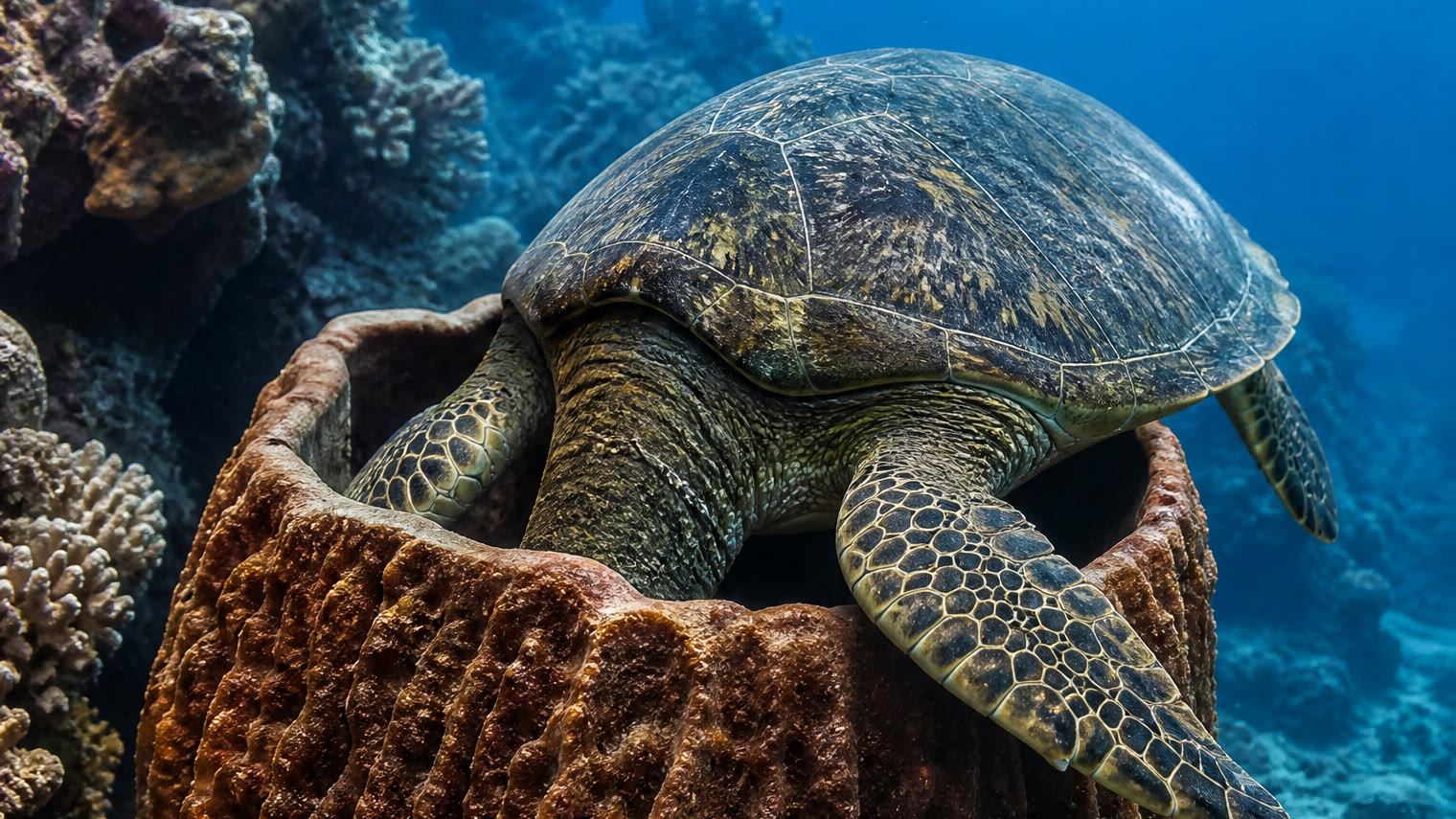
Illustration generated with AI for DomiVerseX
A video from the Philippines shows a turtle that looks like it is in real trouble. The diver who shared it says you should look again.
This article contains affiliate links. If you buy through them, we may earn a small commission at no extra cost to you.
Picture a sea turtle standing on its head. Its head and the front of its body have vanished into a big sponge. Its back end points up into the water. It does not move.
That is what a video from Moalboal, in the Philippines, shows, according to the magazine Discover Wildlife. A dive instructor named Oliver Richardson posted the clip on Instagram, and the magazine wrote about it on 7 October 2026. Richardson works at the Quo Vadis Dive Resort in Moalboal. His partner, Zoe Barrett, is credited with the night footage.
A note before you read on. The picture on this page is our own illustration: a turtle, a sponge and a coral reef, made from the description. The real video belongs to Richardson and Barrett.
Why does this matter to you? Because your first guess about an animal in a strange position is probably the same as everybody else's: something has gone wrong.
"You can't park there, mate"
People who saw the clip online had that same first guess. Discover Wildlife reports that several of them were worried and asked if the turtle had died. Others made jokes. "You can't park there, mate," one of them wrote.
Richardson answered them. "They just love this spot for a nap," he wrote. He told the worried ones that he could "assure" them the turtles are "perfectly fine."
So by Richardson's account, the turtle is not stuck. It is asleep.
He adds a detail that makes his case stronger. "This is the 5th time I have seen this one sleep like this," he wrote. That is one visit for each finger of a hand, by the same turtle, to the same sponge. Richardson and Barrett also say they have seen turtles sleeping in sponges like this both by day and at night.
Why does this matter to you? A person who has watched the same thing again and again often knows more than a crowd looking at one short clip.
One diver, one magazine
Here is the honest part. Everything you have read so far comes from one place: what Oliver Richardson wrote, passed on by one magazine. A second website, JFeed, ran the story on the same day, but it retells Richardson's account. It is not a second witness.
Some simple things are not known at all. No report says what kind of sea turtle this is. No report says what kind of sponge it is. No report says on which day the video was filmed. So this article will not guess.
Why does this matter to you? When a story rests on one person, the fair thing is to say so and to name the person. Then you can decide for yourself how much to trust it.
A sleeper that has to come up for air
Here is something that is known for sure. Sea turtles breathe air, like you do. "Sea turtles cannot breathe underwater, however they can hold their breath for long periods of time," says the Olive Ridley Project, a sea turtle organisation.
So a turtle asleep in a sponge is holding its breath. Sooner or later it has to wake up, swim to the top, breathe and come back down.
How long is "long periods"? In 2001 a team of scientists published measurements from green turtles on long swims to and from Ascension Island. The turtles carried small recorders. The scientists saw two kinds of dive, one for travelling and one for resting.
Enjoying this story?
Get a short teaser by email whenever we publish something new. No spam.
To rest, the turtles went deeper. The scientists think that could be about hiding from hunters such as large sharks. A turtle near the top shows up as a dark shape against the bright water above. Deeper down, it could be harder to spot.
How deep? About 10 to 20 meters. That is as deep as a building with three to six floors is tall. There the turtles stayed for 20 to 30 minutes, about as long as one episode of a cartoon show.
While travelling, the same turtles made short dives of 2 to 4 minutes, about as long as one song. Then they stayed only about 1 meter down, which is one big step.
The longest stays under water in that study lasted 55 to 67 minutes, about as long as a school lesson with a break after it.
Why does this matter to you? Every nap this animal takes is one held breath. A sea turtle that cannot get to the top is in danger. The Olive Ridley Project warns that a turtle caught in a lost fishing net "may drown within minutes if unable to reach the surface."
The twist: the "hours" come from cold water
Discover Wildlife reports that Richardson also said turtles can hold their breath for hours, by slowing their heart. You can find that line in many places. The Olive Ridley Project writes that a resting turtle can stay under for about 4 to 7 hours.
So where do the hours come from? Probably from a study that the Olive Ridley Project lists at the bottom of its page, published in 2005. Scientists put a recorder on a loggerhead, which is one kind of sea turtle. It was spending the winter in the sea off Greece. That turtle made dives of up to about 7 hours. That is about as long as a whole school day, or about 16 ordinary resting dives one after another.
The scientists called them "the longest dives ever reported for a diving marine vertebrate." A marine vertebrate is any sea animal with a backbone.
But look at where and when that happened. It was winter, in a colder sea, and the turtle was hardly moving. Moalboal is in the tropics, where the sea is warm. For warm water, the measured numbers are the ones from the green turtle study: 20 to 30 minutes for a normal rest, and sometimes about an hour.
So here two sources pull in different directions. The diver and the turtle organisation say "hours". The measurements say that hours belong to a cold winter sea. For a nap in a warm sea, "up to about an hour at a time" is the line the numbers can carry.
The 2005 study held a second surprise. Even the turtle with the 7 hour dives was not hibernating the way some pond turtles do. The scientists found strong signs that it came up before the air stored in its body ran out. Its long dives were probably still ordinary breath holds, only very slow ones. They wrote that the common belief that sea turtles hibernate underwater is wrong.
And the slow heart? The Olive Ridley Project says "up to nine minutes may pass between heart beats!" The page does not tie that number to a study, so treat it as that group's claim.
Why does this matter to you? A fact can be true in one place and wrong in another. "Turtles sleep underwater for hours" fits a cold winter sea. It probably does not fit a turtle napping in a warm one.
So why a sponge?
Richardson says the turtles "just love this spot". Nobody has studied why.
Maybe a sponge holds a sleeping turtle in place when the water pushes and pulls. Maybe it hides the turtle. Maybe a hole of the right size is simply comfortable. All three are guesses. The only evidence so far is what divers have seen with their own eyes.
A turtle can rest in many places. If Richardson's count is right, this one has picked the same sponge five times. So what does a sponge give a sleeping turtle that the rest of the sea does not?
Sources
- Diver finds turtle face down in a sea sponge. You won't believe what it's doing, Discover Wildlife
- Turtle's head stuck in sponge: the truth, JFeed
- Can sea turtles breathe underwater?, Olive Ridley Project
- The diving behaviour of green turtles undertaking oceanic migration to and from Ascension Island, Journal of Experimental Biology
- First records of dive durations for a hibernating sea turtle, Deakin University