This fish can swallow prey bigger than itself
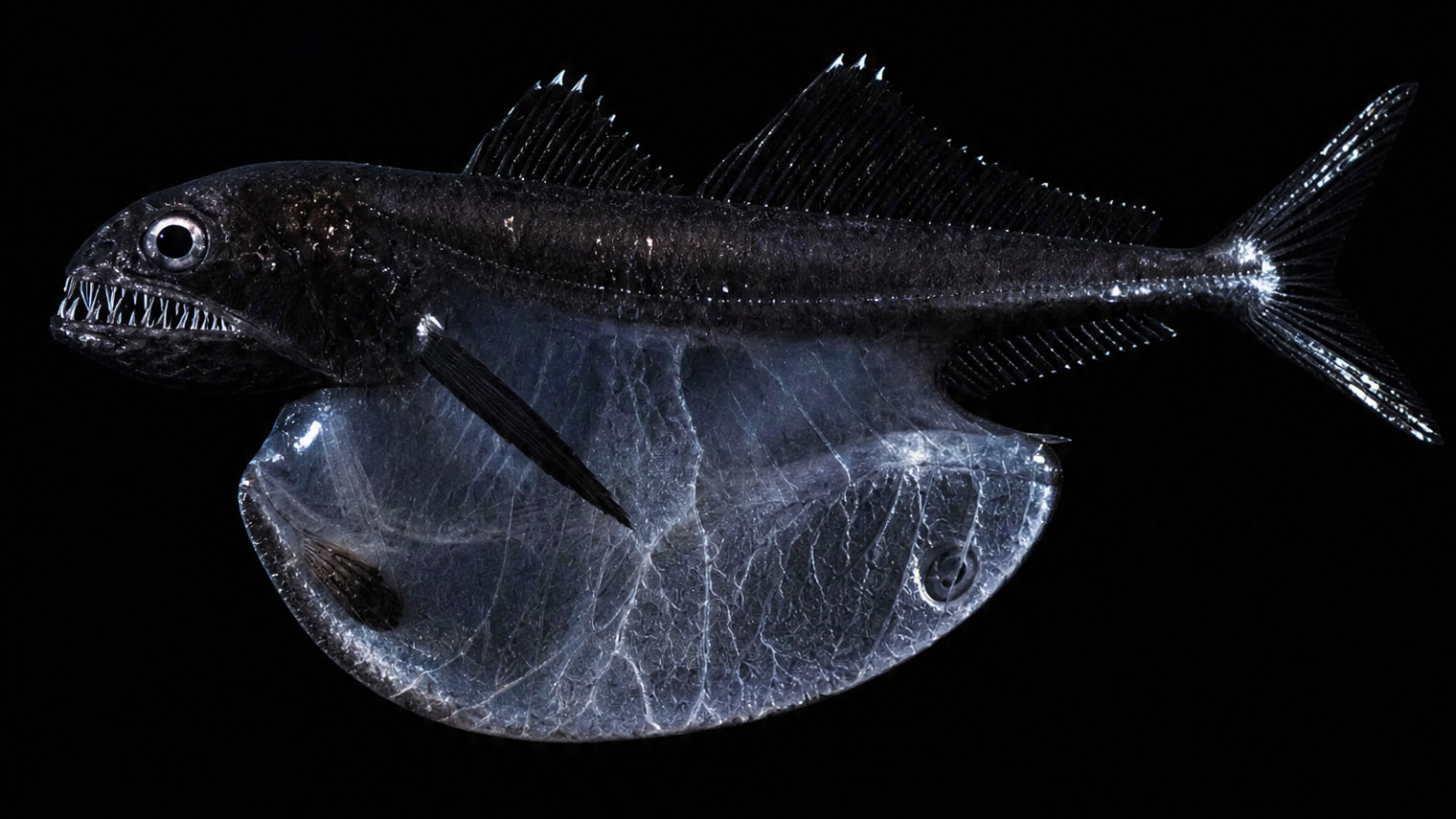
Illustration generated with AI for DomiVerseX
Far below the last of the sunlight lives a black fish that is shorter than a school ruler. In 2026 a robot filmed one alive, with its dinner still showing through its skin.
This article contains affiliate links. If you buy through them, we may earn a small commission at no extra cost to you.
More than a kilometer down in the deep sea off Trinidad and Tobago, the lamps of a diving robot lit up a small black fish. Something pale was hanging under it. It was the fish's own belly, stretched so thin that the camera could see into it. Inside was a recent meal.
The fish was a black swallower. Its kind is known for one thing: it can swallow fish that are longer than it is. The robot, called SuBastian, filmed this one at 1,259 meters. Lay 12 football pitches end to end, point them straight down, and you are about there.
It happened during a month long expedition in July 2026. The scientists worked from a research ship named Falkor (too), which belongs to the Schmidt Ocean Institute. The chief scientist was Dr Diva Amon. The film was made public on 25 August 2026. No source gives the exact day of the dive.
Amon knew how lucky she was. Black swallowers "are notoriously rare to spot in the wild. I saw my first nearly a decade ago in the Gulf of Mexico," she said, as ScienceAlert reports. "I never imagined I'd get a second chance."
Why does this matter to you? A person who studies the deep sea for a living saw this animal alive twice in about ten years. You can watch it on a phone.
The pencil and the baseball bat
Can a fish really do that? For the best proof, go back to October 2007 and to another island, Grand Cayman.
A local fisherman, McPherson "Dorson" Wright, was out off the south coast. The water under his boat was about 1,400 feet deep, which is about 427 meters. He saw a dead fish floating on the surface and picked it up.
"When I first saw it I really couldn't believe my eyes," he told the Cayman Compass.
The fish was 7.5 inches long, which is 19 centimeters. Coiled up in its stomach was a fish called a snake mackerel. That one measured 34 inches, or 86 centimeters. The meal was about four and a half times as long as the fish that ate it.
Picture a new pencil swallowing a baseball bat. Or picture a child who is 140 centimeters tall swallowing something more than six meters long, about as long as one and a half family cars.
Photos went to a fish scientist in the United States, Tracey Sutton of the Harbor Branch Oceanographic Institute. His answer: "I have seen this fish with big prey before but yours takes the cake." He added that the animal normally lives deep in the ocean. The newspaper used another name for it, the "Great Swallower".
Harbor Branch offered to pay to have the fish shipped to the United States. The newspaper does not say if that ever happened.
Why does this matter to you? This is a measured case. The fish was measured, and two lengths were written down. That is worth more than a hundred amazed retellings.
The twist: we mostly know the ones that got it wrong
Now look again at how that fish was found. It was dead, and it was floating.
That is not unusual for this species. It is the normal way. Most of the black swallowers that science has ever collected were found dead at the surface.
The usual explanation goes like this. Sometimes a swallower takes a meal that is too big. The meal starts to rot before the stomach can break it down. Rotting makes gas. The gas blows the fish up like a balloon, and it floats to the top. Nobody has watched this happen from start to finish. It is worked out from the dead fish.
Think about what that means. A black swallower that eats a sensible dinner stays down in the dark, where nobody sees it. One that eats too much comes up to where the boats are. So the fish in jars and photographs are mostly the ones whose last meal went wrong.
Enjoying this story?
Get a short teaser by email whenever we publish something new. No spam.
That is why the 2026 film is special. It shows a swallower that had fed and was alive, down where it lives.
Why does this matter to you? What you know about anything depends on which examples reach you. Here, the examples that reached people were mostly the ones that ate too much.
Shorter than a school ruler
So what is known about the living animal? Start with its size. A black swallower does not grow longer than 25 centimeters. A school ruler is 30. So even the biggest one on record would fit on your desk with room to spare.
It lives between 700 and 2,745 meters down in the sea. The deepest of those numbers is about 2.7 kilometers. On land you could walk that in about half an hour. In the sea it is half an hour of walking pointed straight down.
Science has known this fish since 1864, which is 162 years. In all that time, the thing people remember about it is its stomach. The stomach stretches. If ScienceAlert quotes them correctly, experts at the Woods Hole Oceanographic Institution describe a full one as "a semi-transparent spare tire hanging from their bellies."
How much fits in there? The fish database FishBase says that black swallowers "feed on whole fish, often of individuals longer than themselves." That is what "bigger" means in the title: longer. It is a fact about the species.
There is also a famous old claim that the fish can swallow prey over twice its length and ten times its weight. It comes from a textbook printed in 1905, by a writer named D. S. Jordan. It is not a modern measurement, so treat it as an old claim.
And the fish in the 2026 film? Nobody knows what it ate. The meal was never identified and never measured. So nobody can say how big that one dinner was. "If only we had a CT scanner at sea," Amon said. A CT scanner is a machine that can see inside a body.
Why does this matter to you? A headline can sound bigger than the facts. The species can swallow fish longer than itself. What this one fish swallowed is still a secret.
A month in the dark
The trip that filmed the swallower was the first deep sea expedition in Trinidad and Tobago to be led by local scientists. Amon said its discoveries were "proof that Caribbean scientists can uncover our own deep-sea backyard."
The numbers that follow all come from one place, the Schmidt Ocean Institute's own report, so read them as the team's count. The team says it mapped more than 11,335 square kilometers of sea floor that had never been charted. That is a square about 106 kilometers on each side. It says it found about 20 animals that could be new species, and at least 54 species never seen before in the country's waters. It collected more than 700 specimens, which is more than 20 for every day of the trip.
The swallower was not the only strange sight. If Discover Wildlife has the depths right, the robot filmed a false catshark at 1,086 meters. At 1,025 meters it found a dead manta ray lying on the bottom, with crabs and worms feeding on it. That would put the swallower 234 meters deeper than the ray.
Why does this matter to you? The sea floor this team mapped had never been charted before. In one month of looking, it met animals that had never been recorded in those waters.
How does it get that down?
Here is the strangest gap of all. Nobody has reported watching a black swallower swallow a fish bigger than itself. Every case comes from looking at what was already inside.
Some scientists have guessed that it grabs its prey by the tail and works its jaws along the body, a little at a time. ScienceAlert notes that this is a guess based on how the fish looks.
The film from Trinidad and Tobago shows the after. Nobody has yet filmed the during. So which end goes in first, and how long does a dinner like that take?
Sources
- First Caribbean-Led Expedition to Explore Trinidad and Tobago's Deep Sea Unveils Rich Ecosystems, Schmidt Ocean Institute
- Large animal with cat-like eyes filmed at bottom of Caribbean Sea, Discover Wildlife
- Report on the 2026 black swallower footage, ScienceAlert
- Small fish takes big bite, Cayman Compass
- Cayman fish bites off more than he can chew, DeeperBlue
- Chiasmodon niger, Black swallower, FishBase
- Black swallower, Wikipedia