Why did these cave crocodiles turn orange?
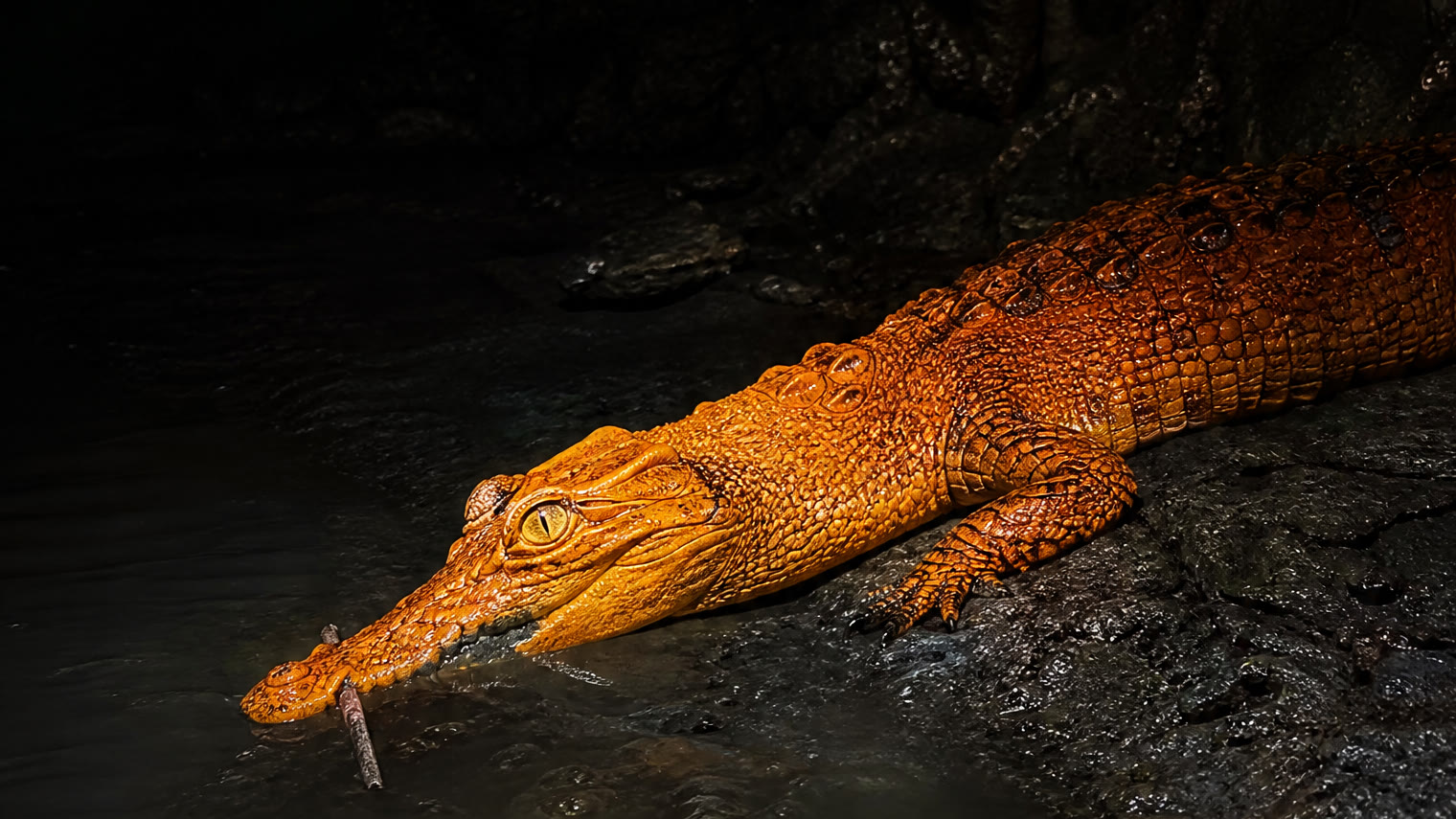
Illustration generated with AI for DomiVerseX
In a cave system in Central Africa, a few crocodiles have changed to a color no crocodile is supposed to be. The best explanation anyone has is a strange one, and the animals are hiding an even bigger surprise.
This article contains affiliate links. If you buy through them, we may earn a small commission at no extra cost to you.
Most wildlife films about crocodiles show wide rivers and bright sun. This story has neither. It takes place underground, in the Abanda caves of Gabon, a country in Central Africa that many people could not point to on a globe. There is no daylight in there. There is water, there is rock, and there are bats on the ceiling in huge numbers.
And on the floor, in the dark, there are crocodiles.
They are dwarf crocodiles, the same kind that lives in the forest outside. You will not find the caves marked on an ordinary map, and for a long time science did not know the animals were down there at all. The archaeologist Richard Oslisly found them in 2008. Scientists first studied them properly in 2010. That makes the whole story younger than most people who are old enough to drive.
Why does this matter to you? Because it shows that a large animal can still be hiding in a place nobody had looked, in a world that often feels fully explored.
A home made of darkness and droppings
Dwarf crocodiles are small for crocodiles. According to Live Science, they grow to only about 1.5 meters long, which is roughly the height of a 12 year old child lying down. News reports call them the smallest crocodile species alive.
Life in the cave is not cozy. A huge number of bats live overhead, and what bats drop ends up on the floor. The polite word for it is guano. Researcher Matthew Shirley, who has studied these crocodiles for about 15 years, told Live Science what it is like to stand in it. In the dry season it is like a "fluffy mattress cloud of bat guano". When it rains, he said, "you're in a bat guano slurry." A slurry is a thick, wet soup.
The crocodiles sit and wade in that soup. They also eat differently from their forest cousins. A 2017 study led by Shirley found that the cave crocodiles eat mainly bats and cave crickets, while forest crocodiles eat insects and crustaceans, the family of crabs and shrimps.
If IFLScience has the number right, about 10,000 bats were disturbed and flew into Shirley the first time he went in. That is like every pupil from 20 big schools rushing past you in a dark corridor at once.
Why does this matter to you? Think of the worst smelling place you have ever been. These animals did not just visit a place like that. They moved in, and they seem to be doing well.
Not all of them are orange
Here is something the photos can hide. Not every cave crocodile is orange. The orange ones are only some of the group, mainly large, older males. The rest are the usual dark color.
"Those orange ones are wild," Shirley told IFLScience. He remembered the first time the team pulled one out of the cave: "It was like, holy cow, what have we been looking at?"
Why does this matter to you? It is a useful clue. If only the biggest and oldest animals are orange, the color probably has something to do with time.
One idea, and nobody has tested it
Why orange? There is one main idea, and it comes from Shirley himself.
He thinks the guano is doing it. The big males have been sitting in the bat slurry for many years. Shirley calls the guano "a highly caustic material". Caustic means it can slowly eat into things it touches. Back in 2018 he told National Geographic that the water in the caves may be "tanning their skin". Tanning is what people do to animal hides to turn them into leather.
In some animals it goes further. Shirley told IFLScience that on the head, some of the skin has worn so thin "you can actually see the skeletal features underneath it."
But keep this in mind. Shirley's own words are that this is "a hypothesis that remains to be tested". We found no report of anyone measuring the guano in the caves. News stories do not agree about its chemistry, so we are sticking with the researcher's own words. It is one scientist's best idea, and it could turn out to be wrong.
Why does this matter to you? A good explanation and a tested explanation are two different things. This one is still only the first kind.
Enjoying this story?
Get a short teaser by email whenever we publish something new. No spam.
The twist: the color may be the least interesting thing
The orange skin gets the attention. What the scientists care about more is on the inside.
Researchers took blood from 30 to 40 of the cave crocodiles and from about 200 crocodiles living above ground, National Geographic reported in 2018. When they compared the DNA, the researchers say, the cave animals carried a set of genes that the forest animals outside did not have. Picture one village where every child shares a family feature that nobody in the next village has.
That points to a group that has been breeding apart from its neighbors for a very long time. How long? Nobody knows. Shirley's estimate in 2018 was that the crocodiles arrived at least a few thousand years ago, and that it would take several hundred generations to build up a difference like this one.
The researchers go further. They say the cave crocodiles could be slowly turning into a new species. "This is evolution in action," Shirley told Live Science. He has also said that whether it happens soon or not "is anyone's guess".
Two warnings belong here. This is the researchers' own claim, and Live Science reported in 2025 that the genetic study had not yet been published for other scientists to check.
There is one more small clue. The 2017 study found that young crocodiles in the caves were in better body condition than young ones in the forest. In plain words, they were better fed. For adults the difference was too small to be sure about.
Why does this matter to you? New kinds of animals usually appear far too slowly for anyone to watch. Here it could be happening in a cave system, to an animal as long as a child is tall.
Caught on camera in 2026
Scientists already knew the cave crocodiles ate bats, because they had looked at what was in their stomachs. What nobody had seen was how a crocodile catches a bat in total darkness.
That changed with a National Geographic series called "Africa: Earth's Wild Home", which first aired on 2 October 2026. Live Science describes the footage as showing the hunt for the first time. That "first" comes from the people who made the series, so read it as their claim.
Even Shirley had not seen it before. "I've been working with this population for almost 15 or 16 years now, and that's something we've never been able to see," he said.
Why does this matter to you? An animal can be studied for 15 years and still keep its most basic habit, how it gets dinner, a secret.
A small group in an unprotected place
How many are there? In 2018 National Geographic gave an estimate of about 100 to 200 crocodiles spread over 10 to 12 caves. That would fit into four to eight school classes. Later reports from Live Science say the real number is not known.
The caves lie outside Gabon's protected areas. Live Science reports that Gabon's government is working on making them a special reserve. "I don't think we're worried about extinction of the species," Shirley said, but "the cave population is definitely at risk."
Why does this matter to you? As far as anyone knows, this is the only place where this story is happening. A group this small has no spare copy.
A stain, or slow damage?
So we are left with a cave full of puzzles. Only some crocodiles are orange. The cause is an idea that no one has tested. The genetic study is still waiting to be published. Even the way they have babies is not settled. Live Science reports that researchers think the eggs are laid at the cave mouths and the young then move deeper inside. Phys.org points out that dwarf crocodiles outside lay their eggs in rotting plants, and the caves do not have any.
The biggest open question is the one in the title, turned around. Is the orange only a color, a stain that does the animal no harm? Or is it the sign of skin being slowly worn away, on the very males that have lived in the cave the longest?
Sources
- Orange Cave Crocodiles May Be Evolving Into a New Species, National Geographic
- Watch the world's smallest crocodiles snatch bats in their hidden underground lair, a behavior never seen before, Live Science
- The World's Smallest Crocodile Lives In A Cave, With Orange Skin So Thin You Can See Its Skeleton, IFLScience
- Orange dwarf cave crocodiles: The crocs that crawled into a cave, ate bats, and started mutating into a new species, Live Science
- Diet and body condition of cave-dwelling dwarf crocodiles (Osteolaemus tetraspis, Cope 1861) in Gabon, African Journal of Ecology, record at University of South Florida
- Strange orange cave dwelling African dwarf crocodiles could be evolving into a new species, Phys.org