This scorpion grew to about a meter long, in a world that hadn't grown its first tree yet.
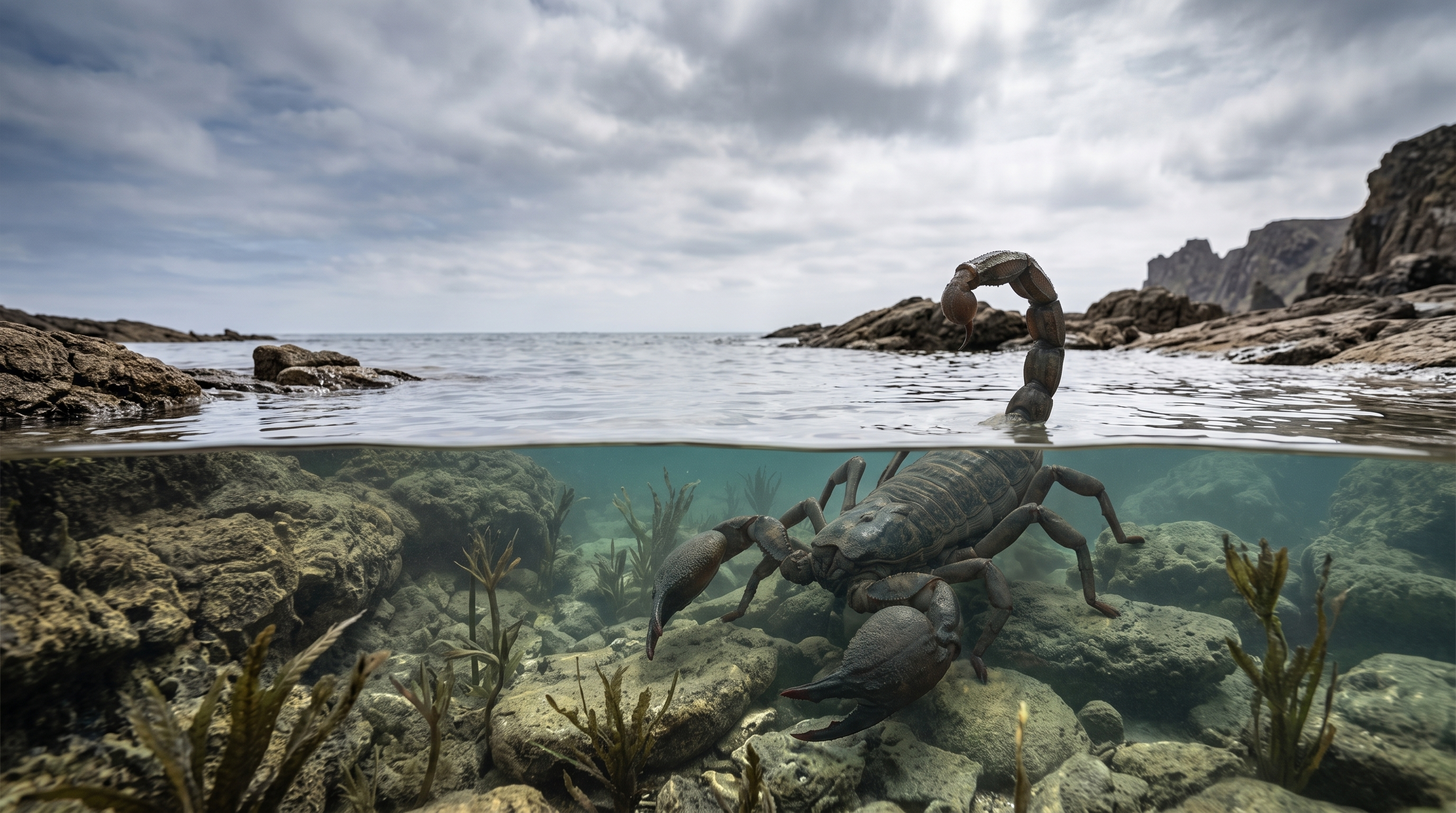
AI-generated illustration
About a meter long, with claws longer than a table knife, Praearcturus gigas patrolled shallow coastlines 415 million years ago, and its fossil sat mislabeled as a giant crustacean in a museum drawer for more than 150 years.
This article contains affiliate links. If you buy through them, we may earn a small commission at no extra cost to you.
Picture a stretch of shallow coastline in what is now England and Wales. There is no grass, no bushes, nothing green taller than a mat of moss clinging to wet rock. The land is almost completely empty. But down in the shallows, something with claws longer than a table knife is moving through the water, and it is not small.
Meet the giant
That animal has a name now: Praearcturus gigas. According to the researchers who studied it, it grew to roughly a meter long, with claws measuring more than 16 centimeters, about the length of a large smartphone. Scientists at the Natural History Museum and the University of Manchester say it is likely the largest scorpion ever known to have lived, and it dates back about 415 million years, to the Early Devonian period, not long after the very first plants had crept onto land but long before anything resembling a tree existed anywhere on Earth. If the thought of claws that size still has you curious, a real scorpion permanently frozen in resin lets you study one up close without the four-hundred-million-year wait.
A 150-year mix-up
Here is the strange part. This exact fossil was not new. It had been sitting in a museum collection since it was first written up in 1871, and for more than 150 years it was filed away as something else entirely: a giant crustacean, a relative of the woodlouse. Nobody was lying or being careless. The pieces of the fossil were broken and incomplete, and without the right comparison it genuinely looked like the wrong animal. It took new fossil finds and modern imaging technology, decades later, for a team to lay the old bones next to fresh evidence and realize they were looking at a scorpion all along, a conclusion they laid out in detail in the journal Palaeontology in 2026. It is a good reminder that a museum drawer can hold a surprise just as easily as a fresh dig site.
Why did it get so big, if not for the air?
When people hear about giant ancient bugs, they usually think of a later time, the Carboniferous period, when the air held far more oxygen than it does today and that extra oxygen is thought to have helped insects grow enormous. But Praearcturus lived roughly 100 million years before that. There were no oxygen-rich forests yet to explain its size. Instead, the researchers think the answer is simpler: there was almost nothing else around big enough to compete with it. With few other large predators sharing its world, Praearcturus may have simply had the run of the place, in a way that would have been much harder once bigger animals showed up later in Earth's history.
Enjoying this story?
Get a short teaser by email whenever we publish something new. No spam.
Part sea creature, part land creature
The fossils also hint at where this scorpion actually lived. Some specimens preserve flap-like structures on the abdomen that look similar to features on modern lobsters, which suggests Praearcturus could move between water and land, or may have stayed mostly in the water. Think of it less like a scorpion crawling across a desert and more like something that patrolled the shallows the way a crocodile does today, at home in the water but able to come out when it needed to.
How long is "about a meter," really?
There is one detail that has not been nailed down yet, and it matters if you are picturing this animal in your head. Scientists have reported the body length as roughly a meter and the claws as over 16 centimeters separately, but it is not made clear whether that one-meter figure already includes the claws stretched out in front, or whether the claws would have added even more length on top of it. Until that gets clarified, the honest answer is: somewhere around a meter, possibly a bit more.
An open question
A fossil can sit quietly in a drawer for a century and a half before anyone realizes what it really is. So here's a question worth sitting with: how many other fossils are still out there in museum collections right now, confidently labeled as one thing while secretly being something else entirely?
Sources
- A coffee-table-size scorpion roamed Earth before forests existed | ScienceDaily, https://www.sciencedaily.com/releases/2026/08/260831015200.htm
- World's largest scorpion revealed from 415-million-year-old fossils | University of Manchester, https://www.manchester.ac.uk/about/news/worlds-largest-scorpion-revealed-from-415-million-year-old-fossils/
- World's largest scorpion revealed from 415-million-year-old fossils in Natural History Museum collection | Natural History Museum, https://www.nhm.ac.uk/press-office/press-releases/world-s-largest-scorpion-revealed-from-415-million-year-old-foss.html
- A revision of Praearcturus gigas: a giant scorpion from the Lower Devonian (Lochkovian) of Britain | Palaeontology (Wiley), https://onlinelibrary.wiley.com/doi/10.1111/pala.70064