This Shrimp Snaps Its Claw So Hard That the Water Itself Flashes With Light
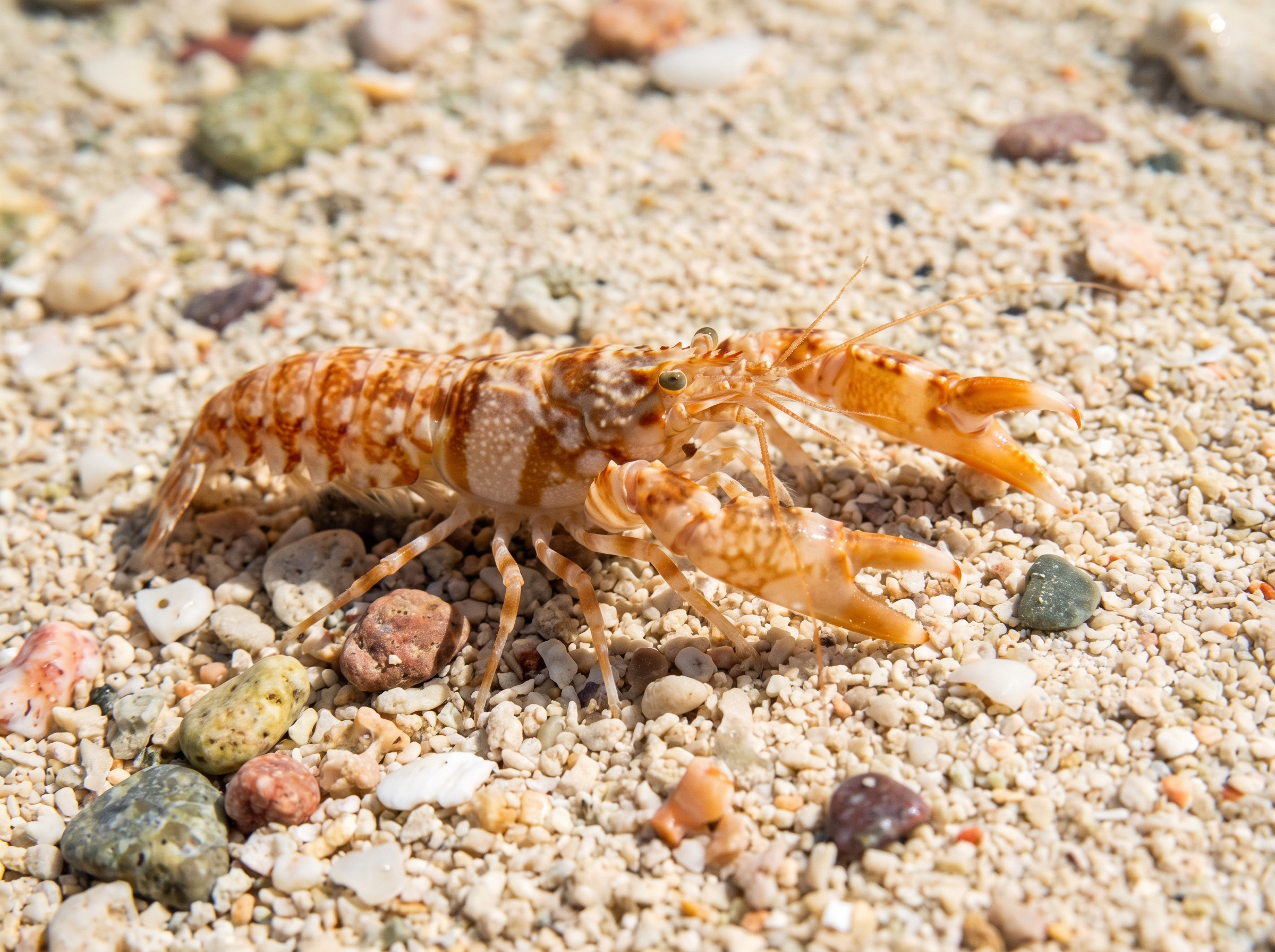
AI-generated illustration
A claw the size of a fingernail can boil seawater, stun a fish and make a flash of light the shrimp cannot even see. The physics is stranger than the legend.
For decades the assumption about snapping shrimp was straightforward. The animal has one grossly oversized claw, it slams the two halves together, and the sound is the impact. Two pieces of shell hitting each other, amplified by water.
That explanation is wrong, and the way it turned out to be wrong is one of the better pieces of biology from the last twenty-five years.
What actually happens
The claw does not make the noise by closing. It makes the noise by what the closing does to the water.
When the snapping claw slams shut, a plunger on one half drives into a socket on the other, forcing out a jet of water at somewhere around 100 kilometres per hour. Behind that jet the pressure drops so far that the seawater vaporises. Not boils in the ordinary sense, but vaporises because the pressure has fallen below its vapour pressure. This is cavitation, the same effect that eats holes in ship propellers.
A bubble forms. Then the surrounding water rushes back in to fill it, and the bubble collapses.
That collapse is the bang. Measurements put it between roughly 210 and 218 decibels underwater, which is louder than a gunshot and comfortably louder than a jet engine at takeoff. Anyone who has listened to a reef through a hydrophone knows the sound: a constant crackle, like frying fat, produced by thousands of these animals.
The light
In 2001 a team published something in *Nature* that nobody had expected.
Training high-speed cameras and photomultipliers on captive snapping shrimp, they found that every snap was accompanied by a brief flash of light emitted at the moment the bubble collapsed. They named it shrimpoluminescence.
It is closely related to sonoluminescence, the phenomenon in which sound waves drive bubbles to collapse violently enough to emit photons. This was the first documented case of an animal producing it.
Enjoying this story?
Get a short teaser by email whenever we publish something new. No spam.
The flash lasts somewhere between about 300 picoseconds and 10 nanoseconds. It is too brief and too faint for the shrimp to perceive. The animal generates light it cannot see, every time it fires.
About the temperature
The number that circulates about this animal needs handling carefully, because it is routinely overstated.
When the cavitation bubble collapses, the gas trapped inside is compressed so fast that it heats enormously. Estimates from the light emission and subsequent modelling put the peak inside the bubble at roughly 4,700 to 5,000 kelvin.
The surface of the Sun is about 5,500°C.
So the correct statement is that the bubble briefly approaches the temperature of the Sun's surface. The very common claim that it is *hotter* than the Sun's surface does not follow from the published estimates, and you will see it written everywhere. It is close, it is extraordinary, and it is not hotter.
It is also worth noting that the temperature is real but the heat is not, in any practical sense. The bubble is microscopic and the event lasts nanoseconds, so there is almost no energy to transfer. A popular-science book on fluid dynamics is the place to chase this properly: temperature and heat are different quantities, and this animal is the best natural demonstration of the difference anyone has found.
What it is for
Hunting, mostly. The shockwave from the collapsing bubble is enough to stun or kill small fish and crabs without the shrimp ever making contact. The prey is knocked out by water.
It is also used for territory. If one shrimp intrudes on another's burrow or hunting ground, it gets a warning snap. Those warning snaps are reportedly not fast enough to generate a cavitation bubble, which means the animal appears to have a non-lethal setting.
And during the Second World War, colonies of these shrimp were loud enough that the acoustic cover they produced was used to help hide submarines from sonar. The noise floor of a tropical reef is, to a considerable extent, made of shrimp.