Scientists Had to Change the Definition of a Mammal Because of This Animal
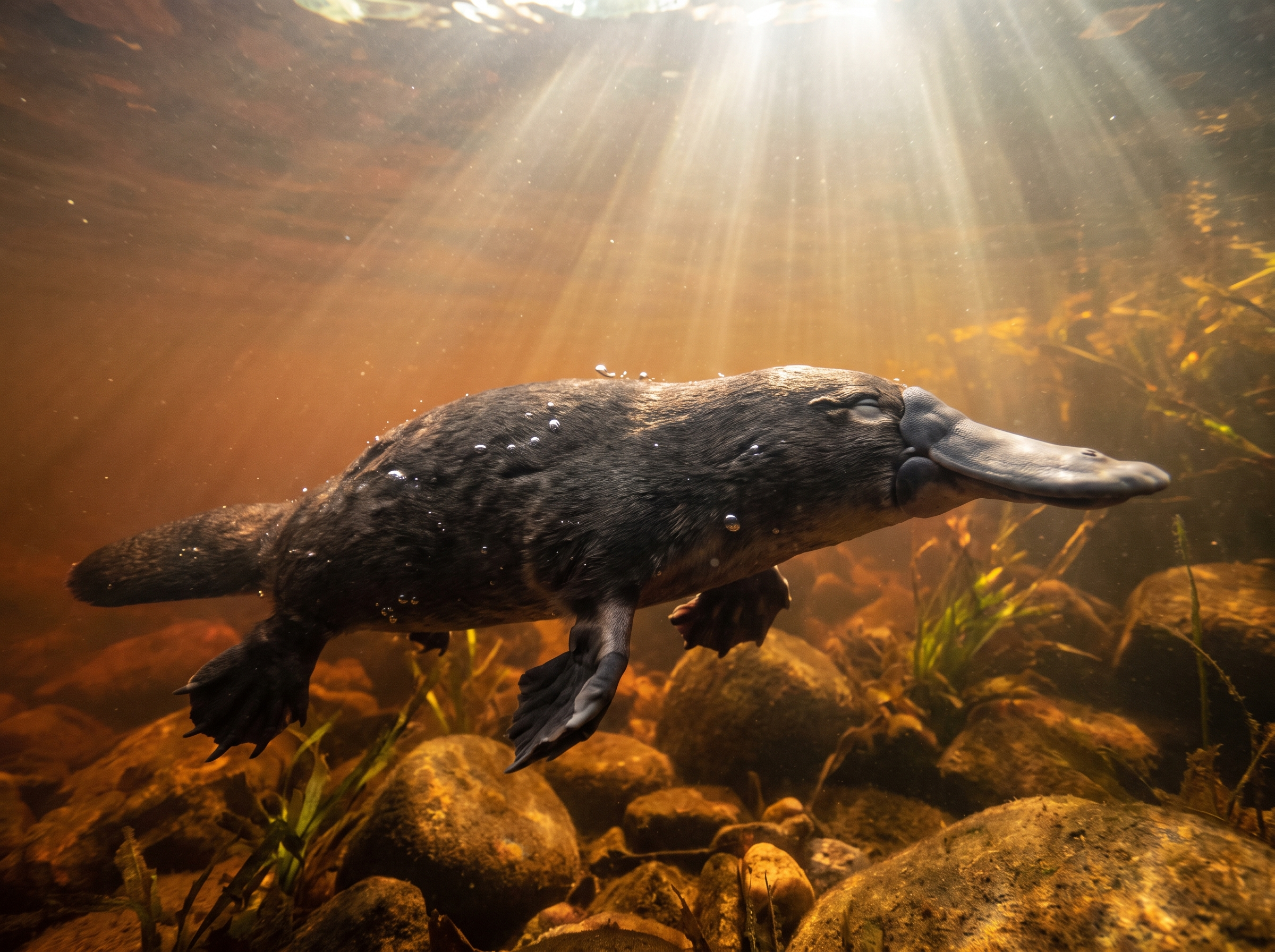
AI-generated illustration
A furred animal with a duck's bill, venom and eggs convinced London's naturalists it was a hoax. Proving otherwise took most of a century.
This article contains affiliate links. If you buy through them, we may earn a small commission at no extra cost to you.
Strictly speaking, nobody rewrote the definition of a mammal because of the platypus. What science had to throw out was a rule everyone treated as part of that definition: that every mammal gives birth to live young. The argument over that rule began with a specimen nobody believed was real.
When the first platypus specimen reached London in 1799, the naturalists who examined it concluded that somebody was playing a joke on them. The obvious explanation for a duck's bill attached to a furred, four-legged body was that a taxidermist had sewn one animal onto another. George Shaw, who wrote the first scientific description, reportedly went looking for stitches.
There were no stitches. The animal was real, and it would take another eighty-five years to settle the argument it started.
What the fight was actually about
It is often said that the platypus forced science to redefine what a mammal is. That is not quite what happened, and the real story is better.
The defining feature of a mammal is the mammary gland. Platypus mammary tissue was identified in 1824, and that settled the classification question for most anatomists. Richard Owen, Britain's most formidable comparative anatomist, was clear that platypuses were mammals.
What nobody could agree on was reproduction. Every mammal known to Europeans gave birth to live young. Aboriginal Australians had been saying for as long as anyone asked them that the platypus laid eggs. Colonial observers reported the same thing in letters dated 1818 and the 1860s. Those reports were dismissed.
Owen had a compromise: the animals were ovoviviparous, meaning eggs formed and hatched inside the mother, and live young emerged. This preserved the rule. It was also wrong.
Why it mattered so much
The resistance was not really zoological. Jack Ashby of Cambridge's University Museum of Zoology has described the nineteenth-century objection directly: many conservative scientists did not want an egg-laying mammal to exist, because it would support evolution, the idea that one group of animals could change into another. Lizards lay eggs. Frogs lay eggs. To share that trait was, to some, degrading.
Enjoying this story?
Get a short teaser by email whenever we publish something new. No spam.
A century and a half later this looks absurd. At the time it was enough to keep a straightforward factual question open for eighty-five years.
The telegram
In 1883 the University of Cambridge, the Royal Society and the British government jointly funded William Hay Caldwell to go to Australia and settle it.
Caldwell collected around 1,400 echidnas, plus an unrecorded number of platypuses, with the help of more than 150 Wakkawakka people whose knowledge and labour made the search possible and who were not credited for it.
In 1884 the team found an echidna with an egg in her pouch, and a platypus with one egg in her nest and another about to be laid.
Caldwell sent a telegram to the British Association for the Advancement of Science, meeting in Canada. It read: *Monotremes oviparous, ovum meroblastic.* Monotremes lay eggs, and the eggs divide the way reptile eggs do rather than the way other mammal eggs do.
Nine words. Argument over.
Everything else about it
The eggs were only the start. The platypus hunts with its eyes, ears and nostrils shut, navigating entirely by detecting the faint electrical fields of muscle movement in its prey. Male platypuses carry a venomous spur on each hind leg, powerful enough to cause severe and long-lasting pain in humans. The genome, sequenced in 2008, is a genuine mosaic: males have ten sex chromosomes rather than two, one of the X chromosomes closely resembles a bird Z chromosome, and the animal carries both reptilian and mammalian genes for egg fertilisation. Females have two ovaries but only the left one works.
They live in eastern Australia and Tasmania, and most people who go looking see a V-shaped ripple and nothing else.
Sources
- William Caldwell (1859–1941) | University Museum of Zoology, Cambridge
- Discovered: 150-year-old specimens that proved some mammals lay eggs | University of Cambridge
- Genome analysis of the platypus reveals unique signatures of evolution | Nature
- Paradox on the Queensland Frontier | Australian Humanities Review