This kangaroo has never lifted a weight in his life.
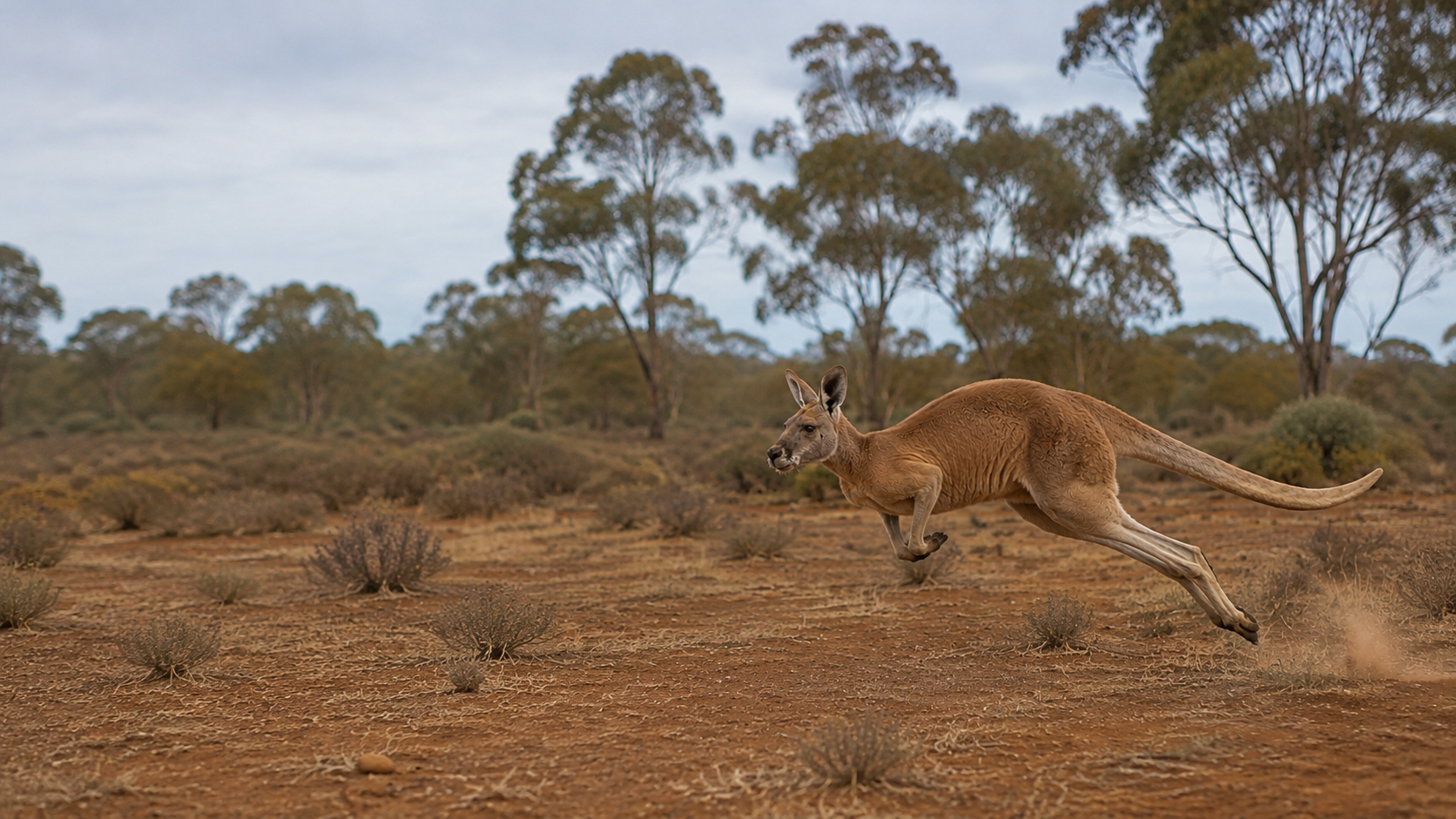
Illustration generated with AI for DomiVerseX
Roger crushed metal buckets for fun and never saw a gym. Those arms are not for lifting.
This article contains affiliate links. If you buy through them, we may earn a small commission at no extra cost to you.
In 2015 the internet stopped for a moment when a kangaroo sanctuary in Alice Springs, Australia, posted a video of Roger. He was a male red kangaroo, two metres tall, as tall as a doorway, around 90 kilos, with arms that belonged on a heavyweight boxer. In the clip he crushes a metal bucket like an empty soda can. Everyone asked the same thing: what does that animal eat? The answer is grass. Roger never touched a scoop of whey protein in his life, and he still looked like he lived in a gym.
He did not. He lived in a rescue sanctuary run by Chris "Brolga" Barns, who tells Roger's story in his book Kangaroo Dundee. And Roger was not a freak. He was simply a big, old, healthy male red kangaroo, and every big old male red kangaroo looks roughly like that. The question is why.
Built to hop, not to lift
A kangaroo moves on its hind legs, and it does so cheaply. The big tendon at the back of each leg works like a rubber band: it stretches when the animal lands and snaps back on the next bound. Britannica notes that a red kangaroo cruising along at speed actually burns less energy than one plodding slowly, because so much of each hop is recycled from the last one. The hind legs are for getting around, and they are big on males and females alike.
The front legs are a different story. A female uses hers for eating and scratching. A male's forearms are thick and his shoulders are wide, the kind of forearm a human chases with a grip strengthener and never quite gets. The size gap between the sexes is enormous. A female red kangaroo weighs somewhere between 18 and 40 kilos, about the size of a medium dog, while a big male can reach 90, the weight of a heavyweight boxer. And according to the Alice Springs Desert Park, males keep growing for as long as they live, so the oldest male in a group is almost always the biggest one.
That still does not explain the arms. Hopping does not need them. Eating grass does not need them. Something else does.
The arms are weapons
In 2013 a team of Australian researchers dissected western grey kangaroos, a close relative of the red, and weighed every muscle in the front legs. In females, the muscles simply grew in step with the body. In males, every forelimb muscle grew faster than the body did, and the ones that grew fastest were the muscles that pull the arm inward and bend the elbow, the exact movement you make when you grab something and haul it toward you (Warburton, Bateman and Fleming 2013). Those are grappling muscles. The researchers' conclusion was that a male kangaroo's arms are shaped by fighting other males, and by nothing else. In the language of biology they are a product of sexual selection, the same force that gave a stag his antlers and a peacock his tail. The female does not need them, so she does not have them.
That is the part the muscles do not tell you at first glance. They are not for lifting anything. They are for holding on to another male while you kick him.
Flexing is a language
Before two males fight, they pose. The San Diego Zoo's behaviour guide, based on the work of kangaroo biologist Terence Dawson, describes a male rising onto his toes and the tip of his tail, arching his back and holding his arms out so the muscle shows. He walks stiff-legged in front of his rival, wrestles with bushes as if they were another male, and rubs his chest on clumps of grass (San Diego Zoo). The natural history museum in Paris describes glands in his neck that produce a dark, strong-smelling secretion, which he spreads over his back and chest in the breeding season. Females skip all of this. They are smaller, blue-grey rather than red, and Australians often call them "blue fliers".
Enjoying this story?
Get a short teaser by email whenever we publish something new. No spam.
The point of the posing is to avoid the fight. You cannot fake muscle, so when two males show each other their arms, the smaller one sees exactly what he is up against and usually backs off with nobody hurt. It is the same logic as a nightclub doorman: a big body is an honest signal of what its owner can do. So when a male kangaroo flexes, he is not flexing for you. He is flexing for the next male over.
When posing is not enough
If neither backs down, the boxing starts. It looks silly on video. It is deadly serious. The males grip each other by the shoulders or lock forearms, push and twist, and then one leans his whole weight back onto his tail and kicks with both hind legs, raking the other's belly. Each hind foot carries a big central claw, and Britannica notes that the same tactic has been known to disembowel dogs and, occasionally, people (Britannica). Two human heavyweights slugging it out with bare fists and no hand wraps would be in hospital by round three. Kangaroos do it with claws. Most bouts are over quickly. Some are not.
The tail is the third leg in a fight, and it turns out it is a leg the rest of the time too. When a kangaroo walks slowly on all fours, it pushes off with its tail, and researchers who measured the forces found that the tail delivers as much forward push as the front and hind legs combined (UNSW / Biology Letters 2014).
The winner gets the mob
Kangaroos live in loose groups called mobs, and each mob has a dominant male. Australians call him the boomer, and the PBS Nature fact sheet describes him as having effectively exclusive access to the females. Females come into season at different times, so the boomer works his way around the mob, sniffing or tasting each female's urine to find one that is ready. When he finds her, he grabs her from behind with those arms and mates for a long time by mammal standards, 25 minutes according to Wikipedia and close to an hour according to Live Science, and then guards her for a few hours so nobody else gets a turn (Live Science).
The reign is temporary. Sooner or later a younger, stronger male wins, and the San Diego Zoo's fact sheet says a displaced boomer ends up living alone. That is what keeps the arms big: the males who win the fights are the males who become fathers.
The female side is just as strange. A red kangaroo female can be more or less permanently pregnant. She can have a joey in the pouch, a bigger joey at her feet, and an embryo in the womb whose development is paused until the pouch is free, three generations at once. Two teats produce two different milks for the two joeys.
The price of the muscle
Roger died in December 2018, aged twelve (ABC News). For a captive male red kangaroo that is old age: by the San Diego Zoo's numbers, half of them do not reach eight. A body like his costs a lot to run, and in the wild the bill comes due in a drought. Red kangaroos breed year-round when there is food, but the San Diego Zoo's fact sheet notes that late in a drought many males and females simply become infertile, and that it takes rain to switch them back on, often within a fortnight of it falling. Muscle is expensive, and evolution pays for it only because the alternative is no offspring at all.
So the next time you see a kangaroo that looks like a bodybuilder in a fur coat, know that it is not photoshopped and it did not come from a gym. Roger spent his whole life in a sanctuary, fed and safe, and never had to defend a mob. Which leaves one question hanging: how big would he have grown if he had?
Sources
- Roger (kangaroo) – Wikipedia
- Roger the ripped kangaroo dies aged 12 – ABC News
- Warburton, Bateman & Fleming (2013). Sexual selection on forelimb muscles of western grey kangaroos – Biological Journal of the Linnean Society
- O'Connor et al. (2014). The kangaroo's tail propels and powers pentapedal locomotion – Biology Letters
- Kangaroos use tail as a fifth leg – UNSW Newsroom
- Red kangaroo fact sheet: characteristics – San Diego Zoo Wildlife Alliance
- Red kangaroo fact sheet: behavior – San Diego Zoo Wildlife Alliance
- Red kangaroo fact sheet: reproduction – San Diego Zoo Wildlife Alliance
- Red kangaroo – Alice Springs Desert Park
- Red kangaroo – Muséum national d'Histoire naturelle
- Red kangaroo – Billabong Sanctuary
- Red kangaroos – Pueblo Zoo
- Kangaroo: behaviour – Britannica
- Do kangaroos really box? – Britannica
- Kangaroo mob fact sheet – PBS Nature
- Animal sex: how kangaroos do it – Live Science
- Red kangaroo – Wikipedia