The Deep
Illustration by Domi Verse X
Over a thousand new species in a single year, and an estimated nine out of ten still have no name at all.
This article contains affiliate links. If you buy through them, we may earn a small commission at no extra cost to you.
In May 2026, a group of scientists announced that they had identified 1,121 species new to science. Every one of them came out of the ocean. Most of them do not have a formal scientific name yet, and many will not have one for another decade.
That last part is not a delay. It is the normal speed of this work, and it is the first clue about how far behind we are.
A Quarter of a Million Named, and Nobody Knows the Denominator
On May 13, 2026, the World Register of Marine Species passed a milestone and published a news item about it. The register had crossed 250,000 accepted marine species. As of August 2026 it lists 250,424.
That is the count of currently accepted, living marine species in the world's central register. It is not a count of everything in the sea. Fossil species are held separately, the register itself is marked 98 percent checked, and coverage of marine microbes is openly incomplete.
The formal naming of species began in the 1750s, with Carl Linnaeus. So it has taken roughly 270 years to reach a quarter of a million.
Now the obvious question. How many are there in total?
Nobody knows, and the published estimates disagree by more than a million. A 2011 study led by Camilo Mora put the number at around 2.2 million marine eukaryotic species, and stated that 91 percent of them still await description. A 2012 study led by Ward Appeltans put it at 0.7 to 1.0 million, and concluded that between a third and two-thirds of marine species are undescribed. Both were peer reviewed. Both are still cited.
That gap is not sloppiness. It is a direct measurement of how little of the ocean anyone has actually looked at. Even a good magnifying loupe is useless if nobody has been to the place where the animal lives.
Where the Light Stops
Sunlight does not get far into seawater. By about 200 metres, so little is left that the sunlit zone is conventionally declared over, although in exceptionally clear water algae have been recorded photosynthesising as deep as 268 metres. Below 1,000 metres, NOAA describes an area of eternal darkness where sunlight does not penetrate at all.
That reorganises everything about how life works down there.
Start with colour. Red light is absorbed first, most of it within the top ten metres and effectively all of it before 100. A red animal in the deep sea is therefore not red to almost anything looking at it, because there is no red light left to bounce off it. Red is the closest thing the ocean has to invisibility.
There is one striking exception, and it is worth knowing. Three genera of dragonfish carry their own red searchlights and can see the red they emit, precisely because almost nothing else can. They are hunting with a private wavelength.
Some animals took the hiding further. A 2020 study in Current Biology, with Alexander Davis as first author and Smithsonian zoologist Karen Osborn as senior author, tested 18 deep-sea fish species and found that 16 of them absorb more than 99.5 percent of the light hitting their skin. The darkest was a dreamer anglerfish of the genus Oneirodes, reflecting 0.044 percent. Shine a UV torch at any normal black object and it still throws something back at you. These fish are closer to a hole cut in the water.
The opposite strategy is to stop hiding and make light instead.
For years the number repeated everywhere, including on NOAA's own pages, was that 90 percent of animals living in open water below 500 metres are bioluminescent. In 2017, two MBARI researchers, Severine Martini and Steven Haddock, counted. They went through 350,536 individual animal observations, collected over 240 remotely operated vehicle dives between 1999 and 2016, from the surface down to 3,900 metres off the California coast.
The measured figure was 76 percent of the individuals they logged. About three quarters. And it barely changed with depth. Jellyfish and their relatives were the extreme, between 97.6 and 100 percent depending on the group.
That is one region rather than the whole ocean, and it counts individuals rather than species. It is still the best count anyone has. A glow-in-the-dark science kit shows the same chemistry in a jar, although nothing in a jar prepares you for three quarters of an ocean doing it at once.
Almost Nothing Down There Has Anything to Eat
This is the part that explains most of the strange body shapes, and it is not pressure and it is not darkness. It is hunger.
Across most of the deep ocean, no food is made locally. There are exceptions and they matter: at hydrothermal vents and cold seeps, bacteria build food out of chemicals instead of light, and a 2018 study estimated that vent microbes produce more than 4,000 tonnes of organic carbon a day worldwide. There is even a bacterium living at 2,400 metres on the East Pacific Rise that photosynthesises using the faint glow of the vent itself.
But those places are islands. Across the vast majority of the abyss, everything edible has to fall in from above.
Scientists call it marine snow, and the name is exact. It is a slow, constant drift of dead plankton, fish droppings, mucus, silt and pieces of dead animals, sinking through the black. NOAA notes the voyage can take weeks.
How much arrives? A 2012 paper in the Proceedings of the National Academy of Sciences, led by Craig McClain, states that at the abyssal seafloor the downward flux represents less than one percent of surface production. The Smithsonian gives a more generous under five percent. Either way the picture holds.
Imagine the sunlit ocean bakes a hundred loaves of bread a day. Somewhere between one and five of them, crumbled and picked at the whole way down, reach the deep seafloor. Everybody down there shares that. Individual flakes are small enough that a beginner microscope is the right tool for looking at one, which tells you the size of the meal.
When food arrives that rarely, you do not evolve to chase it. You evolve to never miss.
This Is Why Nothing Looks Normal
You get mouths that open wider than the animal. The black swallower grows up to about 25 centimetres and can swallow prey up to twice its own length and ten times its own weight, its stomach stretching into a semi-transparent bag hanging off its belly. Sometimes it wins. Sometimes the meal rots before it can be digested, decomposition gases inflate the fish, and it floats up dead from two or three kilometres down. That is how a good number of specimens have reached scientists.
You get fishing rods. Female deep-sea anglerfish grow a fleshy stalk out of the snout with a glowing bulb at the end, and simply wait. Males grow no lure at all. The light is not made by the fish either. It comes from symbiotic bacteria, and a 2019 study in eLife found the fish acquire them from the surrounding seawater rather than inheriting them from their parents.
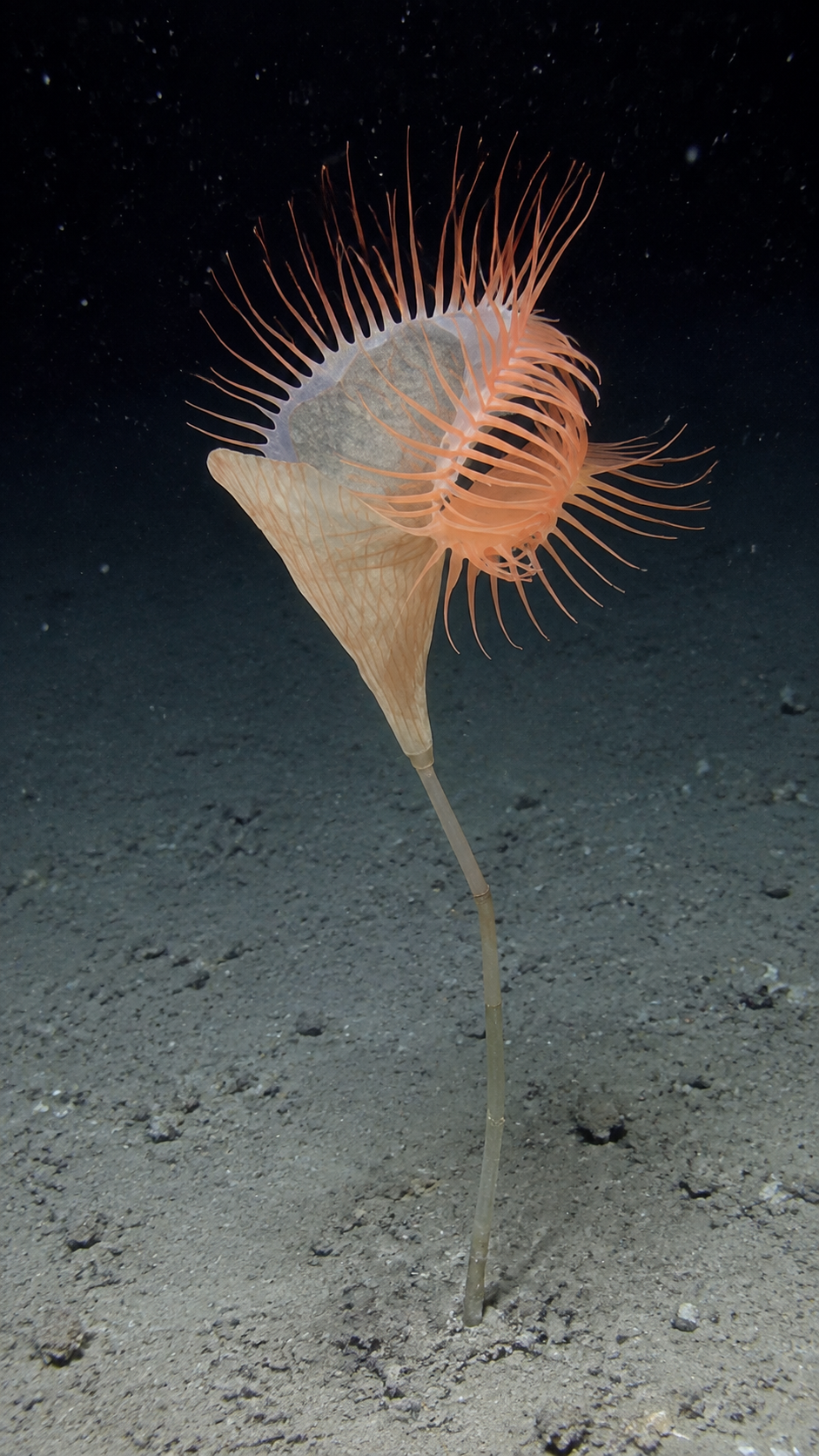
You get animals that gave up moving. The Venus flytrap anemone stands on a slender stalk, turns its funnel into the current like a satellite dish, and folds shut around what drifts in. It looks exactly like a mouth full of teeth, which is a coincidence. It has no teeth and cannot bite. It paralyses its prey with stinging cells instead.
The strangeness is not just an impression. It has been measured. A 2021 study in Ecology Letters, led by Christopher Martinez, analysed 8,362 specimens across 3,033 fish species and 263 families. Deep-sea fish showed roughly twice the body shape disparity of shallow-water fish. The paper's own abstract calls the deep ocean a hot spot of body shape evolution.
Some of these shapes are far enough from expectation that a set of sea creature figurines or a good illustrated ocean book convinces a child they are real faster than a photograph does.
Enjoying this story?
Get a short teaser by email whenever we publish something new. No spam.
The Pressure That Should Crush Everything, and Does Not
Pressure in the ocean increases by about one atmosphere for every ten metres. NOAA, the Woods Hole Oceanographic Institution and NOAA's Pacific Marine Environmental Laboratory all give the same rate.
At 1,000 metres that is around 100 times surface pressure. At 4,000 metres, around 400. At the bottom of the Challenger Deep, close to 11,000 metres, it is roughly 1,100. Spread across one square centimetre of skin, that works out to more than a tonne. Picture a small car balanced on your thumbnail.
So why is anything alive down there?
The answer is almost disappointing, and NOAA states it plainly: most things living in the deep ocean are largely water, and water is incompressible. Pressure crushes things with air inside them. These animals mostly have none. No lungs, and in the open midwater usually no gas-filled swim bladder. Squeeze a balloon full of air and it crumples. Squeeze one full of water and nothing happens. You can demonstrate the principle at a kitchen table with a hand vacuum pump and a marshmallow, working in the opposite direction.
Water is not perfectly incompressible. At 10,000 metres seawater is squeezed about four percent denser than at the surface. That is nothing to an animal and a great deal to a planet: without it, sea level would sit roughly 30 to 50 metres higher than it does.
While we are here, a correction. Deep-sea animals do not explode when they are brought up. Fish with gas bladders do suffer real barotrauma, which is why they sometimes surface with their stomachs pushed out of their mouths, and this starts in water as shallow as about ten metres, because the proportional pressure change is largest in the last few metres before the surface. That is gas expanding, not an animal bursting.
Some animals genuinely do fall apart, and for a stranger reason. A 2024 study in Science found that deep-sea comb jellies build their cell membranes out of cone-shaped molecules that only stack into a stable wall while something is squeezing them. Bring them up and the membranes come apart. As one author put it, the pressure is what is holding their cell membranes together.
For many other animals, though, the bigger problem on the way up is not the pressure at all. It is the warmth. Deep-sea collections have to be kept near freezing to arrive alive.
The Wall at 8,200 Metres
Here is my favourite thing in this subject, because it is a prediction that came true.
Proteins do not cope well with pressure. Deep-sea animals answer this by loading their tissue with a compound called TMAO, which stabilises proteins against it. In 2014, Paul Yancey and colleagues published a paper in the Proceedings of the National Academy of Sciences showing TMAO rising steadily with depth, from 40 to 261 millimoles per kilogram in fish between the surface and 4,850 metres.
Then they extended the line and hit a wall. At about 8,200 metres, a fish would need so much TMAO inside it that it would be saltier than the sea around it, and water would start flooding inward. Their prediction was that fish cannot live below roughly 8,200 metres. They also noted that no fish had ever been found below 8,400 metres, in the deepest quarter of the ocean, and that this limit correlated with no environmental factor they tested except pressure itself.
In August 2022, a team including one of that paper's own co-authors filmed a juvenile snailfish in the Izu-Ogasawara Trench at 8,336 metres. It remains the deepest fish ever confirmed.
That number sits between the predicted wall and the observed ceiling. The prediction was not broken. It was met.
And note what the limit applies to: fish. Invertebrates continue to the bottom of the trenches, close to 11,000 metres, and the reason is not that they are tougher. They are osmoconformers, already in salt balance with seawater, so the wall that stops fish never applies to them at all.
Islands Made of Bone
The last reason the deep sea produces so many different species is that it is not one place. It is thousands of tiny places separated by enormous stretches of nothing.
A whale fall is the clearest example. When a large whale dies and sinks, its body lands on a seafloor where, as covered above, almost no food ever arrives. Craig Smith and Amy Baco reviewed what happens next. A 40 tonne whale delivers as much carbon to one spot as would normally sink to an entire hectare of abyssal seafloor over 100 to 200 years. The sediment directly beneath receives a pulse equivalent to 2,000 years of background supply.
The skeleton then supports a community for at least fifty years.
Their review counted 407 species recorded on whale falls, and 21 known from nowhere else on Earth. Among them are the bone-eating worms of the genus Osedax, whose females have no mouth and no gut. They dissolve into the bone using acid their own skin secretes, and take up nutrition through root structures packed with symbiotic bacteria.
The sex ratio is the part that stops people. The females carry tens to hundreds of microscopic males inside their tubes, males that never develop past a larval body. One female was found with 111. In the largest species, harems of more than 600 have been recorded.
Scatter these islands across an ocean, separate them by hundreds of kilometres of empty water, leave them a few million years, and you get exactly what is found: populations cut off from one another, drifting into their own shapes. If you would rather watch this than read it, the deep-sea episode of Blue Planet II filmed a whale fall properly.
The Nine Tenths We Have Never Met
Every animal in this article is one that has been found. That is the small pile.
Here is the shape of the large one. A 2023 study in Frontiers in Marine Science found the average gap between a marine species being collected and being formally described is 13.5 years. The median is seven. Every one of those 1,121 species announced in May 2026 was found first and will be named later, and the queue behind them is long. In fact 728 of them did not come out of the water that year at all. They came out of museum drawers, collected years or decades earlier and never identified.
Now the arithmetic. Roughly 250,000 marine species named in about 270 years, and currently around 2,000 new marine species described per year. If the true total is a million, finishing takes roughly 375 more years. If Mora's 2.2 million is closer, about 975.
Nobody reading this will see the list completed. Neither will their grandchildren.
And this is not some remote corner where the ignorance is tolerable. NOAA describes the ocean water column as roughly 95 to 99 percent of the total livable volume of the planet, making it the largest habitat on Earth. The place we know least about is, by volume, very nearly the whole place.
Helen Scales covers what that ignorance may cost, with deep-sea mining arriving faster than the science, in The Brilliant Abyss. And if you would rather simply look at the animals, at proper size and in proper photographs, Claire Nouvian's The Deep is still the book that makes people go quiet.
An estimated nine out of every ten species in the ocean have never been given a name. Not because they are hiding. Because almost nobody has been down there to look.
Sources
- Ocean Census: Over 1,100 new marine species discovered
- Scientific American: Ocean census reveals more than 1,100 new species
- WoRMS: World Register of Marine Species
- Mora et al. 2011, PLOS Biology
- Appeltans et al. 2012, Current Biology01138-4)
- NOAA Ocean Exploration: How far does light travel in the ocean?
- NOAA Ocean Exploration: Why are so many deep-sea animals red?
- Davis et al. 2020, Current Biology30860-5)
- Martini and Haddock 2017, Scientific Reports
- MBARI: Three quarters of deep-sea animals make their own light
- NOAA Ocean Exploration: What is marine snow?
- McClain et al. 2012, PNAS
- WHOI: Black swallower
- Baker et al. 2019, eLife
- Martinez et al. 2021, Ecology Letters
- NOAA Ocean Exploration: How does pressure change with ocean depth?
- WHOI: Why is pressure different in the ocean?
- Winnikoff et al. 2024, Science
- Yancey et al. 2014, PNAS
- Jamieson et al. 2023, Deep-Sea Research Part I
- Smith and Baco 2003, Ecology of whale falls at the deep-sea floor
- MBARI: Bone-eating worms