
Tonight while you sleep, something will crawl on your face.
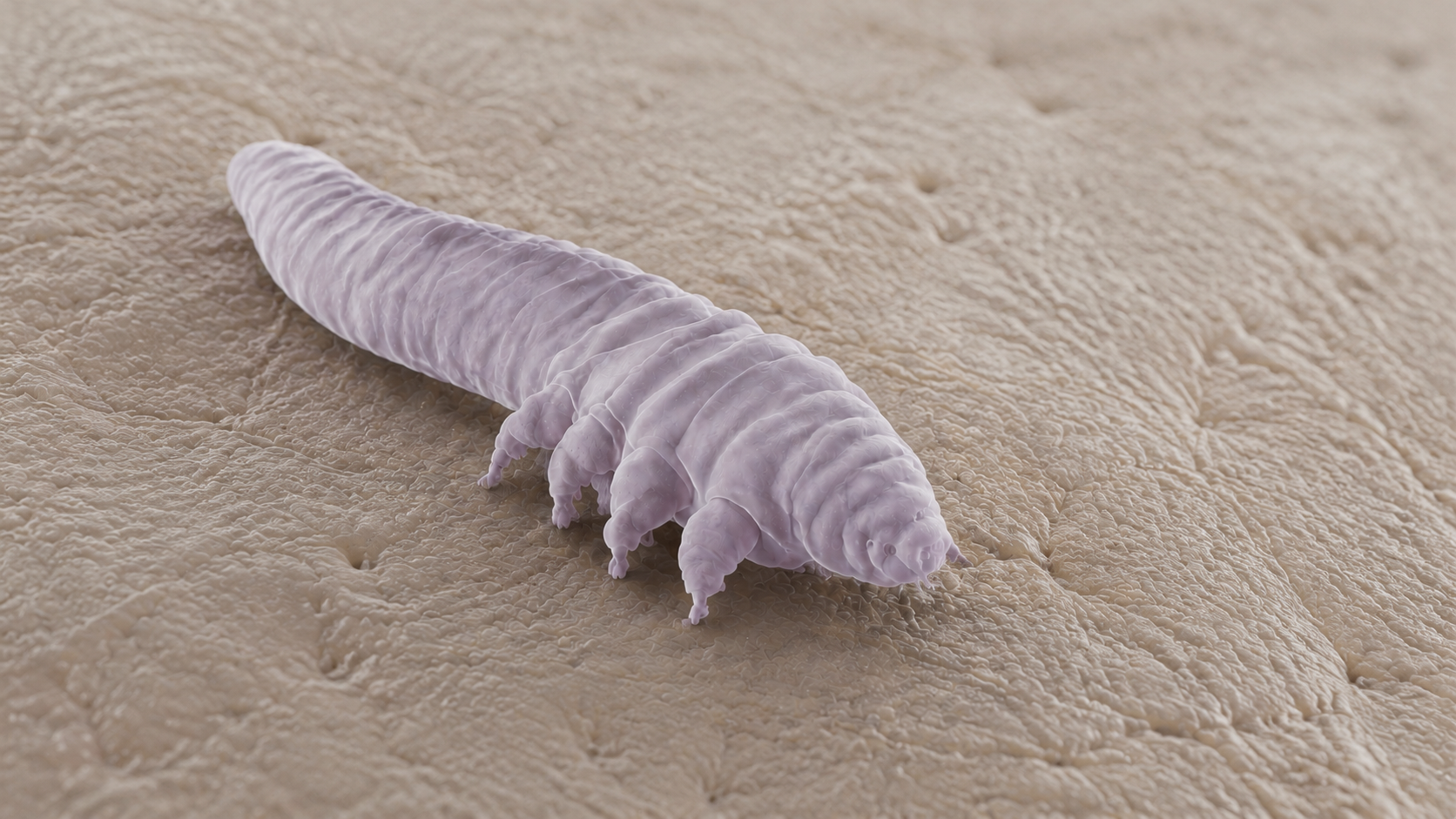
Illustration by Domi Verse X
Nearly every adult alive is carrying them, they wait for darkness before they move, and you were given yours in your first week of life.
This article contains affiliate links. If you buy through them, we may earn a small commission at no extra cost to you.
It is an animal. It has eight legs, a long pale body shaped more like a worm than the spider you are picturing, and it is currently living head first inside the pores of your cheeks, your nose and your eyelids.
It is called Demodex, and almost every adult on Earth is carrying it.
Two species, one address
There are two of them on humans, and they divide the property between them.
Demodex folliculorum is the larger, at 0.3 to 0.4 millimetres, and it lives in the hair follicle itself, clustered around the roots of eyelashes and in the pores of the face. Demodex brevis is half that size and burrows deeper, into the oil glands.
Neither is visible to you. Several of them would fit on the head of a pin, and a pocket jeweller's loupe will not quite get you there either. A single occupied follicle usually holds two to six.
What they do all day
Almost nothing. They sit head down inside the pore, facing into your skin, and they eat.
The food is sebum, the oil your skin produces to keep itself waterproof, the same film that shows up on an oil blotting sheet after an hour outdoors. That is why they concentrate on the oiliest parts of the face, and why populations climb in adolescence when the pores get bigger and the oil gets heavier.
They have no interest in your blood, and they do not bite. They are living in a warm tube full of grease, and from their point of view that is paradise.
Then the light goes out
Movement starts in darkness. The mites climb up out of the pore and walk across the surface of the skin at 8 to 16 millimetres an hour, which for something a third of a millimetre long is a serious journey.
The reason they wait for dark is not shyness. The 2022 genome study from Bangor University and the University of Reading found that they cannot make their own melatonin, the small molecule that tells an animal when to be active. Instead they use yours. Human skin releases melatonin at dusk, and the mites read it like a bell.
They are not up there to feed. They are looking for each other. The males have a penis that points upward from the front of the body, so a pair has to align in a very specific way, clinging onto a human hair while they do it. Then the female goes back down into a pore to lay.
The whole cycle from egg to adult takes about two weeks, and an adult lives only a matter of days after that. Your face is running a fast, complete generational turnover every fortnight, and you have never felt any of it.
Where yours came from
This is the part that changes how the story feels.
Newborn babies do not have them. They are acquired within days of birth, through close skin contact, most likely from the mother. Nursing is one of the routes, which is why the mites turn up not only on the face but around the nipples.
So the population on your face is not something that landed on you. It was handed to you, by whoever held you first, in your first week alive. It has been reproducing on you ever since.
The genome that shocked the people who read it
For a century these were filed as parasites and largely ignored. Then a team led by Bangor University and the University of Reading sequenced Demodex folliculorum and published the result in Molecular Biology and Evolution in 2022, and the animal turned out to be far stranger than anyone had bothered to check.
It has shed genes on a scale that is hard to overstate. Its protein toolkit is the smallest ever recorded in this group of mites and its relatives. Each of its tiny legs is powered by three single cells. Three. Not three muscles made of many cells, three cells.
It has also lost the gene that makes most animals wake up in daylight, along with the ability to protect itself from UV. It has thrown away everything it does not need, because it lives in a place where nothing changes, nothing dries out and food arrives by itself.
Enjoying this story?
Get a short teaser by email whenever we publish something new. No spam.
If you want the wider version of this story, that the human body is less an individual than a habitat, Ed Yong's I Contain Multitudes is still the best popular account of it.
The myth that will not die
You have probably seen the claim that face mites have no anus, that they store their waste for their entire lives and then burst when they die, dumping it into your pores.
It is not true. The same 2022 genome study looked, and they do have anuses.
It matters more than a piece of trivia. The exploding-mite story was one of the reasons Demodex got blamed for inflammatory skin conditions in the first place. Take away the explosion and the case against them gets noticeably weaker.
Parasite, or part of you
The gene loss points somewhere uncomfortable for the word parasite.
An animal that lives in one pore, on one host, and meets only the other mites on that same face, is not mixing much. The researchers describe a population that is close to inbred and highly isolated, which is the classic route by which a parasite stops being a parasite and becomes a symbiont, an organism that is simply part of the body it lives in.
One of the study's authors, Dr Henk Braig, put the possible upside plainly: mites moving in and out of pores all night may help keep those pores unplugged. That is not proven. But the direction of travel in the evidence is that they are becoming less like an infestation and more like an organ you did not know you had.
When they genuinely are a problem
Sometimes the numbers get out of hand, and then it stops being harmless.
Very high mite populations are associated with rosacea, with blepharitis, the inflammation of the eyelid margin, and with a skin condition called demodicosis. One 2022 clinical survey of over a thousand eyecare patients found more than half had Demodex blepharitis. Populations peak in the twenties and again after sixty.
The honest caveat is that association is not the same as cause, and the direction is still argued over. Skin that is already inflamed produces more oil, and more oil supports more mites, so the mites may be a passenger rather than the driver in some cases.
If your eyelids are persistently red, crusted or itchy, that is a matter for an optometrist or a dermatologist, not for scrubbing. Aggressive cleaning strips the skin barrier and tends to make things worse. The standard first step a professional will usually suggest is gentle lid hygiene with something made for the job, such as pre-moistened lid wipes, rather than soap and a flannel.
Can you see your own
Yes, and this is where the story stops being abstract.
The classic method is a tiny sample from an eyelash or a strip of skin oil taken with tape, put under magnification. A cheap USB microscope that plugs into a phone or laptop reaches the magnification needed, and people find them on the first or second try more often than not.
Be warned that you cannot unsee it. The body is unmistakable once you have watched one move.
Nobody is coming to remove them
There is no treatment that clears them permanently, and no reason to want one. They were on your parents, on their parents, and on every human who has ever lived long enough to grow oily skin.
Tonight they will do what they have done every night of your life. You will sleep through it, the way you always have.
And in the morning, when you look in the mirror, there will be more of them than there were yesterday.
Sources
- Smith et al., "Human follicular mites: Ectoparasites becoming symbionts," Molecular Biology and Evolution, 2022
- University of Reading: Secret lives of skin mites in our faces, 2022
- Bangor University: The secret lives of mites in the skin of our faces, 2022
- Review of Optometry: Don't Underestimate Demodex
- Cleveland Clinic: Demodex Face Mites