This is a cockatoo squid
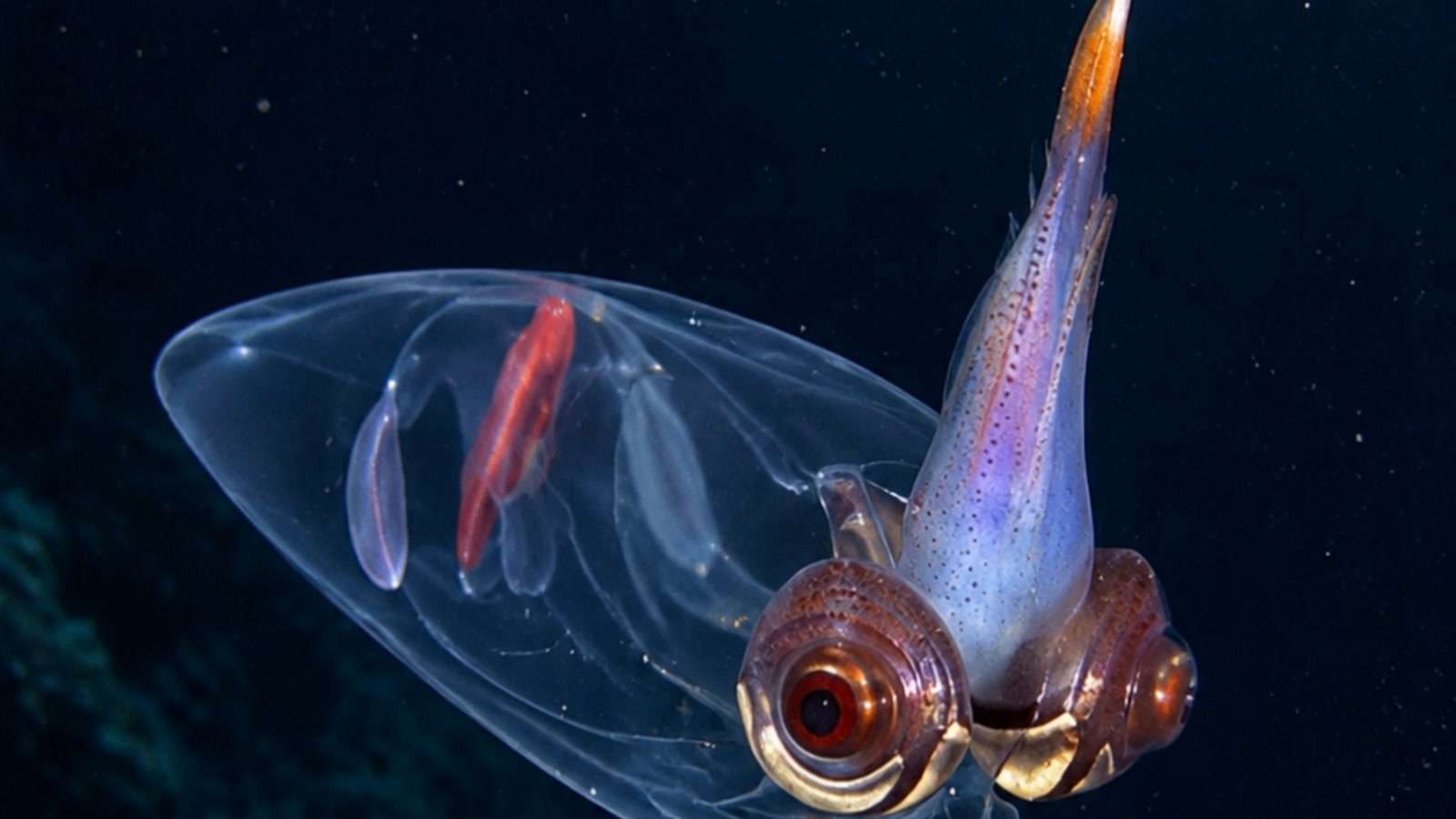
Illustration by Domi Verse X
It is the size of your hand and you can see straight through it. Its family tree has a surprise at the other end.
This article contains affiliate links. If you buy through them, we may earn a small commission at no extra cost to you.
Somewhere in the open Pacific, a few hundred metres below the last of the daylight, a lamp on a remotely operated vehicle swings across empty water and catches something that should not be visible at all. It is roughly the size of a hand. Two enormous copper eyes sit at the front of a body the light passes straight through, and above them a bundle of short arms is held stiffly upright, like a crest.
That posture is where the name comes from. The University of Washington's Interactive Oceans programme, which runs cabled seafloor observatories off the Oregon and Washington coast, describes these animals holding "their stocky arms above their heads in a way that resembles a cockatiel's crest". Scientists file them in the family Cranchiidae, and the group's other common name is blunter: glass squid. If you want to see near invisible tissue at a scale you can hold, a pocket microscope pointed at a water flea from a garden pond shows you the principle for about the price of a pizza.
Being transparent is a choice, not an accident
Most animals that hide in the open ocean have nowhere to hide behind. There is no reef, no kelp, no rock. There is only water in every direction, so the only real camouflage is to look like water.
Glass squid do this by keeping their chromatophores closed. Chromatophores are tiny sacs of pigment in the skin, and most squid open and shut them constantly to flash colour across their bodies. The Monterey Bay Aquarium Research Institute puts it simply: they often keep those sacs closed "so their skin is basically see through", and "this invisibility cloak hides them from both predators and prey".
It is not perfect. The eyes cannot be made transparent, because an eye works by absorbing light, and anything that absorbs light casts a shadow. Neither can the digestive gland, which is why the one solid looking object inside the animal is a compact reddish organ.
Its own light, aimed downward
Which leads to the part that sounds invented. Under each eye sits a light organ, a photophore, and it glows.
At first that seems like the worst possible idea for an animal trying not to be seen. It makes sense once you know where the danger comes from. In the twilight zone, between roughly 200 and 1,000 metres, there is still a faint blue glow filtering down from the surface. A predator hunting below its prey does not look for a shape. It looks for a dark patch blocking that glow.
So the squid fills in the patch. MBARI describes the light organs masking the shadow of the opaque body parts, like the eyeballs: "These organs glow at the same intensity as the dim sunlight from above to hide the squid's silhouette from predators hunting from below." The animal is not lighting itself up. It is erasing itself, by matching the brightness of the water behind it. Biologists call this counterillumination. A 2002 survey in the Journal of Zoology by Peter Herring, Norman Dilly and Christine Cope describes ocular photophores in specimens from all 13 cranchiid genera, so this is a family wide solution rather than one species' trick.
If you want to watch real bioluminescence rather than read about it, a jar of living marine plankton glows blue when you swirl it, using the same basic chemistry.
It does not swim to stay up
There is a second problem with living in open water, and it is duller but just as lethal. Staying at the right depth costs energy, and food down here is scarce.
Enjoying this story?
Get a short teaser by email whenever we publish something new. No spam.
Fish solve it with a gas filled swim bladder. Glass squid solve it with chemistry. MBARI describes a large internal cavity filled with ammonium, a chemical that is lighter than seawater, which holds the animal up without any effort at all. The mechanism was worked out in 1969 by Eric Denton and John Gilpin-Brown and published by the Royal Society. It is the reason these animals look bloated and balloon like compared with a normal squid. A good chunk of that body is not muscle or organ. It is ballast running in reverse, and it lets a glass squid hang motionless in the dark for hours, which is exactly what an ambush hunter with a poor food supply wants to do. A cheap ultraviolet torch over a jar of pond water at night makes the same point in your kitchen: staying level is work, and most small things never stop doing it.
The part the video did not tell you
Everything above describes an animal you could hold in one hand. MBARI notes that the glass squid its submersibles typically see are about 30 centimetres long, and that more than 60 species live in deep twilight waters around the world.
Here is the turn. One member of that same family is Mesonychoteuthis hamiltoni. The colossal squid. The United States federal taxonomic database, ITIS, places it in Cranchiidae, in the subfamily Taoniinae, which is the same group Herring's photophore survey found the most elaborate eye light organs in.
A 2017 review in Polar Biology by Rui Rosa and colleagues calls it "the largest (heaviest) living invertebrate" and gives a maximum recorded weight of 495 kilograms. Older reference sources are far more conservative, with MarineBio putting a typical animal at an estimated 150 kilograms, so treat 495 kilograms as the documented record rather than the average. Estimates of its eyes run to roughly 25 to 30 centimetres across, and Te Papa, the New Zealand museum that holds a specimen, states that it "has the largest animal eyes ever studied".
So the fragile glass thing drifting past the camera, the one you could damage by breathing on it, sits on the same branch of the family tree as the heaviest invertebrate on the planet. Not a distant relative. The same family.
Born at the top, ending at the bottom
The two are also linked by how they live out their lives, and this is the detail that makes the whole group strange.
Glass squid are not deep sea animals from birth. MBARI records the family from the surface down to about 2,000 metres, with some species moving closer to the surface at night. The colossal squid follows the pattern more dramatically. The Polar Biology review reports juveniles mainly from the surface to 500 metres, with larger animals undergoing what it calls an ontogenetic descent towards 2,000 metres.
Read that as a life story rather than a distribution table and it is fairly bleak. The animal is born into light, and then goes down, and keeps going down, and the light it was born under is something it will not see again.
What nobody has watched
The gap in all of this is the middle. We have surface juveniles, and we have adults, mostly recovered dead or filmed briefly. What happens across the years in between, how a transparent hand sized drifter becomes something weighing as much as a grand piano, is almost entirely unobserved.
Which means the honest version of the sentence at the top of this page is slightly longer. This is a cockatoo squid, and we know what it is. We have never really watched one grow up.
Sources
- Glass squid, MBARI Animals of the Deep
- Cockatoo Squid, University of Washington Interactive Oceans
- Herring, Dilly and Cope 2002, The photophores of the squid family Cranchiidae, Journal of Zoology 258, 73 to 90
- Denton and Gilpin-Brown 1969, A buoyancy mechanism found in cranchid squid, Proceedings of the Royal Society B 174, 271
- Rosa et al. 2017, Biology and ecology of the colossal squid, Polar Biology 40, 1871 to 1883
- ITIS, Mesonychoteuthis hamiltoni, family Cranchiidae
- Colossal squid, MarineBio
- Anatomy of the colossal squid, Museum of New Zealand Te Papa Tongarewa