The Butterfly That Has a Compass But No Map
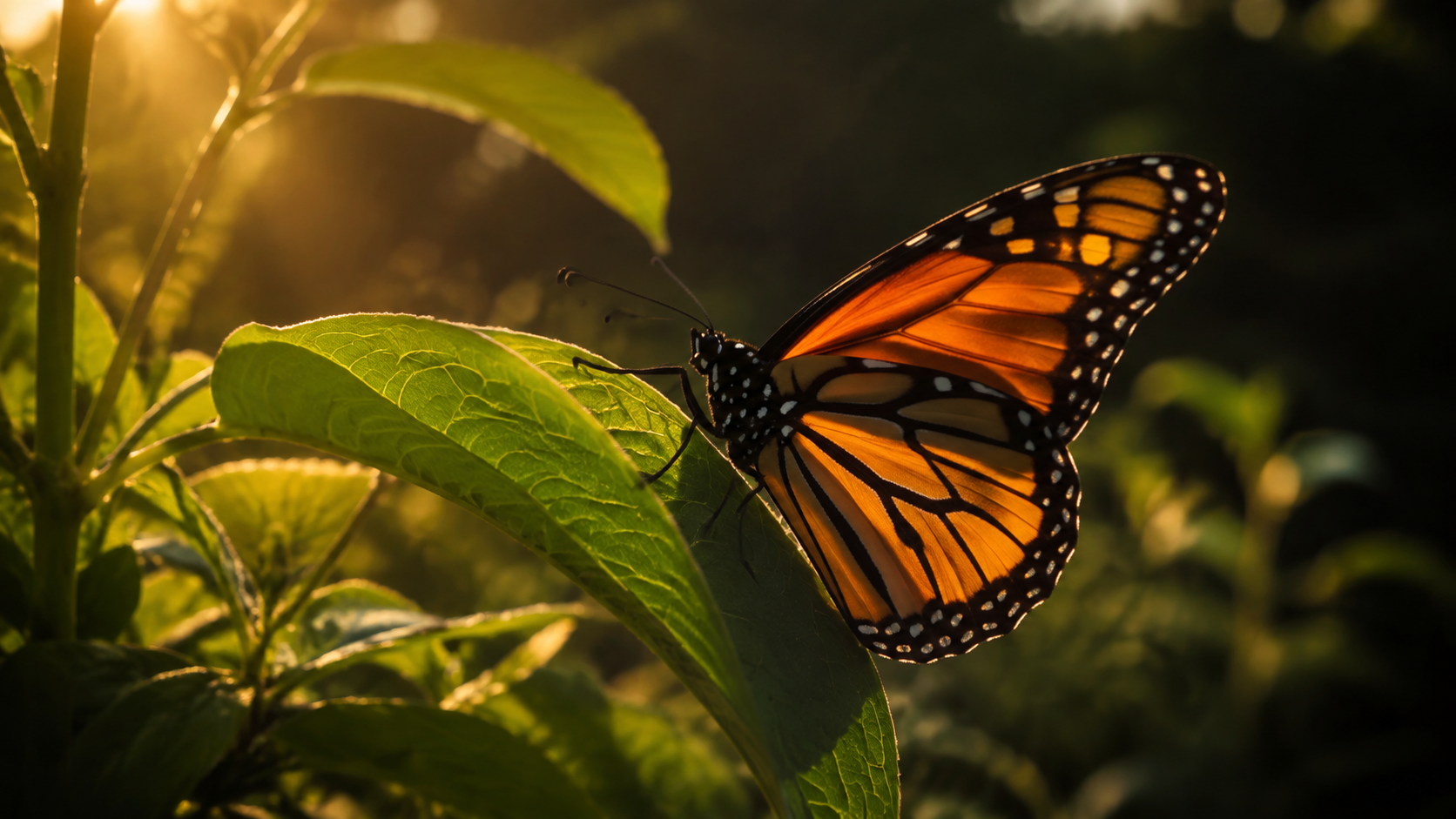
Illustration by Domi Verse X
It has a compass. It does not have a map. It arrives anyway.
This article contains affiliate links. If you buy through them, we may earn a small commission at no extra cost to you.
On the underside of a milkweed leaf somewhere in Canada, there is an egg about the size of a pinhead. Nothing about it looks important. In a few days it will hatch, and the animal that comes out will begin a journey that ends roughly 3,000 miles away, in a forest it has never seen, on a mountainside in central Mexico that covers less ground than a small farm.
It will get there. That part is not in question. Millions of them arrive every winter, in the same nine or so patches of forest, year after year. What is genuinely unsettled is how, because the butterfly making the trip is carrying equipment that should not be enough for the job. If you want to watch the first part of this story happen in your own garden, the whole thing starts with a single kind of plant.
Two weeks of eating, and only one plant will do
Monarch caterpillars eat milkweed. Not mostly milkweed. Only milkweed, the plants in the genus Asclepias, and a female monarch will lay her eggs on nothing else. The caterpillar spends roughly two weeks doing almost nothing but eating, pausing only to shed its skin when it outgrows it. How long that takes depends on temperature, so two weeks is an average rather than a rule.
This is also why the monarch story has become a conservation story. Widespread herbicide use across American farmland has stripped out most of the milkweed that used to grow between and around crops, and milkweed is the only thing monarch caterpillars can eat. Take away the plant, and you take away the butterfly, no matter how many adults survive the flight south. Plenty of people now grow it deliberately, and if you want to watch the caterpillars up close without losing them to wasps and birds, a mesh habitat is how most schools and backyard enthusiasts do it.
Then it takes itself apart
At the end of those two weeks, the caterpillar stops eating, hangs itself upside down from a stem, and becomes a green case with a ring of gold dots near the top. This is the part everybody has seen in a photograph and almost nobody has thought about properly.
Inside that case, most of the caterpillar dissolves. Its tissues break down into a nutrient-rich liquid in a process called histolysis, and the adult butterfly is built out of the remains by small clusters of cells, called imaginal discs, that survive the demolition intact. So it is not quite true that everything is destroyed and rebuilt. Some of it is carried across. But the animal that walks into the chrysalis and the animal that flies out of it are not built from the same body in any ordinary sense.
Only one generation in the year makes the trip
Here is where the story stops being a nature documentary and starts being strange.
Monarchs go through several generations each year, and sources differ on the exact count, with most putting it at three to five. The ones that hatch during spring and summer live about two to six weeks. They mate, lay eggs on fresh milkweed further north, and die. That is a complete monarch life, and it happens several times over between April and August.
Then, in late summer, something changes. The monarchs that emerge in the shortening days of August and September do not breed. They enter a state called reproductive diapause, put their reproductive systems on hold, build up fat, and turn south. This cohort has a name among researchers: the Methuselah generation. Estimates of how long they live range from four to six months in one source to seven to nine in another, but every source agrees on the shape of it, which is roughly ten times longer than their own parents lived.
Enjoying this story?
Get a short teaser by email whenever we publish something new. No spam.
Which means the butterfly flying to Mexico this autumn is the great-grandchild, or the great-great-grandchild, of the one that left Mexico last spring. Nothing about the route was demonstrated to it. Nobody flew it first and came back. The insects that knew the way, to whatever extent an insect knows anything, are several generations dead. If you want to actually watch them pass overhead during the autumn migration, a light pair of binoculars turns a distant orange speck into something you can identify.
A compass, but no map
So how does it find the place?
Part of the answer is solid, and it is genuinely elegant. Monarchs use what researchers call a time-compensated sun compass. They read the position of the sun, and because the sun moves across the sky all day, they correct for the time of day using an internal clock. In 2009 a team at the University of Massachusetts Medical School showed that this clock is not in the brain, as everyone had assumed, but in the antennae. Later work found that monarchs can also use a light-dependent magnetic compass, which appears to help on overcast days when the sun is not available.
That explains direction. It does not explain arrival.
A compass tells you which way is south. It does not tell you where you are, or how far you have left to go, or when to stop. And the evidence suggests monarchs do not have that second piece. A displacement experiment combined with more than fifty years of tag recovery data led one research group to conclude that monarchs are almost certainly not true navigators, meaning they hold a heading rather than steering toward a known destination. Other work suggests they lack the kind of magnetic map that sea turtles and some birds appear to use for working out position.
So the picture is an insect flying south on a compass heading, for weeks, across a continent, with no representation of where it is going, and somehow converging on a handful of groves in Michoacán. Nobody has a complete account of how the last step works. Wind patterns, landscape features and the funnelling shape of the flyways probably all contribute. Probably is doing real work in that sentence.
The place they are aiming for keeps getting smaller
The monarchs that arrive spend the winter clustered on oyamel fir trees, packed so densely that the branches sag. Researchers do not count them individually. They measure the area of forest the clusters cover, and then estimate from there, at somewhere between 20 and 30 million butterflies per hectare.
In the winter of 2025 to 2026, nine colonies covered 2.93 hectares in total. That was a 64 percent increase on the year before, which sounds like good news, and in the short term it is. For scale, though, the colonies covered around 18 hectares in the mid 1990s, and researchers estimate that a stable eastern population needs at least 6 hectares. So the recent rebound is real, and it still leaves the population well below the line.
It is worth saying that the cause of the decline is not fully settled either. The milkweed explanation is the one most often repeated, and it is the one this article has leaned on, but it is not universally accepted. Anurag Agrawal, a Cornell ecologist who has spent much of his career on the relationship between the two species, argues in his book on monarchs and milkweed that the loss of milkweed is not the main driver, and proposes a different explanation for the falling numbers. Researchers still disagree about this.
All of which makes the original question sharper rather than softer. An animal with a compass and no map, on its first and only attempt, is looking for a target that has shrunk by most of its area within a single human lifetime. It is still finding it. Nobody can fully explain how it does that even when the target is large.
Sources
- Monarch Joint Venture: eastern monarch overwintering population 2025 to 2026
- Monarch Watch: monarch population status, March 2026
- Merlin et al., Science 2009: antennal circadian clocks coordinate sun compass orientation
- Guerra et al., Nature Communications 2014: a magnetic compass aids monarch butterfly migration
- Annual Review of Entomology: neurobiology of monarch butterfly migration