A hundred and fifty years ago, this was a normal American sky.
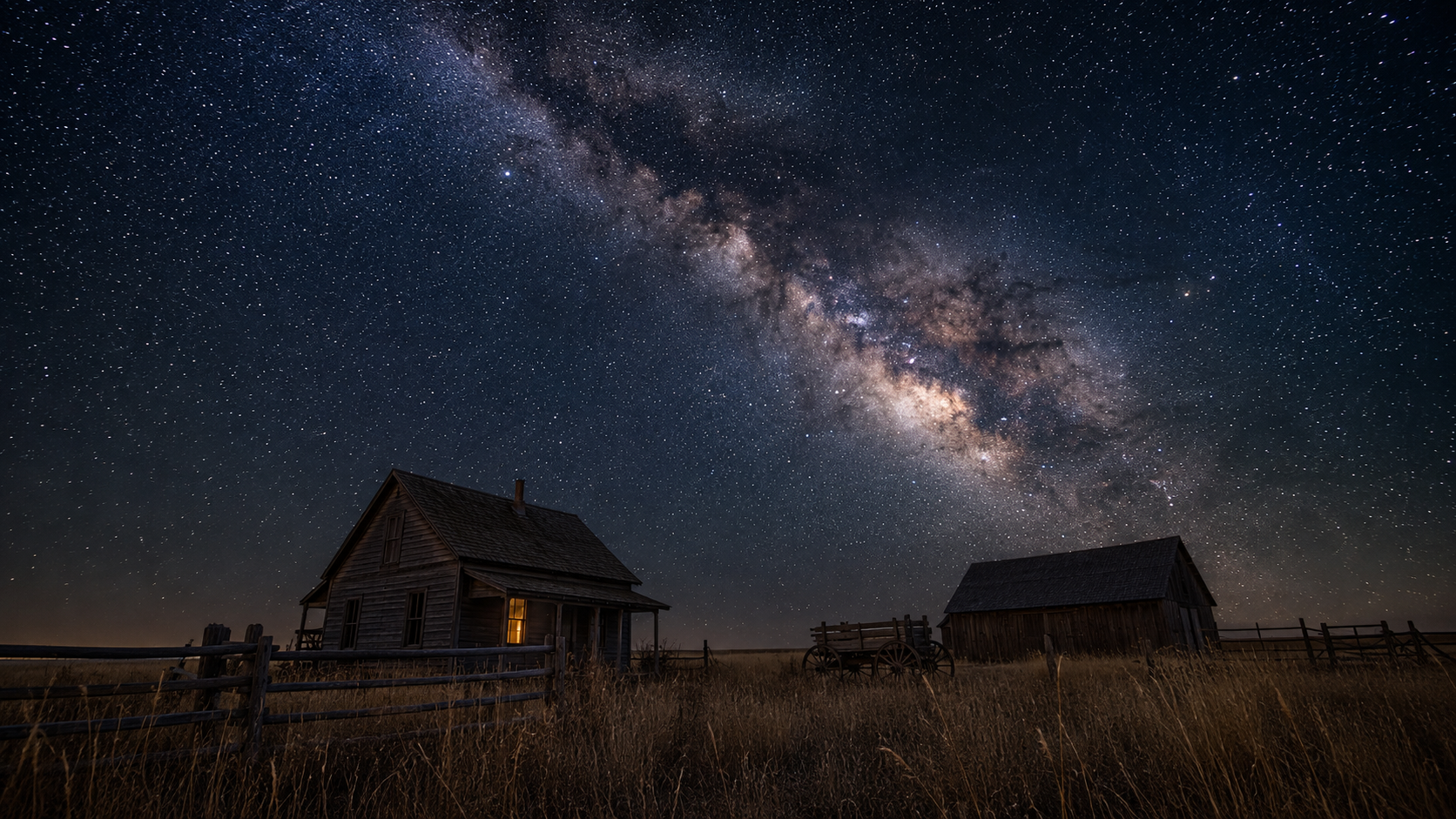
Illustration by Domi Verse X
Every human who ever lived looked up and saw the Milky Way. Then, in a single lifetime, most of America stopped, and almost nobody noticed it happening.
This article contains affiliate links. If you buy through them, we may earn a small commission at no extra cost to you.
Not a long exposure. Not a telescope. No stacking, no filter, no edit. This is what a person standing in a field saw with their own two eyes, on any clear night without a moon, anywhere outside a city.
And it was not faint. Under the darkest skies still measured today, the brightest parts of the Milky Way cast, in the official wording of the Bortle scale, "obvious diffuse shadows on the ground." Not poetry. Your own galaxy, throwing your shadow at your feet.
Today, roughly four out of five people in North America cannot see it from where they live. At all.
Something took it, and it is not the thing most people blame.
First, the honest part
That 80 percent figure comes from one piece of work: the New World Atlas of Artificial Night Sky Brightness, published in 2016 by Fabio Falchi and colleagues. Nobody surveyed 300 million people. It is a model built from satellite readings, ground measurements and population data, and it assumes clear weather and a viewer looking straight up.
It has also never been replaced. The most quoted number in this whole subject is a decade old, and the situation it described has almost certainly got worse since.
What it takes to see it now
Most people who say they have seen a dark sky have not. They stepped outside, looked up for four minutes, and went back in.
Your eyes need twenty to thirty minutes of darkness to reach anything close to full sensitivity, and one glance at a phone screen resets the clock. That is why observers use red light instead of white. A red headlamp costs about the same as a pizza and is the difference between standing in the dark and seeing in it.
Next, know where to look. In August the bright core of the galaxy sits low in the south once the sky is fully dark, which is why this is the best month of the year for it. A paper planisphere beats a phone app for one decisive reason: it does not emit light.
The Milky Way is also not a telescope object. Telescopes magnify far too much. But ordinary 7x50 binoculars turn a faint smear into what John Bortle called veined marble: thousands of individual suns, resolved, from your own hands.
And then the part nobody mentions, which is why most people fail. Half an hour of looking straight up hurts. Necks cramp, people quit at eight minutes and conclude there was nothing there. Every experienced observer solves this the same unglamorous way, by lying down. A folding reclining chair does more for your chances than any piece of glass.
You also need somewhere dark enough. On the Bortle scale of 1 to 9, the Milky Way needs roughly a 4 or better to impress. Most American suburbs are 5 to 7. City centres are 8 and 9, where it is simply not there.
Everyone used to see this
Before electric light, every human being on Earth saw the Milky Way. Not astronomers. Everyone. It was not an event, it was the ceiling.
The proof is not a statistic, it is language. Almost every civilisation named it. The Greeks called it a road of milk, which is where the word galaxy comes from. Aboriginal Australians read the dark dust lanes inside it as an emu. The Finnish name means the Birds' Path, because migrating birds were thought to follow it south, which turns out to be close to true. You do not name a thing you cannot see.
The lights came on slowly, and that is the part people miss
The first commercial power station opened in 1882. But electrification was a crawl, not a switch, and the crawl is what makes this story recent rather than ancient.
In 1880, 72 percent of Americans still lived in the countryside. As late as 1932, only about 10 percent of rural America had electricity. The Rural Electrification Administration was created in 1935 precisely because the countryside was still dark, and power did not reach nearly everywhere until the 1950s.
Read that again with a person attached to it. An American born on a farm in the 1940s grew up under the full Milky Way. Not in a history book. In their own yard, on ordinary nights, well within living memory.
Then a second change happened at the same time, and the two multiplied. As the sky brightened, people moved toward the brightness. The American urban share climbed from 26 percent in 1870 to 35 percent by 1890 and never stopped. Dark places still exist in enormous quantity. Almost nobody lives in them.
Three generations of streetlight
Enjoying this story?
Get a short teaser by email whenever we publish something new. No spam.
Street lighting has been rebuilt three times, and the sky answered differently each time.
Mercury vapour became commercially available in the 1930s and took over American streets after the war: blue-white, and blue light scatters hard in the atmosphere. High-pressure sodium replaced it from the 1970s, the orange glow in every photograph of a city from the eighties. Sodium sits in a narrow band, scatters less, and astronomers could filter it out of their images.
Then white LED from the 2010s: cheap, efficient, long-lived, and heavily weighted toward blue. The same quantity of light now produces more skyglow than it did in the sodium era, purely because of its colour. If you own outdoor lighting this is also the part you control. Putting a 1900K amber bulb in a porch fixture that points down instead of sideways costs a few dollars and takes your household out of the blue end of this entirely.
The efficiency trap
Here it stops being a story about carelessness.
The LED transition was the largest leap in lighting efficiency in human history. Everyone involved was doing the responsible thing. Light pollution accelerated anyway.
Kyba and colleagues measured it from orbit with the VIIRS instrument between 2012 and 2016. Lit outdoor area grew 2.2 percent per year, and radiance grew 2.2 percent per year. The savings were real in every individual project. At national scale they were spent immediately on more lights, brighter lights, and lights where there had been none. Efficiency did not cut consumption. It cut the price, and we bought more.
The instrument that cannot see the problem
Now the detail that reframes everything above it.
VIIRS, the sensor behind most global light pollution maps, cannot detect light below about 500 nanometres. Blue light. Exactly where white LEDs are brightest. The instrument we use to measure the problem is blind to the wavelength that made it worse, so every map understates it, and understates it in the same direction every time.
You can see the size of the gap. Satellites said 2.2 percent a year. Then in 2023 Kyba's team published 51,351 star counts made by ordinary people between 2011 and 2022. Human eyes, no instruments. Their answer was 9.6 percent a year, and 10.4 percent in North America.
At that rate the sky doubles in brightness every seven to eight years. Kyba put it the only way that really lands: a child born where 250 stars are visible will find 100 stars there on their eighteenth birthday. Same house. Same window. Same universe. Fewer stars.
Two measurements, one phenomenon, and the human eye caught what the machine could not.
Nobody wrote it down
The strangest part is the silence. There was no year it happened, no announcement, no last night. Each generation was handed a slightly dimmer sky than the one before and had no way to know, because you cannot miss what you never saw.
Paul Bogard spent years chasing what was left, travelling from the brightest place on Earth to the darkest, and wrote it up in The End of Night. It is still the best long account of what a truly dark sky does to somebody who has never stood under one.
The only environmental problem with an undo button
Light pollution has no half-life. Nothing to remove from the atmosphere, nothing to bury, no decades of recovery, no tipping point. It is not a substance. It is a condition, and it exists only while the lights are on.
Turn them off and the sky comes back the same night.
That is not hypothetical. Flagstaff, Arizona passed its first lighting ordinance in 1958 and became the world's first International Dark Sky City in 2001, and it still has a genuinely dark sky above a city of 75,000 people. Shielded fixtures that point down instead of sideways, warmer colour temperatures, and switching things off when nobody is there. That is the whole intervention.
One last thing, and it is new. A recent phone in night mode, held still on any basic tripod for a thirty-second exposure, will often record the Milky Way on a night when your eyes are still struggling with it. It is the fastest way to prove to yourself that it is up there.
So the ending is not a warning. It is an instruction, and the deadline is tonight. Find the darkest place within an hour of you. Bring nothing white. Lie back and give it thirty minutes, and do not look at your phone. Not once.
Your great-grandparents did none of this. They just walked outside.
Sources
- Falchi et al., The new world atlas of artificial night sky brightness, Science Advances, 2016
- Kyba et al., Citizen scientists report global rapid reductions in the visibility of stars from 2011 to 2022, Science, 2023
- Kyba et al., Artificially lit surface of Earth at night increasing in radiance and extent, Science Advances, 2017
- Sky & Telescope: Gauging Light Pollution, the Bortle Dark-Sky Scale
- Sky & Telescope: The Lost LED Revolution, Light Pollution Is Increasing
- Smithsonian National Museum of American History: Power from the people, rural electrification
- U.S. Census Bureau, Table 4: Population 1790 to 1990, urban and rural
- U.S. Census Bureau: Increasing Urbanization
- DarkSky International: Flagstaff, Arizona