Webb found stars only twice the size of Jupiter. They're not supposed to exist.
AI-generated illustration
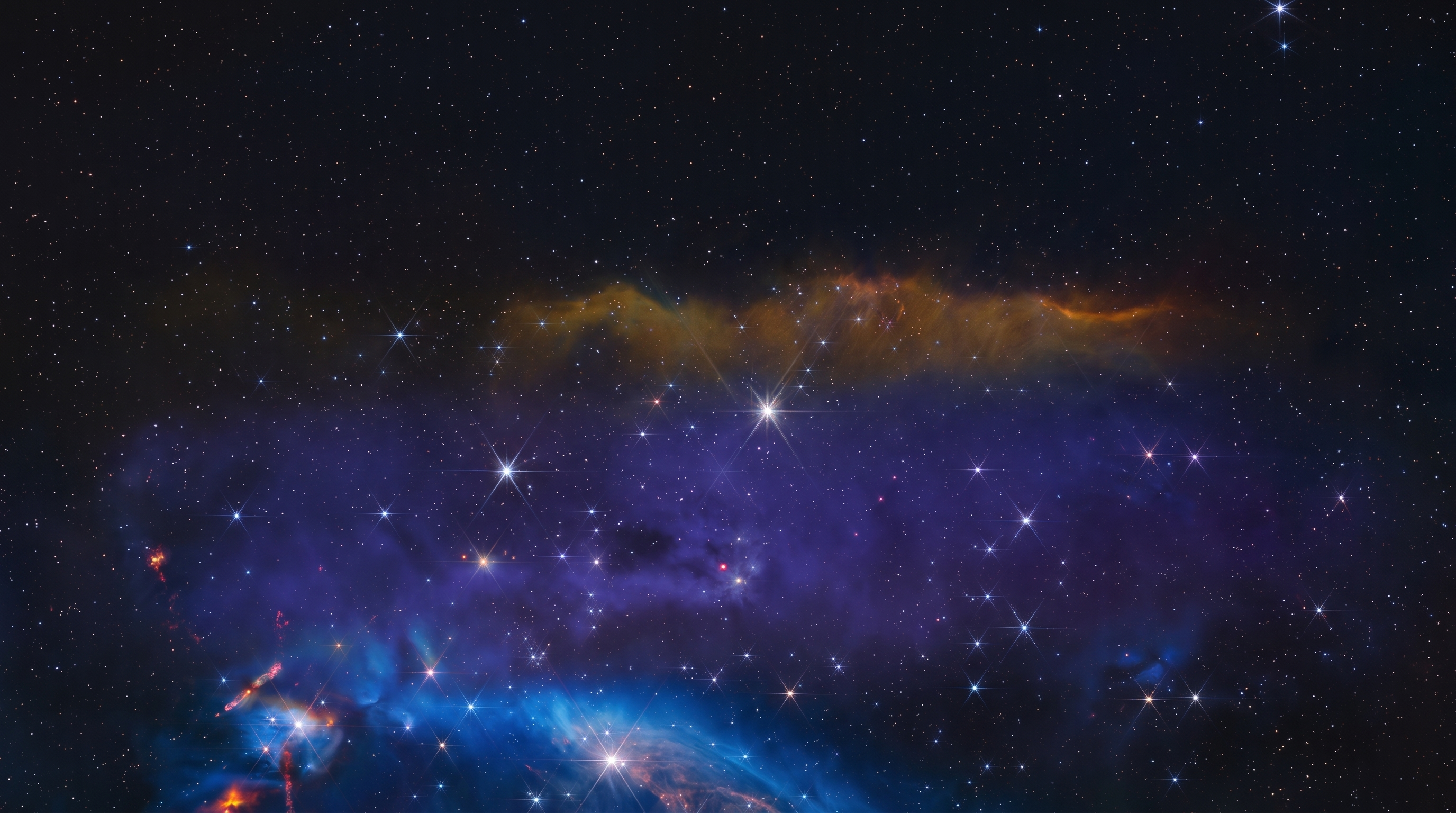
Inside a giant new photograph of a stellar nursery, astronomers spotted brown dwarfs barely twice the mass of Jupiter, the lightest ever confirmed, and one of them has its own disk of dust and gas that could go on to build planets.
This article contains affiliate links. If you buy through them, we may earn a small commission at no extra cost to you.
On September 15, 2026, NASA and the European Space Agency released a brand new picture from the James Webb Space Telescope: a sprawling, colorful view of a cloud of gas and dust called IC 348, sitting in the constellation Perseus about 1,000 light years from Earth, according to NASA. The cloud is a nursery, a place where baby stars are still being born, and Webb's infrared eyes let scientists see straight through the dust to watch it happen. Long streams of glowing gas shoot out from young stars, and scattered across the frame are hundreds of faint points of light. One of them, though, was not supposed to be there at all.
A Sky Full of Newborn Stars
Webb's picture of IC 348 is huge. Both NASA and ESA called it one of the largest images the telescope has ever released to the public. Packed inside it are two jets of gas, named HH 797 and HH 211, blasting out from newborn stars still wrapped in their birth clouds. Picture sparklers being waved around in the dark, except each spark is really a jet of hot gas shot out by a baby star as it grows. These jets are the fireworks of star birth, and they show astronomers exactly where new stars are still forming inside the cloud. If a photograph like this makes you want a piece of that night sky closer to home, a tabletop star projector can scatter a similar field of stars across your own ceiling.
The Point Too Small to Be a Star
Buried in that same picture, researchers led by Kevin Luhman of Penn State University and Catarina Alves de Oliveira of the European Space Agency found something odd: a handful of faint red dots that turned out to be brown dwarfs weighing only about twice as much as Jupiter, or roughly 0.19 percent of the Sun's mass, according to NASA and Earth.com. That is so light it would take roughly 500 of them stacked together to equal one Sun. NASA itself called them "the least massive brown dwarfs known," and said their existence "poses a challenge to models of how stars form." Brown dwarfs are sometimes nicknamed failed stars, because they never get heavy enough to start burning like the Sun does. These new ones are so light they sit right at the fuzzy edge of what counts as a brown dwarf at all.
Not the First Tiny One, But the Lightest Yet
Enjoying this story?
Get a short teaser by email whenever we publish something new. No spam.
This is not the first time astronomers have found a lightweight brown dwarf hiding in IC 348. Back in December 2023, NASA announced that Webb had spotted brown dwarfs there weighing three to four times as much as Jupiter, calling them the tiniest free-floating ones confirmed at the time. The newly reported objects are even lighter, only about half that mass, which is why scientists are treating this as a new, smaller record rather than the same discovery all over again.
A Ring That Could Build Planets
One of these tiny brown dwarfs turned out to have something wrapped around it: a disk of dust and gas, the same kind of swirling ring that once surrounded our own young Sun before it clumped together into Earth and the other planets, NASA and ESA both report. That means an object barely bigger than a planet itself might be busy building planets of its own, a strange thought that blurs the line between what counts as a star and what counts as a planet.
A Smell With No Name
Webb's instruments also picked up a chemical signal in these tiny objects that scientists could not identify: an unnamed hydrocarbon, a molecule made only of hydrogen and carbon atoms, the same kind of atoms found in things like natural gas. It only shows up in the lightest, coldest of these objects, and for now nobody knows exactly which molecule it is or why it appears there and nowhere else.
So Webb's giant new photograph is not just a pretty picture of a stellar nursery. Somewhere inside it sits an object barely heavier than a planet, wrapped in a disk that might be building worlds of its own, giving off a chemical signature nobody can name yet. What else might be hiding in that faint red light?
Sources
- NASA's Webb Reveals Dynamic Panorama of Star Formation | NASA Science, https://science.nasa.gov/missions/webb/nasas-webb-reveals-dynamic-panorama-of-star-formation/
- Webb reveals stunning panorama of star formation | ESA/Webb, https://esawebb.org/news/weic2619/?lang=
- Webb finds mysterious objects barely twice the mass of Jupiter | Earth.com, https://www.earth.com/earth-science/webb-finds-mysterious-objects-barely-twice-the-mass-of-jupiter/
- NASA's Webb Identifies Tiniest Free-Floating Brown Dwarf | NASA Science (Webb Telescope), https://science.nasa.gov/missions/webb/nasas-webb-identifies-tiniest-free-floating-brown-dwarf/