This star died, and then it may have done something no dead star should do
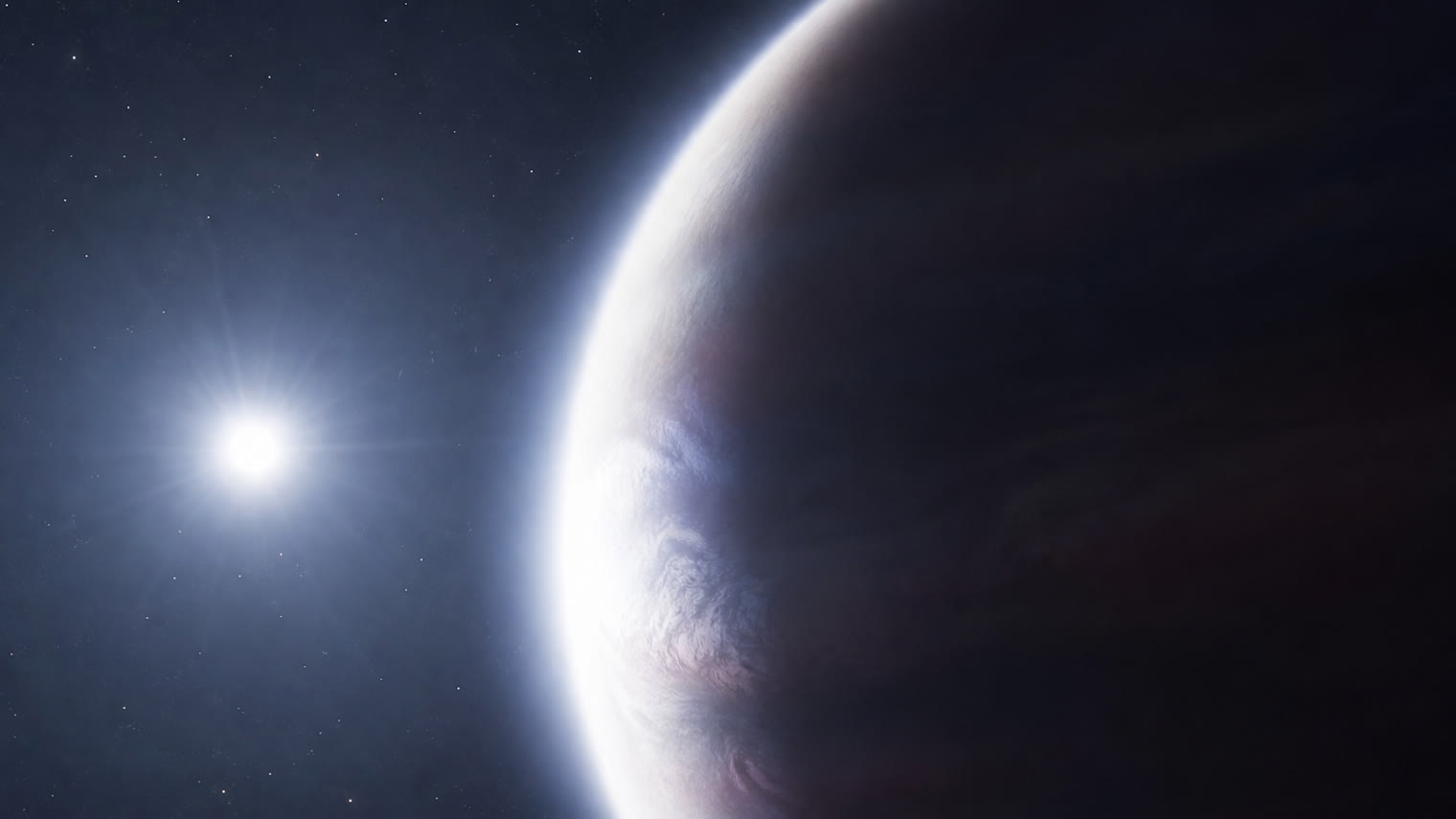
Illustration generated with AI for DomiVerseX
Astronomers think a burned out star could have company that was not there while the star was alive. The best clue lay unread in a telescope's records for 27 years.
This article contains affiliate links. If you buy through them, we may earn a small commission at no extra cost to you.
Every planet in our solar system was built from leftovers. When the Sun was born, some material was left over, and the planets formed from it. Astronomers call planets like Earth "first-generation" planets, the European Space Agency explains.
So a planet gets one chance to be born, right at the start. That was the simple story.
Then a star has its life. A star that is not too heavy ends as a white dwarf. That is the small, hot core that is left when the star has used up its fuel and lost its outer layers to space. It is a dead star, still glowing.
A team of astronomers now thinks that one such dead star may have started all over again.
Something circles a dead star every 4.4 days
The white dwarf has a name that looks like a phone number: HS 0209+0832. Most reports put it about 270 light years from Earth. A light year is how far light travels in one year. So the light that telescopes catch from this star set out about 270 years ago, which is more than three long human lives.
One report does not agree. Space.com gives the distance as about 790 light years. Sci.News, CNN and Notebookcheck all say about 270, and this article follows the three.
A NASA space telescope called TESS watched the star for four months. In that time its brightness changed in a regular way. The same faint signal came back every 4.4 days.
The team thinks the best explanation is a planet going around the star. It would be a giant ball of gas, about the size of Jupiter, the biggest planet we have at home.
And it would be very close to its star: about 6 million kilometers. That is only about 16 times the distance from Earth to the Moon. Mercury, the planet nearest to our Sun, is about ten times farther from the Sun than that.
Earth needs 365 days to go once around the Sun. This planet, if it is there, would go around its star about 83 times in one Earth year. You would have a birthday every four or five days.
There is no picture of it. Every image you see with this story is an artist's drawing. In a real telescope the star is one point of light, and the planet cannot be seen at all.
Why does this matter to you? Because nobody has seen this planet. Everything in this story is worked out from a flicker of light and from what the star is made of. Keep that in mind as you read on.
A planet made from its own star?
Here is the bold idea. The team thinks this planet did not form when the star was born. It may have formed much later, from material that the star threw off as it died. Astronomers call that a "second-generation" planet.
Jamie Williams of the University of Warwick, who led the study, put it like this, according to Space.com: "It's a bit like finding a planet that has risen from the ashes of the very star it once orbited."
That picture comes from the old story of the phoenix, a bird that burns up and is born again from its own ashes. So some people call this one the phoenix planet.
Is that impossible? No. It is unexpected, which is a different thing. Science News reports that a scientist named H. B. Perets worked out in 2010 that planets like this could exist. That was 16 years before this report. If this planet is confirmed, it would be the first one that anybody has actually spotted.
Zifan Lin, a researcher who was not part of the team, told Science News that until now the idea was "more like a hypothesis, more like speculation".
Why does this matter to you? If this is right, a dead star is not the last page of the book. As Williams says, the star systems we know may be only "the first chapter of a potentially much longer tale".
The twist: the clue waited 27 years
Enjoying this story?
Get a short teaser by email whenever we publish something new. No spam.
You might think this discovery needed a brand new telescope. It did not. The most important clue was collected in 1999.
In that year the Hubble Space Telescope looked at this white dwarf and spread its light out into colors. In that light were about 100 marks that nobody could name. Each mark is the trace of some kind of matter in the star, a bit like a fingerprint. Imagine a page with 100 words in a language that no one can read.
The page went into the archive. It stayed there for 27 years. A baby born in the year Hubble took that look would be a grown adult of 27 by the time someone could read it.
What changed was not the telescope. It was the list of fingerprints. With an updated list, Williams found that many of the mystery marks fit one metal: niobium. A retired NASA space telescope called FUSE had also seen strong signs of niobium in the same star, according to the European Space Agency.
"I was truly gobsmacked," said Boris Gaensicke, also of the University of Warwick, "as that element had not been reported in any other white dwarf analysed to date."
And there is a lot of it. This star has more than 1,000 times as much niobium as the Sun has. Think of one spoon of sugar in a cup, and then think of 1,000 spoons.
Why does niobium matter so much? Because a star does not make it in the normal way. Niobium is built only in the strange conditions inside a dying star. Nicholas Stone of the University of Wisconsin-Madison calls it "a signpost of these 'death' throes".
So the team's idea goes like this. The dying star threw off material rich in niobium. A planet may have formed from that material. The planet is so close to the hot white dwarf that its outer air is probably boiling away. That gas falls onto the star, and there Hubble could see it.
Other details point the same way. Zinc and copper are also unusually high. And Science News reports that the star shows almost no iron and only a trace of silicon. An ordinary rocky world has plenty of both, so this is probably not the dust of an ordinary rocky world.
Why does this matter to you? The answer was sitting in a drawer the whole time. Sometimes a discovery does not need a new machine. It needs a new look at old notes.
It is still only a candidate
Now the honest part. Some headlines say astronomers "have discovered" this planet. The team does not say that.
"It's not a confirmed planet," Williams told CNN. "It's only a candidate for now." The title of the study, in the journal Nature Astronomy, uses the word "candidate" too.
The case rests on one repeating signal and on the strange mix of metals, and it comes from one team. Williams is open about the gap. "We're not really sure, if it's not a planet, what it is," he told Science News.
There is also a missing piece. A star that dies alone throws its material out evenly in all directions, and the material escapes. To gather it into a ring where a planet can grow, the star probably needed a partner to pull the material back. According to CNN, Williams suggests that the partner could have been a small star with about one fifth of the Sun's mass, or an even smaller object called a brown dwarf. No such partner has been found.
Why does this matter to you? "Candidate" is not a boring word. It is the word that tells you how sure the scientists are, and here they are not sure yet.
Planet or not, and for how long?
More looks are planned. CNN reports that Hubble and another space telescope, Chandra, will observe the star again within about a year, and that the team has asked for time on the James Webb Space Telescope. Those looks could confirm the planet. They could also make it disappear.
And if it is real, there is a second question. Its air seems to be streaming away onto the very star it may have come from. Williams is hopeful. "If the second-generation planet is there, I think it is likely to survive," he says.
Our own Sun will end as a white dwarf one day too, astronomer David J. Wilson told CNN. Nobody knows enough yet to say what could happen around it afterwards.
So is there really a planet circling this dead star every 4.4 days? And if there is, will it last, or will it boil away into the ashes it was made from?
Sources
- Suspected second-generation planet solves Hubble cold case, ESA/Hubble
- The phoenix planet: astronomers find a world reborn from its star's ashes, University of Warwick
- A 'phoenix' planet was born from the ashes of its dead star, Science News
- First-ever evidence of a second-generation planet detected around dead star, CNN via KEYT
- Astronomers Spot Possible Second-Generation Planet around Young White Dwarf, Sci.News
- Dead star likely birthed a new planet, in astronomical first, Popular Science
- 'Completely unexpected' Phoenix planet was born from the ashes of a dying star, Space.com
- Like a Mythical Phoenix, This Planet May Have Risen From the Ashes of a Dead Star, Smithsonian Magazine