Every spring and summer morning a giant cloud appears over a dead volcano on Mars
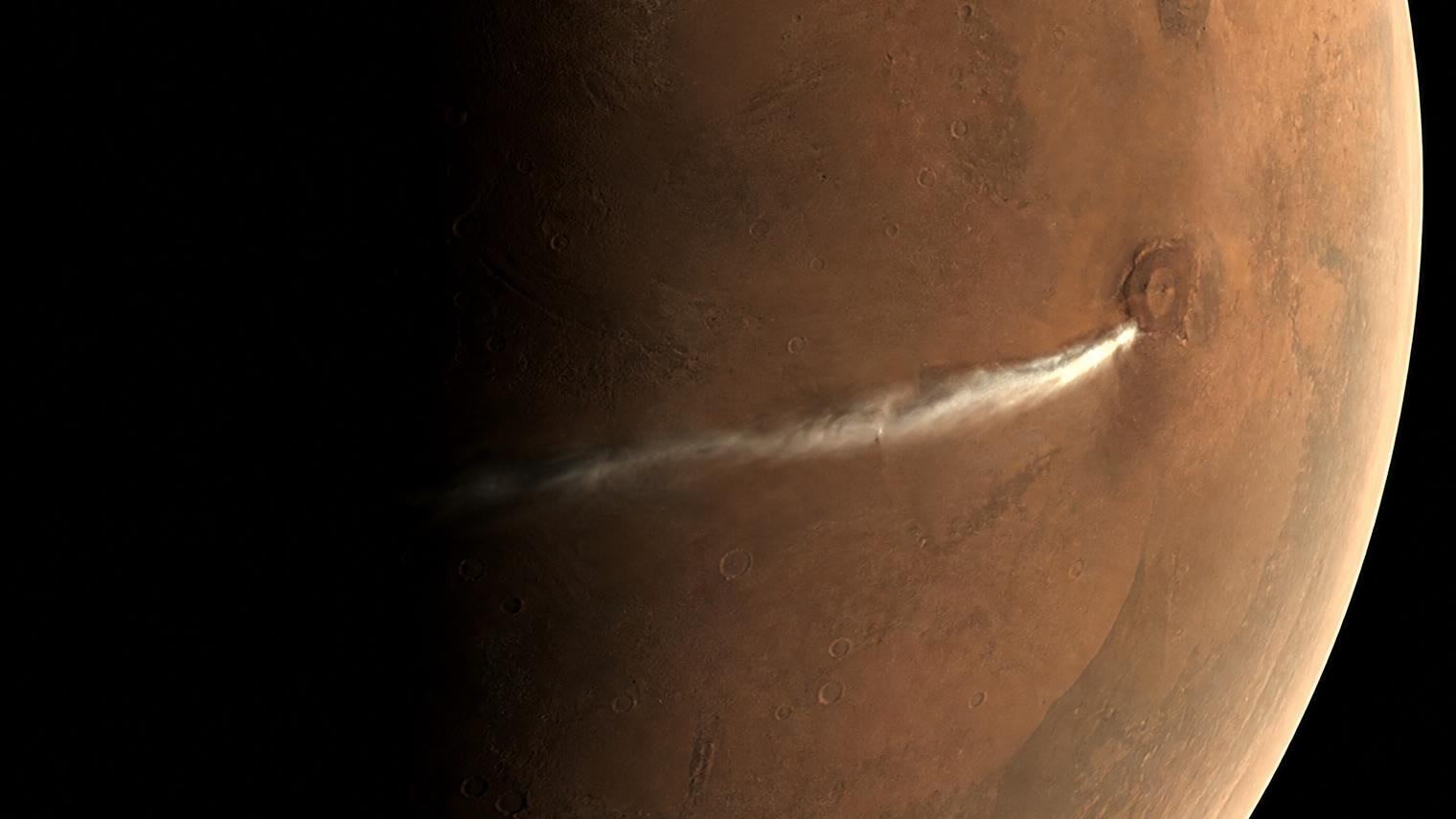
Illustration generated with AI for DomiVerseX
It shows up before sunrise, races across the sky and is gone by lunch. The mountain underneath has been silent since about the time the dinosaurs died out.
This article contains affiliate links. If you buy through them, we may earn a small commission at no extra cost to you.
It is still dark on Mars. On the western side of a huge volcano called Arsia Mons, a small white patch starts to grow. There is no rumble and no glow. The mountain does nothing at all. The patch gets longer anyway.
Arsia Mons is about 20 kilometers high, according to the European Space Agency, ESA. That is more than twice the height of Mount Everest, and about twice as high as passenger jets fly. You will also find a smaller number. The fact box on Wikipedia says 11.7 kilometers. The two figures are not counted from the same starting level, so this article uses ESA's.
By the time the Sun is up, the white patch has turned into a long, thin streak that points away from the mountain like a flag in the wind.
Why does this matter to you? Because this is weather on another world, and you can follow it in photographs taken from space.
A cloud that keeps a timetable
Scientists who followed the cloud through a whole season worked out its routine. It starts before sunrise. It grows toward the west for about two and a half to three hours, which is about as long as a long movie. Then it lets go of the mountain and dries up. Before the afternoon it is gone.
In that short time it can reach 1,800 kilometers, which is 1,118 miles. ESA calls that nearly twice the length of the United Kingdom. A car going 100 kilometers an hour would need 18 hours without a single stop to drive from one end to the other. On Mars, the cloud can cover about one twelfth of the way around the whole planet.
The front of the cloud moves at about 170 meters every second. That is about 612 kilometers an hour, twice as fast as a high speed train. It also sits very high, about 45 kilometers up. Passenger jets on Earth fly about four times lower than that.
The cloud does not come all year, though. It appears only in spring and summer in the southern half of Mars. In that season it returns morning after morning. ESA wrote in 2020 that it repeats for "80 days or even more", which is more than 11 weeks. A newer ESA text says "several months". Live Science is a little more careful and says "nearly every morning".
One year the show began late. The scientists think a dust storm that covered the whole planet was probably the reason.
Why does this matter to you? A thing this big, on a planet with no people, keeps a routine steady enough that you could plan a photo around it.
The mountain that went quiet
So is the volcano waking up? No.
A NASA team studied the giant bowl at the top of Arsia Mons. They counted 29 places where lava once came out, about one for every child in a school class. The best current estimate, from that NASA team, puts the last lava at about 50 million years ago.
How long is 50 million years? If every one of those years lasted just one second, you would still have to count for about a year and seven months.
"Think of it like a slow, leaky faucet of magma," said Jacob Richardson, one of the researchers, in NASA's report on the study. Magma is melted rock. NASA even compares the mountain with the dinosaurs. In Richardson's words, the volcano's activity "died out around the same time as Earth's dinosaurs."
The bowl itself is about 110 kilometers across. A car going 100 kilometers an hour would need more than an hour to cross it. NASA says it is deep enough to hold all the water in Lake Huron, "and then some."
So the white streak is not smoke. ESA says plainly that it has nothing to do with volcanic activity. It is a cloud of water ice, the same frozen water as in a snowflake. It forms because wind has to climb over the mountain.
Why does this matter to you? A dead mountain can still make weather. It only has to stand in the way of the wind.
The twist: it was there the whole time
Enjoying this story?
Get a short teaser by email whenever we publish something new. No spam.
Here is the strange part. A cloud up to 1,800 kilometers long, coming back morning after morning for months, went almost unnoticed for decades.
Mars Express, a spacecraft from ESA, began to follow the cloud on 13 September 2018. That is when the cloud drew attention. On 10 October 2018, according to ESA, the spacecraft photographed it stretching 1,500 kilometers, about five sixths of the longest length ever reported. Several news reports still say the cloud was first seen in 2018.
The research paper tells a different story. When the scientists went back through old pictures, they found the same cloud in images from Viking 2, a spacecraft that looked at Mars in the 1970s. That is about 40 years before Mars Express started to follow it.
How do you miss something that big? The answer is timing. Most spacecraft that circle Mars pass overhead in the afternoon. By then the cloud has already dried up. ESA adds a second reason: many cameras see only a narrow strip, too narrow to show the whole streak. Mars Express flies a path that lets it look down in the early morning, and one of its cameras takes in a very wide view.
In the end the scientists used pictures from five missions, one for each finger of a hand: Mars Express, MAVEN, Viking 2, MRO and India's Mars Orbiter Mission.
Why does this matter to you? If everybody looks at the same time of day, even a giant can hide. Sometimes a discovery is not a new thing. It is an old thing seen at a new hour.
Ice with nothing to hold on to
On Earth, a cloud drop needs something to start on. Water in the air gathers on a tiny speck of salt, pollen, soot or dust. On Mars, scientists think dust usually does that job.
That was the trouble. Computer weather models of Mars, built on that idea, could not make this cloud.
In October 2026, a team led by Jorge Hernández-Bernal published a study in the journal Nature Geoscience. Their model made the cloud only when they let water in the air freeze straight into ice, with no speck at all. "Water vapor turns directly into icy cloud particles without any middle step," Hernández-Bernal said, as Sci.News reports. He added: "we've never seen it before in a planetary atmosphere."
Here is how the model says it happens. Wind hits the volcano and makes a wave in the air. The wave lifts damp air several kilometers within minutes. The air cools by about 30 degrees Celsius in about 10 minutes. That is like walking out of a warm summer afternoon and into a freezer in the time it takes to eat breakfast.
For ice to form with no speck, the air has to be extremely damp. The ESA text says more than 100,000 times damper than what people usually feel on Earth. Picture one person standing next to a huge stadium with every seat taken.
Now the careful part. Nobody has measured this inside the real cloud. It is what one team's model suggests. The published study uses the word "suggested" in its own title. An earlier version, posted before other scientists had checked it, used the stronger word "evidenced". ESA also notes that some parts of the model cloud do not exactly match the real one. And according to ESA, the cloud season on Mars is the dusty season. So the fair way to say it is this: a 2026 study suggests the ice forms with no dust to grow on.
Why does this matter to you? Hernández-Bernal says this kind of freezing is in the textbooks, but it is "treated as theoretical and usually thought not to happen in nature." If his team is right, it could be happening on Mars every spring and summer morning.
Does it happen anywhere else?
This is where the story runs out of answers.
Scientists have proposed that the same kind of freezing could take place very high in the air of Earth and of Venus. Nobody has seen it there.
Colin Wilson, the project scientist for Mars Express, did not take part in the study. Live Science quotes him as saying that "understanding this exotic Martian cloud required exotic physics".
So if ice can make itself out of nothing but cold, damp air above a dead volcano on Mars, could the same thing be happening high above your own head, where nobody has caught it yet?
Sources
- An Extremely Elongated Cloud over Arsia Mons Volcano on Mars: I. Life Cycle, arXiv
- Return of the extremely elongated cloud on Mars, ESA
- Elongated cloud on Mars, 10 October, ESA Science & Technology
- Mars' Oddest Cloud May Be Even Odder Than We Thought, Astrobiology.com
- Homogeneous Nucleation of Water Vapor Evidenced by Elongated Clouds on Mars, Astrobiology.com
- Giant Martian Cloud May Form Through Physics Never Before Seen in Planetary Atmosphere, Sci.News
- 1,000-mile-long cloud that forms and vanishes on Mars every day obeys 'exotic physics' never seen on Earth, Live Science
- Mars Volcano, Earth's Dinosaurs Went Extinct About the Same Time, NASA
- Arsia Mons, Wikipedia