Can you find all five moons in this photo?
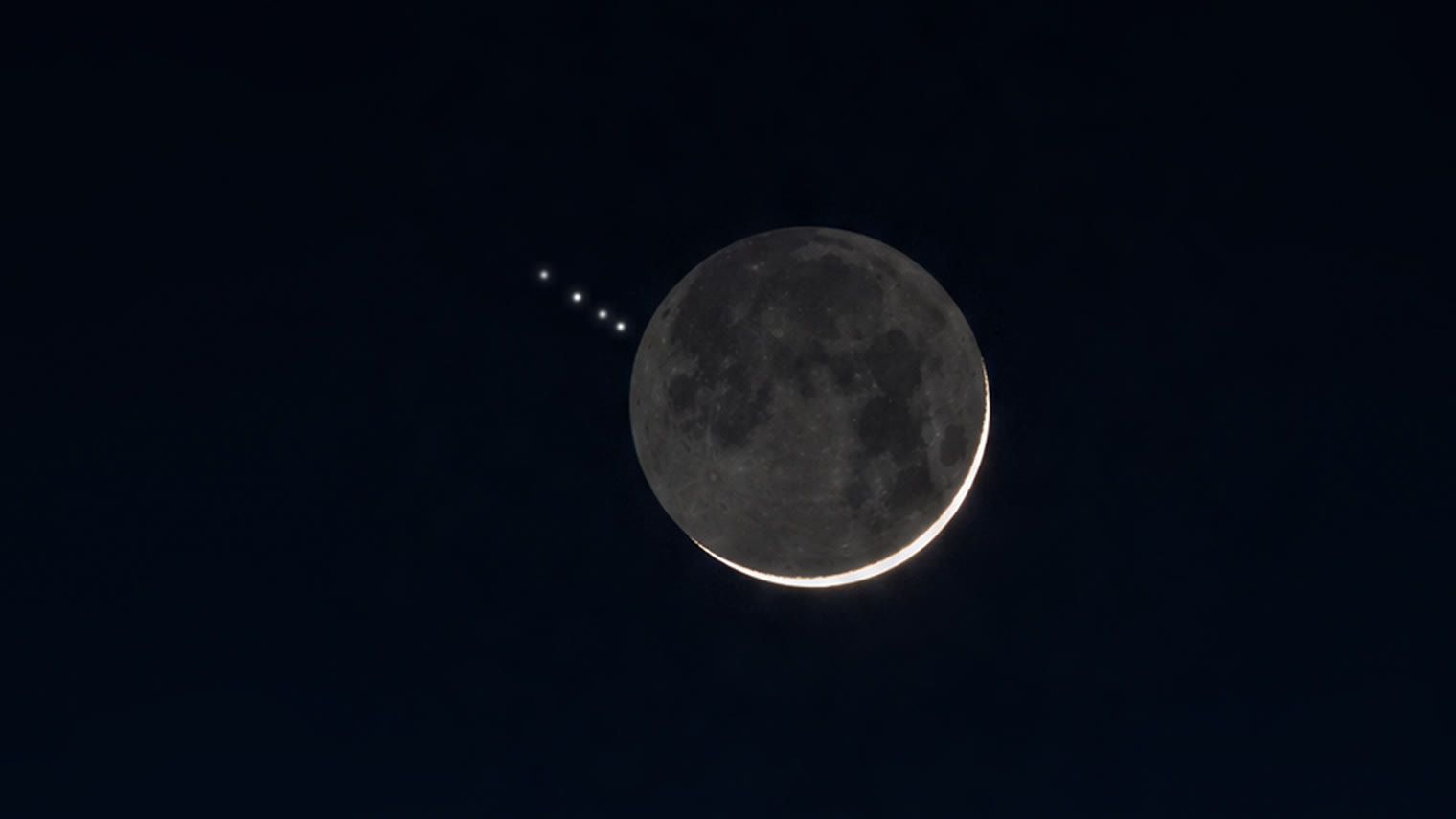
Illustration by DomiVerseX
One of them is easy. The other four are so small that most people take them for stars, and they are keeping a secret about size.
This article contains affiliate links. If you buy through them, we may earn a small commission at no extra cost to you.
Start with the easy one. There is a thin, bright crescent in the dark sky, and you have known it all your life. It is the Moon. That is one.
Now look beside it. There is a short row of four tiny points of light. They look like faint stars, but they are not stars. They are moons too, and they belong to the planet Jupiter. One plus four makes five, a moon for every finger on one hand.
A note before you count. The picture on this page is our own illustration. The real photo is by Chirag Upreti, and you will find it below.
Why does this matter to you? Most people stop counting at one. The sky has more in it than the first bright thing you notice, and you do not need to be a scientist to count.
The real photo, and our picture
The real photograph was taken by Chirag Upreti. NASA chose it as its Astronomy Picture of the Day for 12 October 2026, with the title "Jupiter and the Moons". You can see it on NASA's page for that day, where the image is credited to him and the copyright is his. According to NASA's caption, he took it from Westchester, New York.
One thing must be clear. The picture on our page is not his photograph. It is our own illustration of the same scene, made so that you can play the counting game here. To see the real one, follow the link.
Why were the Moon and Jupiter so close together? Before dawn on 6 October 2026, the Moon slid right in front of Jupiter and hid it. People in eastern North America, the northern Caribbean and western Africa were in the right place to watch, as the sky watching site When the Curves Line Up explained before it happened.
Seen from New York City, Jupiter vanished at about 4:23 in the morning and came back at about 5:27. That is a little more than an hour, about as long as one school lesson and the break after it. If NASA's caption is right, the photo was put together from several shots taken close to that moment.
Why does this matter to you? Nothing here needed a spaceship. It was one morning when two things in the sky lined up over ordinary towns, while most people were asleep.
Which dot is which?
If NASA's caption has the order right, the four dots in the real photo run from bottom to top like this: Ganymede, Io, Callisto, Europa. Our illustration does not copy the layout of the photo, so do not use our picture to name the dots.
There is a second small puzzle in the photo. You can see the dark part of the Moon as well as the bright crescent. How? The caption gives the answer. The crescent is lit by the Sun, and according to NASA the dim part is lit by earthshine. That is sunlight that bounced off the Earth first.
There is a catch. According to NASA's caption, the sunlit crescent in the photo is overexposed, which means it came out brighter than it should. A crescent that bright and four dots that faint are hard to catch in one shot. If NASA's caption is right, blending several shots is how the bright crescent, the earthshine and the faint moons all appear together.
These four moons have been famous for a long time. Galileo first saw them in 1610. That was 416 years before this photo was taken, or about 17 generations of people.
And they are only the start of the family. NASA lists 115 moons of Jupiter. If you learned the name of one every day, you would need almost four months. The photo shows four of them, which is about one in every 29.
Why does this matter to you? The same four dots that surprised Galileo are still there for anyone to find. A person more than 400 years ago and a person with a camera in 2026 were looking at the very same row of lights.
The twist: the dots are the giants
Here is what the picture hides. The big bright crescent is not the big one.
Enjoying this story?
Get a short teaser by email whenever we publish something new. No spam.
Our Moon is about 3,475 kilometers wide. Now look at the numbers for the dots, from NASA's fact sheet for Jupiter's moons. Ganymede is about 5,262 kilometers wide. Callisto is about 4,821. Io is about 3,643. Only Europa is smaller than the Moon, at about 3,122 kilometers.
Those numbers are hard to picture, so shrink everything. If our Moon were a soccer ball, 22 centimeters across, Ganymede would be a ball 33 centimeters across. Callisto would be about 31 centimeters and Io about 23. Europa would be the little one, at about 20.
So three of the four dots are bigger worlds than the Moon. Of the five moons in the photo, ours is the second smallest.
Ganymede is the real shock. It is the largest moon in the solar system, and about three and a half Moons would fit inside it. NASA's page on Ganymede adds that it is bigger than the planet Mercury, and bigger than Pluto too. That speck in the photo is a moon that is larger than a planet.
It looks tiny for one reason only. It is very far away.
Why does this matter to you? You already know this trick. Hold up your thumb, and it can cover a whole house at the end of the street. The house did not shrink. Your eyes can tell you how big something looks, but not how big it is.
Four moons, four characters
The dots are not copies of each other.
Io is the fast one. It goes around Jupiter in 1.77 days, which is less than two days. In one year on Earth it makes more than 200 laps. According to NASA, Io is the most volcanically active body in the solar system, a world of volcanoes.
Europa takes 3.55 days for a lap, about three and a half days. It is the icy one, and it is the only one of the four that is narrower than our Moon, by about a tenth.
Ganymede needs 7.15 days, which is about a week.
Callisto is the slow one. It takes 16.69 days, about two and a half weeks. It is also the third largest moon in the solar system.
Because they move at such different speeds, the row of four dots does not keep the same order for long.
Why does this matter to you? Four specks that look the same in a photo turn out to be four different places. Looking the same from far away tells you very little.
The smallest dot
That leaves the one dot that is smaller than our Moon.
Europa is about nine tenths as wide as the Moon, so it is not much smaller. It has an icy surface. According to NASA, there could be water under that ice. Nobody has seen that water. It is a possibility, not a finding.
So the smallest moon in the photo is the one with the biggest question attached to it. If there is water down there, is anything alive in it?
Sources
- APOD: 2026 October 12, Jupiter and the Moons, NASA Science
- 2026, October 6: Crescent Moon Occults Bright Jupiter in Predawn Sky, When the Curves Line Up
- Jovian Satellite Fact Sheet, NASA NSSDC
- Moon Fact Sheet, NASA NSSDC
- Jupiter Moons, NASA Science
- Ganymede: Facts, NASA Science
- The Galilean Satellites, NASA Science