SpaceX is about to try a catch nobody has ever made
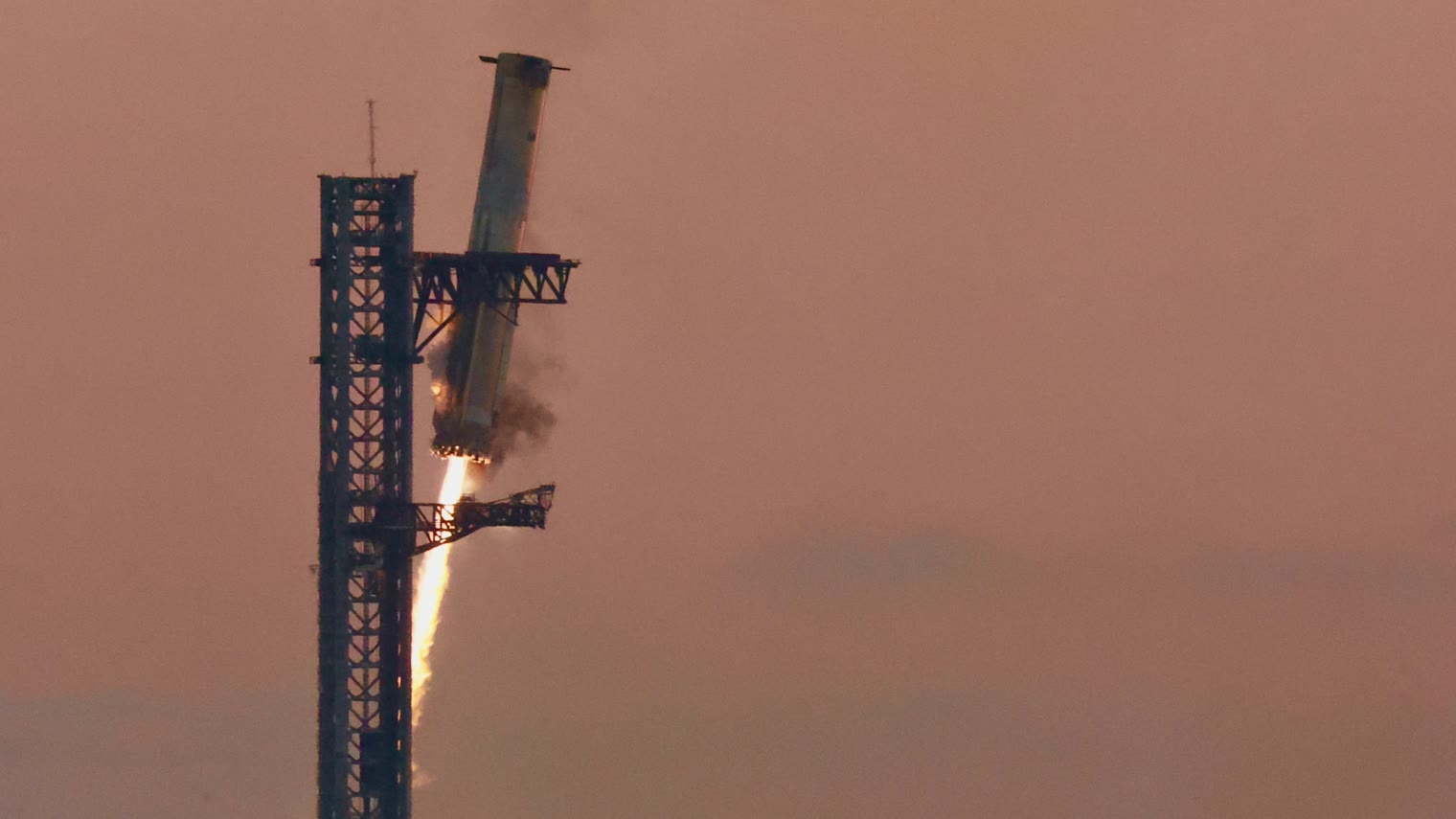
Photo: Steve Jurvetson, CC BY 2.0, via Wikimedia Commons
A giant tower with two steel arms has already plucked one half of the world's biggest rocket out of the sky. Now SpaceX wants the other half too, and that half is coming back from space.
This article contains affiliate links. If you buy through them, we may earn a small commission at no extra cost to you.
SpaceX's Starship is the biggest rocket ever built, and it is also the machine NASA hopes will one day carry astronauts back to the Moon. Stacked up, it stands more than 120 metres tall, about the height of a 40 storey building. On its next test flight, called Flight 15 and aimed for this November 2026, SpaceX plans to do something with it that no one has done before: catch both halves of the rocket with the arms of its launch tower, one half after the other, on the same flight.
Elon Musk announced the plan on SpaceX's earnings call on 20 October 2026, Space.com reported. SpaceX is aiming for November 2026, but it has not given a launch date, and final approval from the US aviation regulator, the FAA, had not been reported by the end of October. Why should you care about a rocket being caught? Because even the reusable rockets flying now still throw away a big part of themselves on every trip, Space.com notes, and that is one reason space is so expensive.
Two halves, one giant tower
Starship has two parts. The bottom half is the Super Heavy booster, about 70 metres tall, taller than a building of 20 floors. It does the heavy pushing for the first few minutes and then falls back. The top half is called the ship. It is about 50 metres tall, roughly a 17 storey building, and it is the part that actually flies into space.
At SpaceX's Starbase site in Texas, the launch tower has two huge arms that fans call "chopsticks", and the tower itself is nicknamed Mechazilla. Instead of landing on legs, a returning booster slows down, hovers next to the tower, and the arms close around it.
This has already worked three times. The first catch came on 13 October 2024, about seven minutes after liftoff, roughly the time it takes to boil an egg. Back then the top half was not caught. It splashed down in the ocean, as planned.
Why use arms instead of legs? Legs are heavy. One engineer quoted by the Institution of Mechanical Engineers estimated that landing legs for a booster this size could weigh 24 to 36 tonnes, about as much as 20 to 30 small cars. Every tonne you do not carry is a tonne of cargo you can carry instead.
Orbit came first
The double catch plan follows a big step a few weeks earlier. On Flight 14, on 28 September 2026, the ship reached orbit for the first time and released 26 new Starlink internet satellites, about one for every letter of the alphabet, Spaceflight Now reported. It circled the Earth about 290 kilometres up, roughly 30 times higher than airliners fly.
It was not a perfect day. One booster engine and one ship engine quit early on the way up. The flight was cut short, and after about three hours, about the length of a long film, the ship came down tail first in the Pacific north of Hawaii, then tipped over and exploded, as ships usually do after an ocean landing. The booster was not caught either. It splashed down off Texas.
That is the point of the next flight. A rocket that ends up in the sea has to be built again. A rocket that ends up in the tower's arms might fly again.
The hard half
Here is the part most headlines skip: catching the ship is a very different job from catching the booster.
The booster never really leaves home. After it lets go of the ship, it coasts up to about 96 kilometres and slows to about 1,200 kilometres per hour, according to the Institution of Mechanical Engineers. That is fast, about 12 times highway speed, but it turns around within minutes and is back at the tower in about seven.
Enjoying this story?
Get a short teaser by email whenever we publish something new. No spam.
The ship's job is to go all the way to orbit. Anything orbiting the Earth that low moves at about 28,000 kilometres per hour, according to the Smithsonian. That is about 23 times faster than the booster at its turnaround, or nearly 8 kilometres every second, the length of about 80 football fields in one tick of a clock. To come home, the ship has to throw away almost all of that speed by plowing into the air. The Smithsonian says surfaces can heat up to nearly 1,650 °C on the way down, about six times the top setting of a kitchen oven.
The only thing between the ship and that heat is a skin of about 18,000 hexagonal ceramic tiles, an engineering professor wrote in The Conversation. If you checked one tile every 10 seconds, you would need about 50 hours to check them all. Musk said back in 2024 that in most places the ship could not survive losing even a single tile.
And after all that, the ship still has to keep enough fuel to flip upright, slow down, and stop in exactly the right spot between two arms. Space.com sums it up simply: the ship travels higher, farther and faster than the booster, which makes it much harder to catch.
Is that really new? NASA's Space Shuttle came back from orbit for decades, and its winged orbiter flew again and again. But NASA says the shuttle's giant fuel tank was "the only component" that was never reused: on every flight it was dropped, most of it broke apart in the air, and the rest fell into the ocean. If Flight 15 works, Musk says it would be "the first time that an orbital launch vehicle has been fully recovered." The key word is fully.
Why the heat shield decides everything
Getting the ship back is only half of the dream. The other half is flying it again quickly, like an airliner, without weeks of repairs.
After Flight 13 in July 2026, the ship came back in one piece and Musk said he would "consider the heat shield problem solved." Not everyone agrees. Nature World News reported that experts looking at photos of that ship saw cracked tiles and signs that hot gas got into the gaps. Dan Rasky, a former NASA engineer who helped invent a famous heat shield material, called the tile approach a "dead end" for fast reuse, the site reported.
Why does that matter to you? Because the price of a ticket depends on what you throw away. A plane would cost a fortune to fly if it were scrapped after every trip. As the professor writing in The Conversation points out, spreading the cost of building a rocket over many flights makes each launch cheaper, but only if inspections, repairs and lost vehicles do not eat up the savings. SpaceX's own investor documents warn that if full reuse fails, launches could cost more.
Cheaper launches could mean more internet satellites, more science missions, and perhaps someday the trips to the Moon and Mars that SpaceX keeps talking about.
What happens next
SpaceX has already lit all 33 engines of the booster planned for Flight 15 in a ground test. Musk said on the earnings call that success is "more likely than not" on this flight, and that if it fails, more attempts will follow. He wants Starship flying about once a week in the first half of 2027, and SpaceX aims to fly a recovered ship a second time in early 2027, Drive Tesla reported.
It is fair to keep some salt nearby. In August 2026, Musk said SpaceX would try to catch the ship on the very next flight if regulators allowed it, and that flight ended in the Pacific instead. Rocket schedules slip all the time, and this is still a test program.
But think about what is being tried. A tower about to grab a booster taller than a 20 floor building, and later, a ship built to race around the world at 8 kilometres a second. If both arms close and hold, will rockets finally start working like airplanes, or will 18,000 small tiles keep the biggest rocket ever built waiting in the hangar?
Sources
- SpaceX will attempt 1st ever double Starship rocket catch on next test launch, Space.com
- SpaceX targets November for first catch of both Starship stages, Drive Tesla
- Starship returns to Earth; rocket splashes down north of Hawaii after three-hour flight, Spaceflight Now
- Starship's first orbital flight put its heat shield to the test, The Conversation via Cobb County Courier
- How to catch a rocket: the engineering behind our generation's man on the Moon moment, IMechE
- Why do orbiting spacecraft get so hot during reentry?, Smithsonian National Air and Space Museum
- Space Shuttle external tank, NASA
- SpaceX Starship heat shield cracked tiles and rapid reuse, Nature World News