A ripple in space just did something Einstein predicted a century ago, and something even he didn't expect.
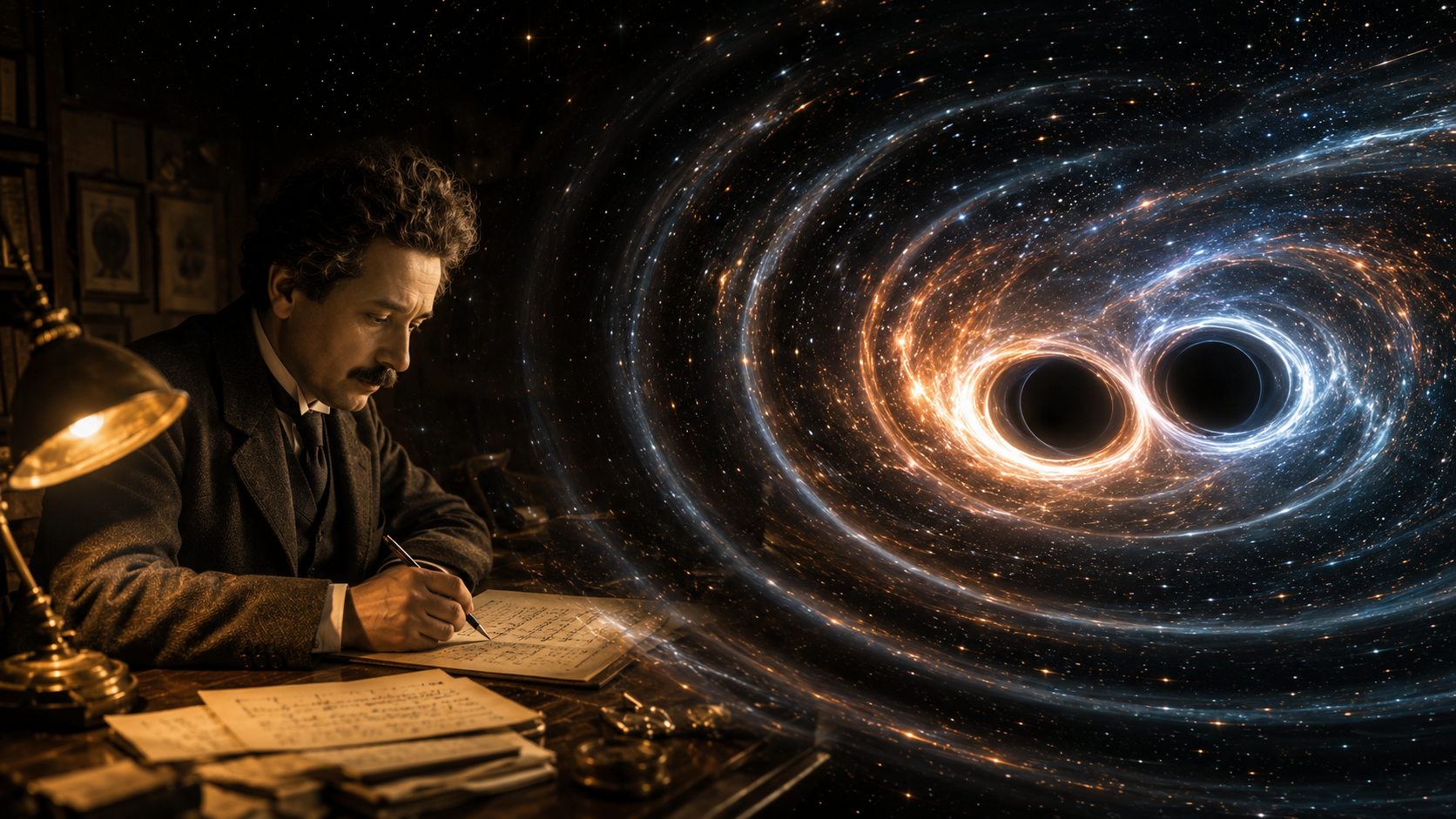
Illustration by Domi Verse X
The clearest signal ever caught from space just put Einstein to his hardest test yet.
This article contains affiliate links. If you buy through them, we may earn a small commission at no extra cost to you.
On January 14, 2025, twin detectors in the United States picked up a tremor that had been travelling for about 1.3 billion years. Two black holes, each roughly 30 times heavier than the Sun, had spiraled into each other and merged into one. Scientists named the signal GW250114, and when they finally finished analyzing it more than a year later, it turned out to be the clearest gravitational wave ever recorded, roughly three times sharper than the very first one detected back in 2015. That clarity let researchers do something new: listen to the newborn black hole "ring like a bell" and check the sound against a set of equations a physicist wrote out by hand in 1915. If you have ever struck a real bell, or one of the physics tuning forks used to demonstrate sound waves in a classroom, you already understand the basic idea: hit something, and the exact tone it rings at tells you what it is made of.
A Bell Ringing 1.3 Billion Light-Years Away
When two black holes collide, the newly formed black hole does not settle down instantly. For a fraction of a second, it wobbles and vibrates, "ringing" the fabric of space itself with gravitational waves at very specific frequencies, before settling into a calm, silent sphere. Picture the slowly swirling stars of a galaxy projector on a bedroom ceiling, then imagine the fabric behind those stars itself shaking. General relativity, Albert Einstein's 1915 theory of gravity, predicts exactly what that ringing should sound like if it is true. It says the ring should be made of at least two distinct tones, a strong fundamental note and a fainter, faster-fading overtone, and that both tones should encode the exact same two numbers: the mass and the spin of the new black hole. If scientists measure those two tones separately and they agree on the same mass and spin, that is a direct, no-excuses test of Einstein's math.
That is exactly what happened with GW250114. Researchers at Cornell University and the Max Planck Institute for Gravitational Physics, working with the LIGO, Virgo and KAGRA collaboration, measured the fundamental tone and identified, for the first time with real confidence, that fainter first overtone predicted by the theory. The signal was even clean enough to put limits on a third, higher tone. Everything lined up with what Einstein's equations said it should. "If those two measurements agree with one another, you are effectively verifying general relativity," said Cornell physicist Keefe Mitman, a co-author of the analysis, in comments to the university's Chronicle. The full result was published in Physical Review Letters on January 29, 2026, and according to the Max Planck Institute, the test built from this one signal alone was two to three times more precise than combining data from dozens of previous black hole mergers.
And you do not have to take anyone's word for what that ringing was like, because you can listen to it. The video below is the real thing: the actual detector data from both the very first detection in 2015 and GW250114, converted into sound by LIGO. The bell strike in our own video above is a dramatization. This is what the universe actually sounded like.
The Man Who Predicted Black Holes, Then Refused to Believe In Them
Here is the twist Einstein himself would have found hard to accept. His own equations are the reason scientists believe black holes exist at all, but Einstein did not think they were real. In a 1939 paper published in the Annals of Mathematics, he tried to mathematically rule black holes out, arguing that a collapsing cluster of stars could never actually squeeze down to the point of no return, because the stars inside it would have to move faster than light to hold the shape together. He called the whole scenario "not convincing" and did not believe anything like it existed in nature. He died in 1955, more than a decade before the name "black hole" even came into common use, and long before anyone detected one. If you have ever seen the famous 1947 portrait of him, the one on posters in a thousand physics classrooms, that is a man who went to his grave certain that the strangest prediction of his own theory was a mathematical illusion.
So the same theory that Einstein used to argue black holes could not exist is now the theory being used, with extraordinary precision, to prove that black holes exist exactly as his own equations describe, ringing at the frequencies his math predicted, a full century after he wrote it down. That is the part "even he didn't expect": not that gravity bends space, which he was confident about, but that the very objects his equations quietly allowed for turned out to be real, and to behave precisely as the math said, whether he believed in them or not.
Enjoying this story?
Get a short teaser by email whenever we publish something new. No spam.
The Universe's Bookkeeping Rule Also Held Up
Ringdown tones were not the only prediction on trial. Long before Einstein, and separate from his own doubts, physicist Stephen Hawking proposed in 1971 that the surface area of a black hole's event horizon, the invisible boundary past which nothing escapes, can never shrink. Merge two black holes, and the horizon of the result has to be at least as big as the two originals combined.
GW250114 let scientists check that rule too. According to a Northwestern University analysis of the same signal, the two original black holes had a combined horizon area of roughly 240,000 square kilometers, about the size of the state of Oregon. After the merger, the new, single black hole's horizon measured about 400,000 square kilometers, roughly the size of California. The area grew. Nothing shrank. Hawking's fifty-year-old rule held, one more piece of cosmic bookkeeping that checked out exactly as predicted. Two independent black holes, spiraling toward each other under gravity alone, an idea a little like the momentum passed down a row of swinging balls on a Newton's cradle desk toy, except here the "balls" are collapsed stars each carrying tens of times the mass of our entire Sun.
A Test Sharper Than a Decade of Data Combined
What makes GW250114 special is not that it broke new theoretical ground. Physicists were fairly confident general relativity would hold up. What makes it special is how cleanly it let them check the math. Keefe Mitman described the signal as "pretty much identical" in shape to GW150914, the very first gravitational wave ever detected in September 2015, just far sharper, thanks to a decade of quiet upgrades to the LIGO detectors' sensitivity. Where the 2015 detection proved gravitational waves existed at all, the 2025 one was clean enough to pull apart individual overtones inside a single, split-second ring, a feat that used to require stitching together dozens of separate, messier events just to get a statistically useful answer.
That kind of clarity matters for more than bragging rights. Every one of these tests is also a search for the moment general relativity finally breaks. Physicists broadly agree Einstein's theory cannot be the final word on gravity, since it does not mesh cleanly with quantum mechanics, the rules that govern the universe at its smallest scales. Somewhere, in some future signal, scientists expect to find a ring that does not quite match, a mass or a spin that does not add up the way Einstein's equations say it should. Mitman himself has pointed out that spotting a deviation like that in a future, even sharper detection could be the first hard evidence of quantum gravity, the elusive theory that would finally connect Einstein's universe of huge, curved spacetime to the universe of tiny, strange particles.
An Open Question Einstein Never Got to Ask
For now, GW250114 is another point for Einstein, a full century after 1915, confirmed by objects he once refused to believe existed. But the same scientists celebrating that result are already listening for the signal that proves him wrong. Gravitational wave detectors are getting more sensitive every year, and a next-generation network is already being planned that could catch mergers with even sharper ringdowns than this one. If a black hole a little heavier, a little farther away, or spinning a little differently ever rings the wrong note, it would not undo Einstein's legacy, it would extend it, pointing toward whatever comes after general relativity. Nobody yet knows what that next theory looks like, or when the signal that reveals it will arrive. Readers curious how physicists came to be listening for these ripples in the first place, decades before a single one was ever caught, can find the whole strange hunt laid out in Black Hole Blues and Other Songs from Outer Space, Janna Levin's account of the decades-long chase that led to LIGO.
Sources
- Cornell Chronicle: Gravitational wave signal tests Einstein's theory of general relativity
- Max Planck Institute for Gravitational Physics: Testing Einstein's theory of relativity with the clearest gravitational-wave signal yet
- Live Science: Record-breaking gravitational wave puts Einstein's relativity to its toughest test yet, and proves him right again
- Northwestern Now: Gravitational-wave detection verifies Stephen Hawking's theorem
- LIGO Lab: GW250114 vs. GW150914 audio (video, credit: Derek Davis / LIGO/Caltech/MIT)
- LIGO Scientific Collaboration: GW250114 science summary
- Universe Today: How a Perfect Gravitational Wave Tests Einstein
- ScienceDaily: A record breaking gravitational wave is helping test Einstein's theory of general relativity
- History.com: Black Holes Were Such an Extreme Concept, Even Einstein Had His Doubts
- Scientific American: The Reluctant Father of Black Holes