The Biggest Thing Anyone Has Ever Found
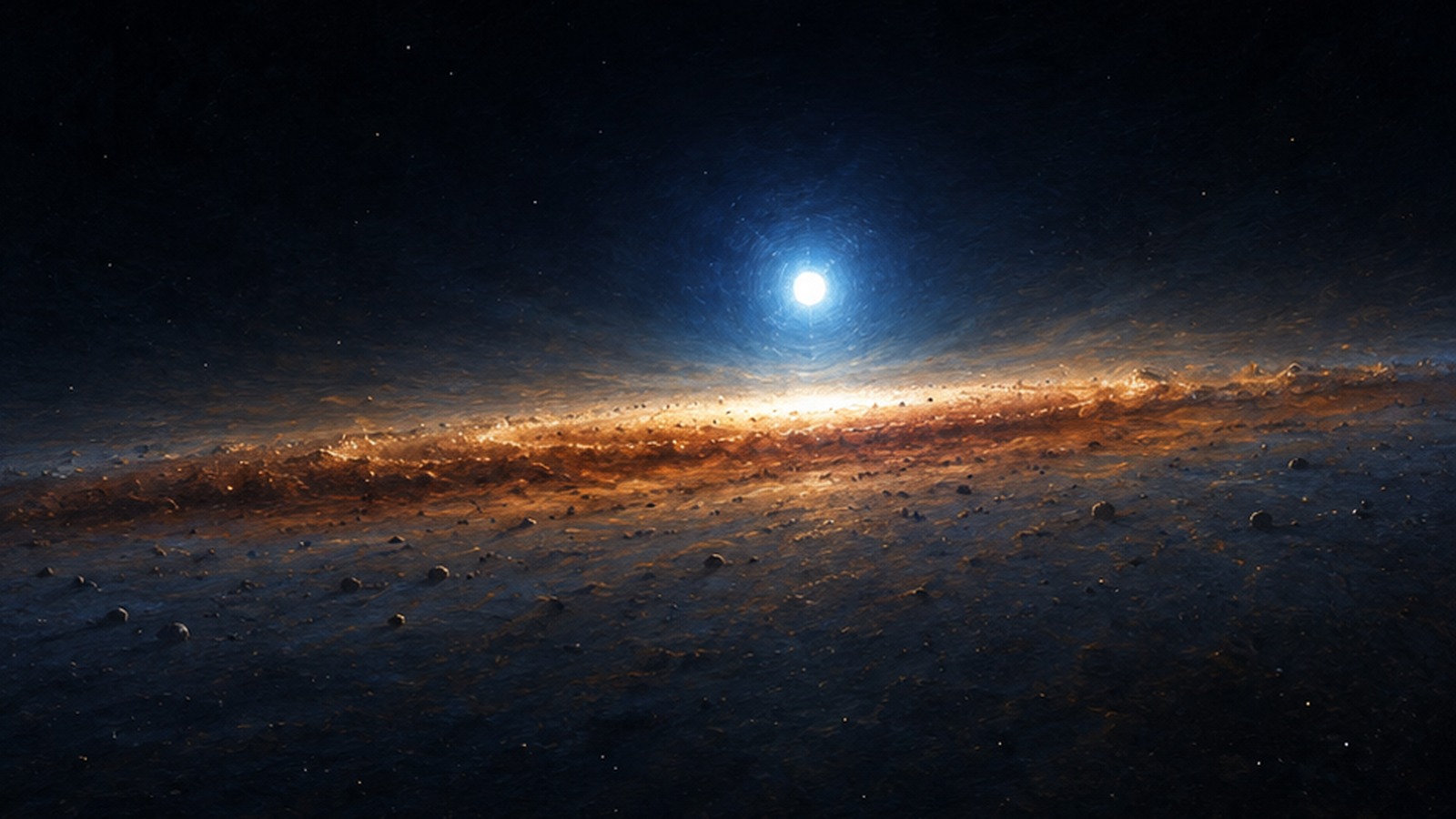
AI-generated illustration
A chain of galaxy clusters more than 1.3 billion light-years long holds a record for the nearby universe. It is unlikely to keep it.
This article contains affiliate links. If you buy through them, we may earn a small commission at no extra cost to you.
In January 2025 a team led by Hans Böhringer at the Max Planck Institute for Extraterrestrial Physics published a map of the nearby universe that contained something nobody had catalogued before. They called it Quipu, after the knotted cords the Inca used to record numbers, because that is what it looks like: one long strand with many smaller strands branching off it.
Quipu is more than 400 megaparsecs long. That is over 1.3 billion light-years, and it holds roughly 200 quadrillion times the mass of our Sun.
What you are actually looking at
A galaxy is not the largest thing in space. Galaxies gather into clusters, clusters gather into superclusters, and superclusters stretch into filaments that thread through mostly empty volume. Cosmologists call the whole arrangement the cosmic web. No home instrument shows you this: the structure is visible only when you map thousands of clusters at once and step back far enough to see the pattern.
Böhringer's team mapped that pattern using X-rays. Galaxy clusters hold enormous amounts of hot gas between their galaxies, and that gas glows in X-ray wavelengths. Trace the X-ray sources and you trace the mass. The survey behind Quipu is called CLASSIX, Cosmic Large-Scale Structure in X-rays.
What stood out about Quipu is that the researchers did not need a detection algorithm to find it. They wrote that it was visible by eye on a sky map of clusters in the right distance range. It was simply there, and it had been there all along.
Five giants, not one
Quipu was the largest of five superstructures the survey turned up between 130 and 250 megaparsecs from Earth, roughly 425 to 815 million light-years. The others are Serpens–Corona Borealis, Sculptor–Pegasus, Hercules, and Shapley.
That last name matters. The Shapley supercluster held the record for the largest known superstructure before this survey. It now sits fifth of five.
Together the five contain about 45 percent of the galaxy clusters in the volume studied, 30 percent of the galaxies and 25 percent of the matter, while taking up only 13 percent of the space. That ratio is the thing worth understanding: most of the matter is packed into a small fraction of the volume, and the rest is close to empty.
Enjoying this story?
Get a short teaser by email whenever we publish something new. No spam.
The honest caveat
Quipu is not straightforwardly the biggest thing ever found, and the researchers do not claim that it is.
The Hercules–Corona Borealis Great Wall, inferred from the clustering of gamma-ray bursts, is roughly ten billion light-years across. That is several times larger. But its existence as one connected object is disputed. Only a couple of dozen gamma-ray bursts trace it, the satellites that detect bursts do not survey the sky evenly, and critics argue that uneven coverage rather than real structure could be producing the pattern. Its discoverers pushed back in a 2020 follow-up and stood by the result, while admitting the burst catalogue is not yet good enough to settle the question.
So the precise claim is narrower and more interesting. Quipu is the largest structure confirmed in the nearby universe, mapped directly from cluster positions rather than inferred statistically. Böhringer himself told EarthSky that larger structures quite probably exist further out, once bigger volumes are surveyed.
There is a second caveat worth stating. It is not yet clear whether everything inside Quipu is gravitationally bound together, or whether it is a dense region that will eventually be pulled apart by cosmic expansion. Seshadri Nadathur of the University of Portsmouth, who was not involved in the work, raised exactly that point.
Why anyone cares
This is not trophy hunting. Structures this large bend light passing through them, distort images of the sky behind them, and drag nearby galaxies into streaming motions that contaminate measurements of how fast the universe is expanding. If you want an accurate Hubble constant, you need to know what mass sits between you and your yardstick.
The team also looked for Quipu's fingerprint in the cosmic microwave background, where a superstructure should leave a faint imprint through the integrated Sachs-Wolfe effect. They found a signal of about the expected strength in the Planck data, though at low statistical significance.
Quipu will almost certainly lose its title. That is roughly the point.
Sources
- Unveiling the largest structures in the nearby Universe: Discovery of the Quipu superstructure (arXiv preprint, accepted by Astronomy & Astrophysics)
- Astronomers find the largest structure in the universe and name it Quipu | Phys.org
- Astronomers discover Quipu, the single largest structure in the known universe | Live Science
- An Enormous, Branching String of Galaxy Clusters Is the Largest Known Structure | Smithsonian Magazine
- New data support the existence of the Hercules-Corona Borealis Great Wall | arXiv